Why does Patriarch Bartholomew ignore the plight of UOC believers?
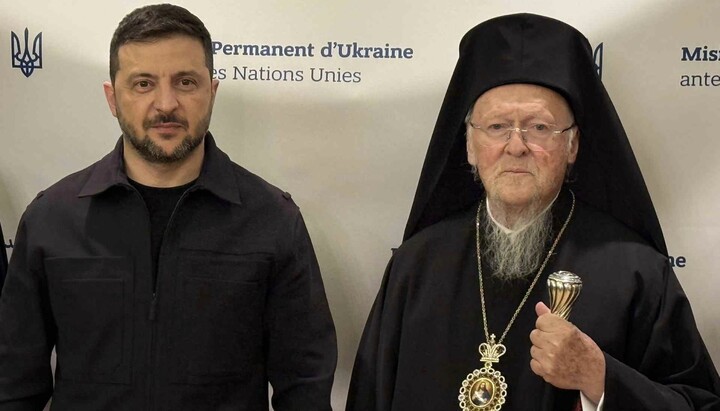
Photo: Press Service of the Patriarchate of Constantinople
Member of Parliament Rostyslav Pavlenko, who oversaw negotiations with the Phanar beginning in 2015, has shared revealing details about his conversations with Patriarch Bartholomew.
1. Bartholomew was ready to grant the Tomos as early as 2015.
According to Pavlenko, the initial plan differed from what happened in 2018: the UOC-KP and UAOC were to announce their unification at a council, after which this structure would receive recognition from the Ecumenical Patriarch and then negotiate further union with the UOC. However, the plan failed at the last moment when the UAOC refused to participate.
2. The process accelerated after the 2016 Council of Crete, which the Russian Orthodox Church and several others boycotted. Pavlenko said, “The Ecumenical Patriarch took it as a personal affront, and the negotiations intensified significantly.”
3. Before the final stage in 2018, Patriarch Bartholomew set several conditions.
“First – it must serve the good of the Ukrainian people; second – it must not lead to a genuine religious war (the UOC and ROC warned him that it certainly would); and third – it must become a path toward unity,” Pavlenko quoted the Patriarch as saying.
He explained that then-President Poroshenko assured Bartholomew that everything would unfold exactly as he desired, and there was nothing to fear. It was precisely this third promise – the promise of unification – that helps explain the wave of violent church seizures that began immediately after the Tomos was granted in the winter of 2019.
“It was crucial for parishes to start transferring, for the process of unification to begin. The state was supposed to support this process, not abandon it,” Pavlenko said.
Yet the most telling point is this: although Patriarch Bartholomew pretended to believe that the Tomos would not spark a religious war, in reality he did not. This is clearly shown by the final paragraph of the Synod’s resolution of October 10, 2018, when the heads of the UOC-KP and UAOC, Filaret and Makariy, were legalized:
“To call upon all involved parties to refrain from appropriating churches, monasteries, and other property, as well as from any acts of violence.”
In summary:
• Patriarch Bartholomew was warned that his interference in Ukraine would provoke conflict and division.
• He demanded guarantees from Poroshenko that there would be no religious war.
• Unsatisfied with those assurances, he effectively “washed his hands” with an appeal to “avoid seizures and any acts of violence.”
At the very least, the Patriarch feared that the Tomos would bring Ukrainians not peace and unity, but the very opposite. At most – he knew it would. Yet he proceeded nonetheless.
And here lies the crucial question. Many now insist that Patriarch Bartholomew remains ignorant of what is happening to the UOC because he simply receives no reports. But let us think honestly: have we not all made major decisions we feared might fail? Can we imagine taking such a step – and then never caring about the outcome? Hardly.
The notion that Patriarch Bartholomew is unaware of events in Ukraine, or uninterested in them, strains belief.
He is aware. He knows.
Why, then, does he do nothing?
Perhaps the answer lies in the status of the “first among equals” – and in pride.
The “first” cannot err, for if he can – then what kind of “first” is he?
Read also
Why is it legal to kill a person before birth but not after?
Children are the most privileged members of society. Yet that same society officially permits children to be killed – and on a massive scale.
Honoring the Bolsheviks’ successors at Kyiv Lavra
It was under the Reserve that the relics of the saints were desecrated, Lavra churches were turned into an atheism museum, and toilets were installed in sanctuaries.
"Degenerates" and "stupid animals": anti-UOC activists turn on children
Future historians will wonder how a vast country’s information agenda could have been shaped for so long by people so petty, vicious, and utterly contemptible.
Zelensky sees murder of Polish priest but not of Sviatohirsk monk
Why does Zelensky react so emotionally and swiftly to the murder of a Catholic cleric while remaining completely silent about the murder of an Orthodox monk?
UOC vs. OCU numbers: pollsters count, social media recount
Official polling suggests Dumenko’s structure has an overwhelming lead in the number of parishioners, while social media polls paint a very different picture. Which should we believe?
Who is working for the Kremlin in Poland? OCU, Uniates and Catholics versions
Who in the conflict between Poland and Ukraine is "an agent of the Russian Federation"? Zelensky, who gave the UPA name to an AFU special operations center? Nawrocki, who stripped him of an order for it? Polish MEPs?