Patriarchs Bartholomew and Daniel сonsecrate world’s largest Orthodox church
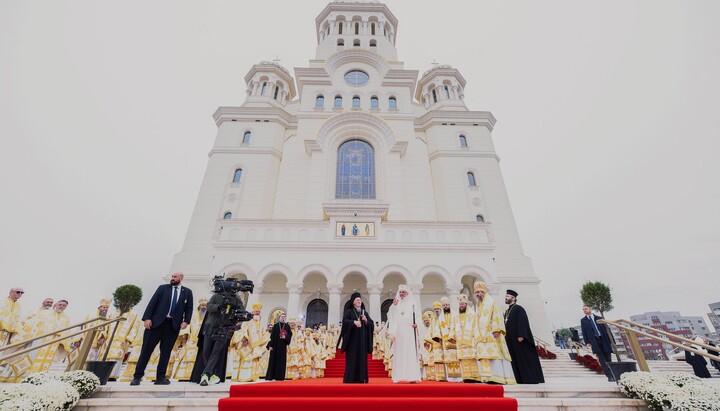
Patriarchs before the cathedral. Photo: basilica
On 26 October 2025, a solemn consecration of the mosaic iconography of the Cathedral of the Salvation of the Nation – the tallest Orthodox church in the world – took place in Bucharest, Romania’s capital. The service was led by Ecumenical Patriarch Bartholomew and Patriarch Daniel of Romania.
The ceremony gathered 65 hierarchs, 70 priests, and 12 deacons. Around 2,500 official guests were invited, while another 8,000 people followed the service on large screens outside the cathedral. Among the honorary guests were Romanian President Nicușor Dan and Moldovan President Maia Sandu.
The consecration of the cathedral’s interior artwork became the central event of 2025, marking the 140th anniversary of the Romanian Orthodox Church’s autocephaly and the 100th anniversary of its elevation to patriarchal rank.
The Cathedral of the Salvation of the Nation (Catedrala Mântuirii Neamului), located on Arsenal Hill opposite Bucharest’s Palace of Parliament, was founded in 2007. Construction began in 2010 under Patriarch Daniel. The cathedral was first consecrated on 25 November 2018, dedicated to the Ascension of the Lord and the Apostle Andrew the First-Called, Romania’s patron saint. That ceremony was also presided over by Patriarch Bartholomew and drew about 55,000 worshippers.
With a height of 135 meters, including the cross, the cathedral surpasses Moscow’s Cathedral of Christ the Saviour (103 meters), making it the tallest Orthodox church in the world. It can accommodate 6,000 worshippers inside, and the surrounding complex up to 125,000 people. The building is earthquake-resistant, designed to withstand tremors up to 8.5 on the Richter scale.
The idea of building a national cathedral in Bucharest dates back to the 19th century, after Romania gained independence in 1878. In 1884, King Carol I initiated a law to construct a national cathedral, but wars and political upheavals delayed the project for over a century. It was only in the 1990s, under Patriarch Teoctist, that the project was revived after the fall of communism.
The construction was financed with state support, and total costs are estimated at over €110 million. The project has faced public criticism due to its scale and expense amid Romania’s economic challenges.
Earlier, the UOJ reported that according to Patriarch Bartholomew, the Romanian Church has fulfilled the expectations of the Mother Church.
Read also
Met. Meletiy consecrates house of worship for UOC community in Dankivtsi
Members of the persecuted UOC Intercession parish in Dankivtsi have converted a house into a place for communal prayer and worship services.
OCU eparchy sells church center site to developer for housing
The OCU’s Volyn Eparchy sold land intended for a spiritual center to a private developer planning to build townhouses and residential buildings.
SBU names UOC priest’s wife a suspect in Cherkasy region
The SBU accused Matushka Kateryna Prykotenko of “spreading enemy propaganda” through correspondence with parishioners.
UGCC cleric calls Russian Orthodox literature dangerous for clergy
While examining the causes of divisions within the UGCC, Yustyn Boiko concluded that Russian Orthodox literature had influenced Greek Catholic clergy.
UOC will play major role in achieving peace, says Vadym Novynskyi
UOC Protodeacon Vadym Novynskyi believes the Church will help bring about reconciliation within Ukrainian society after the war ends.
Catholic media outraged by forcible conscription of Uniate cleric
The Vatican’s Apostolic Nunciature has demanded the return of a forcibly mobilized Greek Catholic cleric.