Why is Halloween an “Anti-Pascha”?
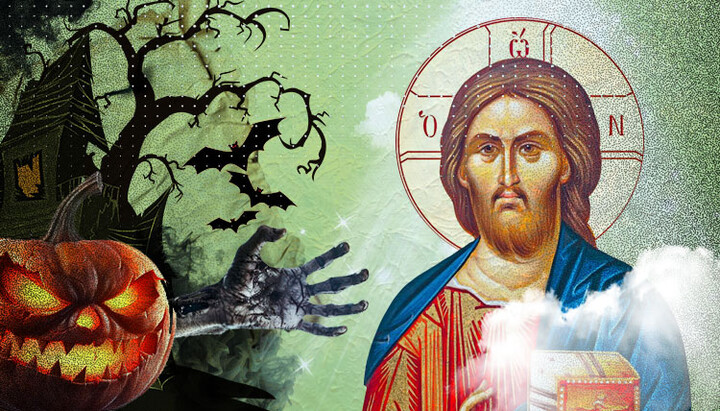
Halloween – a parade of the “masks of hell.” Photo: UOJ
Halloween is a special day on the calendar. It is not merely a “holiday” but a reminder that the dark side of human nature is still alive. It reveals how, when given the opportunity, people are ready to cast off the mask of social decency and expose the unrestrained face of the soul.
Such masks fall away wherever a person feels that everything is permitted and nothing will have consequences – wherever power grants certain groups the right to act without moral restraint or accountability.
Today, Halloween has become precisely that: a parade of the “masks of hell” – a seemingly harmless spectacle that reveals what humanity is capable of when conscience falls silent. This phenomenon has both a spiritual and a psychological dimension. By immersing themselves in scenes of blood and horror, people experience the thrill of fear within the safety of play, knowing that nothing truly threatens them. The body reacts as though in danger, while the mind remains aware of the illusion – and this tension produces a strange pleasure, a fleeting sense of power and control.
The psychology of fear: the pleasure of feeling invulnerable
When people voluntarily expose themselves to conditional danger – for example, riding a roller coaster – they experience an emotional surge rewarded by dopamine and endorphins. Immersing themselves in frightening scenarios becomes a way to confront and process their own fears.
That is why public executions once drew enormous crowds, and why many people instinctively recoil from the sick or the poor: deep down, they fear finding themselves in the same situation.
Halloween is a celebration of breaking the taboos of death, horror, and the dark side of the human psyche. It is a carnival where social norms are temporarily suspended, allowing the world to be turned upside down and inner tension to be released.
The pleasure derived from fear is a kind of cognitive trick: the body reacts with shock, while the mind delights in its own safety – followed by relief and a strange euphoria.
The antithesis of Pascha
All Christian feasts center on life, on the triumph over death, on joy and light. Halloween, by contrast, is an anti-Pascha – a dark inversion that fixates on fear, death, evil, violence, and ugliness in all their forms.
Its character is openly demonic – not only in the choice of costumes, but also in the glorification of fear and horror, in the cultivation of a morbid fascination with suffering.
How, then, can we explain to people – and especially to educators – that Halloween is not an innocent game? Let us look at its dangers one by one:
- Desensitization to violence. A festival centered on blood, zombies, demons, and death reduces sensitivity to real suffering. Turning horror into entertainment dulls natural disgust toward cruelty and distorts one’s perception of reality.
- Distortion of children’s understanding. For children, especially the very young, the line between play and reality is blurred. Encouraging them to imitate evil can cause anxiety, nightmares, and a dangerous normalization of violence.
- Harm to vulnerable groups. In a world already burdened by anxiety and trauma – especially in a country at war – aggressive Halloween imagery (blood, masks, monsters) can trigger panic and paranoia among those with mental distress.
- Erosion of moral restraint. Psychological studies show that the glorification of masked violence lowers social inhibitions and fosters vandalism and petty aggression.
- Spiritual danger. For Christians, Halloween represents a promotion of occultism and paganism. Despite its commercialized form, it remains tied to the pagan festival of Samhain, devoted to communication with fallen spirits. Even playful participation in these rituals is, in essence, a veiled act of demon-worship.
The very essence of this so-called “holiday” is the distortion of the image of death.
For Christians, death is not the end but a passage into eternity, a journey toward the Risen Christ. Halloween, by contrast, aestheticizes and mocks death, turning it into spectacle and play, fixating on decay and terror – a direct denial of the hope of resurrection.
By adopting the symbols of evil – dressing as demons, witches, or displaying occult signs – a person consciously legitimizes the presence of darkness in his or her life and culture. Even in its playful form, such participation becomes a violation of the divine commandment not to share in the works of darkness.
Read also
Facade of bones and facade of light
Antoni Gaudí spent forty-three years building a church in Barcelona, knowing that this construction was for the ages.
Trial of a dead pope
Once in Rome, the body of a deceased pope was seated on the throne and put on trial. The accusation relied on a church canon that had once saved his see.
Monastery built in defiance of king
When Orthodox believers in Minsk were left with just one church, townspeople decided to build another – and even a royal decree did not stop them.
Young Mother and Sleeping Christ
Michelangelo carved a Virgin Mary who looks younger than her Son – and signed his name in marble for the only time in his life. Neither of these peculiarities was accidental.
Orthodox books from a Uniate printing press
In the 18th century, Uniate monks at Pochaiv printed books used in prayer by Orthodox Christians and Old Believers alike.
The story of the honey brotherhood
The Mogilev Brotherhood began with members pooling money to brew honey drinks for feast days – and eventually grew to have its own printing press.