From duchess to nun: the spiritual journey of Anastasia of Kyiv
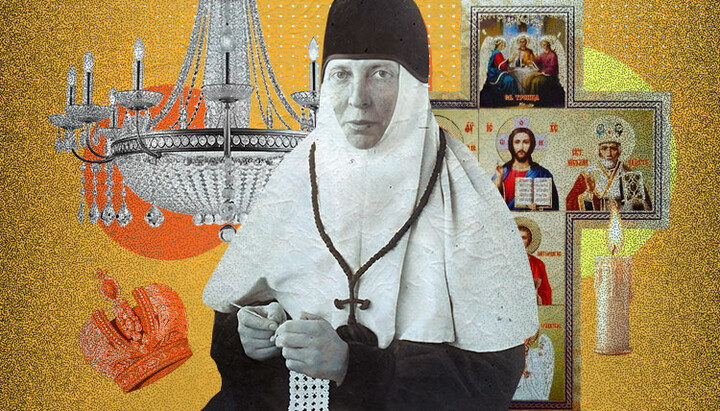
From the palace to the monastery and holiness. Photo: UOJ
The biographies of people who lived relatively recently give us a unique opportunity to look deeper into the souls of the glorified righteous. Impersonal, stencil-like lives of saints, which have come down to us in a glossy binding of ideal holiness, do not provide such an opportunity.
This Sunday we celebrate the day of the finding of the relics of the saint who is especially close to our Church: this is the Grand Duchess Alexandra (in monasticism – Anastasia). We can feel a lot based on what she had to endure in her difficult fate.
“What else is needed for happiness?”
It would seem that everything in her life should have turned out well. St. Anastasia (in the world Alexandra) was born in 1838 into a noble family. Her husband, Grand Duke Nikolai Nikolaevich, or “Nizi,” as his wife affectionately called him, was the brother of Emperor Alexander II.
It was a love match, not a marriage of convenience.
Their lavish wedding took place in January 1856. While a luxurious palace was being built for the young couple, they lived in the Winter Palace. Who could have thought then that a little time would pass, and Prince Nikolai would ask his wife for a list of all the jewelry given to her with a demand to return them. But that would come later. Meanwhile, when the duke left, Alexandra wrote him tender letters.
Faith against the world
The duchess, who was a Protestant, accepted Orthodoxy not formally but wholeheartedly. Like the future venerable martyr Elizabeth Feodorovna, she began to actively live her new faith, organizing medical assistance, and then the Intercession community of sisters of mercy, which grew into a hospital for the poor.
Soon the duchess “crossed the boundaries of secular decency”: she herself did dressings, assisted surgeons, and performed the dirtiest work in the hospital.
In high society, where the attitude towards the Church was cold, she began to be considered a fool for Christ.
Living in luxury, she did not notice it, did not wear jewelry, and spent all her money on others, while balls and theaters did not interest her.
“Bearing the name of a Christian, we must strive to be worthy of this name, remembering that we will answer for every harsh word. We must judge ourselves strictly and daily fight the slightest manifestations of sin,” the duchess wrote in her diary.
Betrayal of the husband
In contrast, the duchess's husband was fascinated by secular entertainments. In the mid-1860s, the Grand Duke became infatuated with the ballerina Ekaterina Chislova. He bought her a mansion, and had five children with her. The whole of St. Petersburg, including Duchess Alexandra, knew about the affair.
The man she loved lived in sin. The mistress demanded guarantees and wanted to become the mistress of Niсholas Palace. The Grand Duke was so infatuated that, according to the children, he dreamed of the early death of his lawful wife.
Accident, slander, and exile
At this time, the duchess got into a mysterious carriage accident. She miraculously survived, but from a spinal injury, both her legs and her right arm were paralyzed.
After this misfortune, Duke Nikolai accused his paralyzed wife of infidelity with her spiritual father, Priest Vasily Lebedev.
After this, he expelled her from the palace, brought the mistress there, and demanded the return of all the jewelry. Emperor Alexander II did not intervene in their relations and sided with his brother, sending Duchess Alexandra abroad, allegedly for treatment.
She was forty-two years old. Confined to a chair, betrayed by her husband, she was essentially deported from the country.
Return to Kyiv and the establishment of a monastery
When the duchess's ship passed by Athos, one of the elders sailed up to her and talked with her for a long time. After this conversation, the content of which is unknown, the duchess revived, and her faith strengthened.
After the accession of Alexander III to the throne, she wrote to him, begging to allow her to return and settle in Kyiv to live in “spiritual comfort”. The Emperor granted her request.
In Kyiv, in the Lukyanovka neighbourhood, Alexandra acquired land and began the construction of the Intercession (Pokrovsky) Convent, fulfilling the prophecy of Elder Theophilus about the “royal woman”. The construction progressed rapidly, and all the duchess's funds were spent on it. Learning that she could not sell one very expensive precious stone, Emperor Alexander III himself bought it.
Miracle of healing and service
The monastery had a free pharmacy and the largest hospital for the poor in the region, equipped even with an X-ray machine and receiving up to 20,000 people a year. The blind, cripples, orphans were brought here to find care in the sanctuary.
And a miracle happened to the duchess herself. After praying before the Pochaev Icon of the Mother of God, she, who had been paralyzed for ten years, began to walk. Here is how the saint recalls this in a letter to Metropolitan Platon of Kyiv:
“I dared to pray to my Intercessor: ‘If it pleases You, Mother of God, Queen of Heaven and Earth, raise me up to serve You, accept my sinful labors and zeal. Allow me to serve You and the holy monastery created in Your Name until the end of my life. Help me.’ I stood up and took a few steps…”
This happened after ten years of paralysis. Doctors could not call it anything other than a miracle.
Once she had barely regained her strength, the duchess began caring for the sick herself: she carried bedpans, washed gangrenous wounds, and assisted in surgeries. She taught her nuns to care for the sick as if for Christ Himself.
She lived in a modest cell. Only after her death on April 13, 1900, it became known that the Grand Duchess had secretly taken monastic vows with the name Anastasia.
Different fates
Until the end of her life, the venerable one prayed for her husband. Amazingly, she died on the same day, hour, and minute as her husband, only nine years later.
The fates of her offenders were terrible.
Grand Duke Nikolai, suffering from a tumor that metastasized to the brain, fell into “complete idiocy” and died alone. Ekaterina Chislova died in 1889 from esophageal cancer, in bitterness not allowing the Grand Duke to visit her.
Their posthumous fate is unknown to us, but the Grand Duchess, Nun Anastasia, was canonized in 2009.
Read also
Facade of bones and facade of light
Antoni Gaudí spent forty-three years building a church in Barcelona, knowing that this construction was for the ages.
Trial of a dead pope
Once in Rome, the body of a deceased pope was seated on the throne and put on trial. The accusation relied on a church canon that had once saved his see.
Monastery built in defiance of king
When Orthodox believers in Minsk were left with just one church, townspeople decided to build another – and even a royal decree did not stop them.
Young Mother and Sleeping Christ
Michelangelo carved a Virgin Mary who looks younger than her Son – and signed his name in marble for the only time in his life. Neither of these peculiarities was accidental.
Orthodox books from a Uniate printing press
In the 18th century, Uniate monks at Pochaiv printed books used in prayer by Orthodox Christians and Old Believers alike.
The story of the honey brotherhood
The Mogilev Brotherhood began with members pooling money to brew honey drinks for feast days – and eventually grew to have its own printing press.