UCCRO’s anti-corruption appeal – a calculated attempt to rebrand themselves?
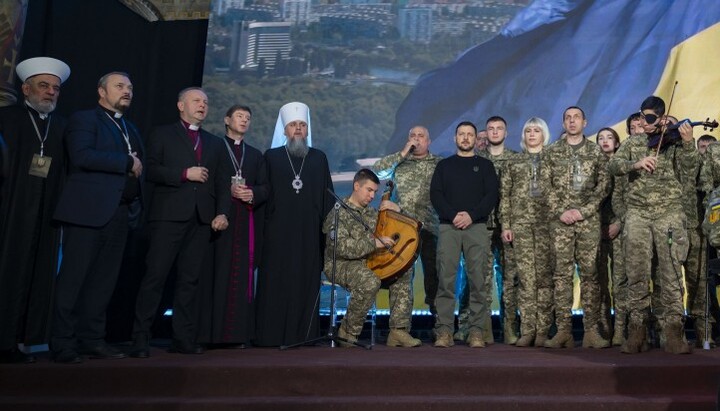
Zelensky and UCCRO members. Photo: OP
The All-Ukrainian Council of Churches and Religious Organizations (UCCRO) has released a loud statement regarding the government’s corruption scandal. The members of the organization claim to have accepted “with deep pain” the theft of hundreds of millions of dollars in public funds involving several ministers as well as a former deputy prime minister.
The UCCRO solemnly declared that corruption during wartime undermines national unity, and that “Ukraine’s enemies” are exploiting it.
But the most astonishing part is that the members of this organization are appealing to the government (whose top officials are implicated in the scandal) and to Zelensky (whose close friend oversaw the corruption schemes) with a call to fight corruption.
Of course, the UCCRO knows all of this. So why issue such a statement?
In big politics – and UCCRO is undoubtedly part of it – every resounding declaration has two or even three layers. In this case, we may assume (with little risk of being wrong) that this document is an attempt by UCCRO’s members to distance themselves from the current authorities while there is still time. After all, in recent years their relationship with the government has been extremely cozy.
UCCRO met repeatedly with Zelensky and with members of his government. For example, with former deputy prime minister Chernyshov, who has already been served a notice of suspicion by NABU. But even that is not the main point. Under Zelensky, UCCRO essentially became part of the state structure, dutifully fulfilling the authorities’ assignments.
These assignments were simple but crucial. The members of this structure traveled abroad and claimed that Ukraine had “freedom of religion.” In official language, this was called “advocacy for Ukraine.”
Here are several examples just from the last year:
• 16 August 2024 – UCCRO supported Zelensky’s legislative initiative against the UOC.
• 4 December 2024 – UCCRO told a U.S. delegation about religious freedom and asked for weapons.
• 16 December 2024 – Zelensky thanked UCCRO members for “advocating” for Ukraine abroad.
• 30 March 2025 – The Office of the President organized a meeting between UCCRO and “Trump’s spiritual advisor” Burns, where he was told about “freedom of religion” in Ukraine.
• 22 April 2025 – Zelensky once again thanked UCCRO members for advocating for Ukraine abroad.
• 3 May 2025 – UCCRO conducted another “advocacy visit” to the United States.
• 22 May 2025 – The deputy head of the OP discussed with UCCRO how the state and churches could “cooperate even more effectively.”
• 24 July 2025 – The authorities praised UCCRO for its “religious diplomacy.”
• 18 August 2025 – At a meeting with Zelensky, UCCRO spoke in favor of continuing the persecution of the UOC.
• 11 September 2025 – UCCRO members assured the Egyptian ambassador that Ukraine enjoyed “freedom of religion.”
• 20 October 2025 – UCCRO arrived in Norway on another mission of “advocacy for the Ukrainian state.”
You may ask: why all this endless “advocacy” if the Ukrainian authorities have nothing to hide? The answer is simple. Zelensky then points to UCCRO when speaking to Western partners, claiming that everything is fine with religious freedom in Ukraine and that no one persecutes the UOC. “Those Moscow priests are lying,” he says. “Look, even UCCRO confirms it. And they are godly people – they would not deceive anyone.”
And now, when the ship of the current Ukrainian government has begun to take on water, those who openly served it are quietly jumping overboard. And this latest statement by UCCRO is addressed not to Ukrainians at all, but to the “Western partners.” As if to say: “We are not with Zelensky – we are against corruption.”
But is that really so? Because corruption is not only about money.
In the case of UCCRO, corruption is servility toward the authorities in exchange for various “perks”: military draft exemptions, unrestricted travel abroad, and the simple favor of the “great ones.”
Everyone knows the “wise” saying: “to betray in time – is not betrayal, but foresight.” Judging by everything, UCCRO has mastered this art of foresight to perfection.
Read also
Why is it legal to kill a person before birth but not after?
Children are the most privileged members of society. Yet that same society officially permits children to be killed – and on a massive scale.
Honoring the Bolsheviks’ successors at Kyiv Lavra
It was under the Reserve that the relics of the saints were desecrated, Lavra churches were turned into an atheism museum, and toilets were installed in sanctuaries.
"Degenerates" and "stupid animals": anti-UOC activists turn on children
Future historians will wonder how a vast country’s information agenda could have been shaped for so long by people so petty, vicious, and utterly contemptible.
Zelensky sees murder of Polish priest but not of Sviatohirsk monk
Why does Zelensky react so emotionally and swiftly to the murder of a Catholic cleric while remaining completely silent about the murder of an Orthodox monk?
UOC vs. OCU numbers: pollsters count, social media recount
Official polling suggests Dumenko’s structure has an overwhelming lead in the number of parishioners, while social media polls paint a very different picture. Which should we believe?
Who is working for the Kremlin in Poland? OCU, Uniates and Catholics versions
Who in the conflict between Poland and Ukraine is "an agent of the Russian Federation"? Zelensky, who gave the UPA name to an AFU special operations center? Nawrocki, who stripped him of an order for it? Polish MEPs?