Protests erupt in Turkey over Pope’s visit to Nicaea
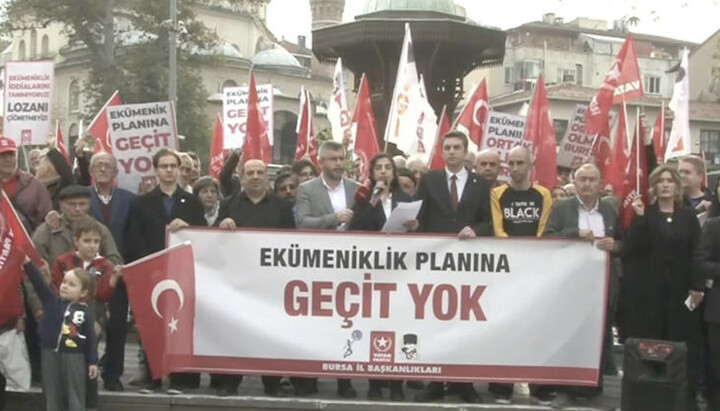
Protests in Turkey. Photo: ilmessaggero.it
Protests have broken out in Turkey in connection with the upcoming visit of Pope Leo XIV, who is scheduled to arrive in the country on 27–30 November and then continue his trip to Lebanon through 2 December.
The protests were sparked by the Vatican’s decision to solemnly commemorate the 1700th anniversary of the First Ecumenical Council in İznik (ancient Nicaea) on 28 November – a date of particular historical significance for Turkey.
The reason is that this date coincides with the 105th anniversary of the capture of Nicaea by Turkish forces in 1920 during the Greco–Turkish War.
Turkish nationalist groups and several small political parties say that overlapping the anniversary with a major Christian celebration amounts to “an insult to historical memory and national identity.”
On Sunday, a protest was held in Bursa, near İznik. Demonstrators chanted: “This is not Byzantium, this is the Republic of Turkey. This is not Nicaea, this is İznik.”
One activist, Dilek Çınar, claimed that the pope’s visit is “not an innocent religious ceremony, but a political initiative aimed at Turkey’s sovereignty,” adding: “False claims about ecumenism will not pass here.”
According to Turkish media, among the organizers were representatives of the Vatan (“Motherland”) Party, who vowed to try to obstruct the visit by holding peaceful demonstrations on the day of Leo XIV’s arrival.
Protesters held signs reading: “Stop the Ecumenical Conspiracy.” The KNA agency reported that demonstrators denounced ecumenism as “an American lie and a conspiracy.”
Despite this, Leo XIV has kept the trip on his schedule – it was originally planned by his predecessor, Pope Francis.
Patriarch Bartholomew, who initiated the anniversary celebrations of the 1700th anniversary of the Council of Nicaea – the council that defined the Creed – is expected to join the pope on the visit.
However, it is precisely the presence of the Ecumenical Patriarch that has drawn additional criticism. Several Turkish media outlets stress that the visit is gaining political overtones because the pope will be accompanied by the “Greek patriarch” – the leader of a body which, according to critics, “asserts its own ecclesiastical autonomy without regard for Turkish law.”
Turkish nationalists argue that recognizing the Ecumenical Patriarchate as “ecumenical” constitutes “a blow to the sovereignty of the Republic of Turkey,” violating the 1923 Treaty of Lausanne, which defines the Patriarchate’s status as strictly religious, with no political authority.
Earlier, the UOJ reported Patriarch Bartholomew’s statement that overcoming egoism is necessary for dialogue with the Vatican.
Read also
Medieval сhurch сrumbles as Culture Ministry сites missing agreement
The 14th–15th-century St. Nicholas Church in Chesnyky, Ivano-Frankivsk Region, is falling into disrepair.
Poland сondemns Lviv Regional Council's decision to declare 2007 year of UPA
Polish Prime Minister Donald Tusk says the Lviv Regional Council's decision to dedicate 2027 to the UPA and Roman Shukhevych is harmful to Ukraine.
OCU seeks court recognition of ownership of seized Cherkasy cathedral
The Cherkasy Regional Commercial Court will hear an OCU lawsuit seeking ownership of St. Michael's Cathedral, which was seized from UOC believers.
Lithuanian bishop: Ukraine is no model for believers' rights
Vicar of Vilnius Diocese voices concern over attempts to import Ukraine's religious conflict into Lithuania.
Hundreds of believers honor St. Alexis of Carpatho-Russia in Khust Eparchy
At the St. Nicholas Monastery in the village of Iza-Karputlash, Metropolitan Mark of Khust led a festive liturgy, concelebrated by six metropolitans, five archbishops and three bishops.
Court upholds UOC parish appeal in Voloshky over OCU switch dispute
The Northern Commercial Court of Appeal has upheld the appeal of the St. Nicholas parish of the UOC in the village of Voloshky, Volyn region, in a dispute over a transfer to the OCU.