Roman Catholic Church recognizes the Creed without Filioque, Pope says
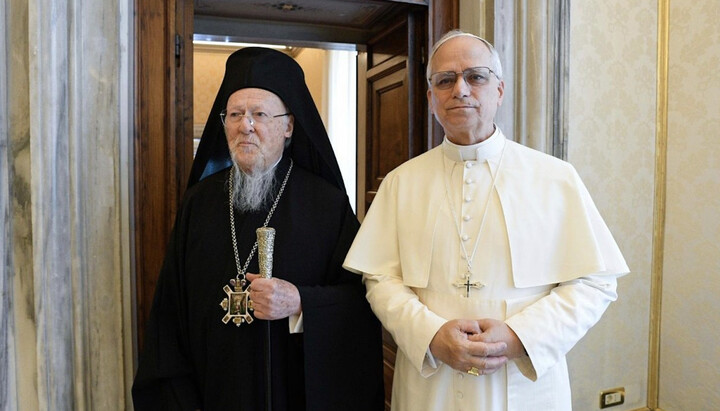
Patriarch Bartholomew and Pope Leo. Photo: sib-catholic.ru
In a document dedicated to the 1700th anniversary of the First Ecumenical Council in Nicaea, the Pope declared that the Catholic Church recognizes the Nicene Creed in its original form, as formulated in 325 and 381 – that is, without the Latin addition Filioque (“and from the Son”), which was introduced in the Western Church in later centuries.
In his message, the pontiff notes that Christians are called “to walk together with one accord in the unity of the faith that was proclaimed from the very beginning of the Church,” and he reminds readers that Nicaea gave the world the formula of the fundamental Christian confession that unites all followers of Christ.
The Pope adds: “The Creed’s article concerning the Holy Spirit was formulated at the First Council of Constantinople in 381. Thus, the Creed, which since then has been known as the Nicene–Constantinopolitan Creed, states: ‘We believe in the Holy Spirit, the Lord, the giver of life, who proceeds from the Father, who together with the Father and the Son is worshipped and glorified, who spoke through the prophets.’”
The Pope recalled that “through the Council of Chalcedon (451), the Council of Constantinople was recognized as Ecumenical, and the Nicene–Constantinopolitan Creed was declared universally authoritative.”
“Thus it constituted a bond of unity between East and West. In the sixteenth century, it was also retained by the ecclesial communities that arose from the Reformation. Therefore, the Nicene–Constantinopolitan Creed is the common confession of all Christian traditions,” the Pope writes.
He also adds that “no confession of faith belonging to a particular liturgical tradition may contradict this expression of faith that was taught and professed by the undivided Church.”
“We share the same faith in the one God, the Father of all people. Together we confess the one Lord and true Son of God, Jesus Christ, and the one Holy Spirit, who inspires us and moves us toward full unity and a common witness to the Gospel. Truly, what unites us is far greater than what divides us,” the Pope wrote.
Earlier, the UOJ reported that the Pope will visit the Phanar on an official trip.
Read also
Mobilized priest of Volodymyr-Volynsky Eparchy of UOC killed
A funeral service for Fr Andrii Korynchuk, a priest killed in the war, to be held at UOC Resurrection Cathedral in Kovel.
TRC officers draft UOC priest in Chernihiv
TRC officers have detain Archpriest Pavlo Tovstohon of the Christ's Nativity Church.
Patriarch Bartholomew and Shevchuk discuss obstacles to ecumenical unity
The head of the UGCC said that replacing Christian patriotism with the idea of loyalty to a "warring god" is an obstacle to ecumenical dialogue.
Ukraine’s Foreign Ministry plans advocacy visits abroad for UCCRO
Members of the All-Ukrainian Council of Churches and Religious Organizations have planned advocacy visits abroad following a meeting with Ukraine’s deputy foreign minister.
UOC priest detained by recruitment officers in Kyiv sent to training ground
UOC priest Maksym Kostiuchenko, who was detained on his way to a church service in Kyiv, has been sent to a military training ground in Chernihiv Region.
25 tons of humanitarian aid from Volyn reach Sviatohirsk Lavra
Around 25 tons of food donated by believers of the UOC Volyn Eparchy arrived at Sviatohirsk Lavra on October 22.