Why Finnish archbishop speaks out against Trump’s peace plan
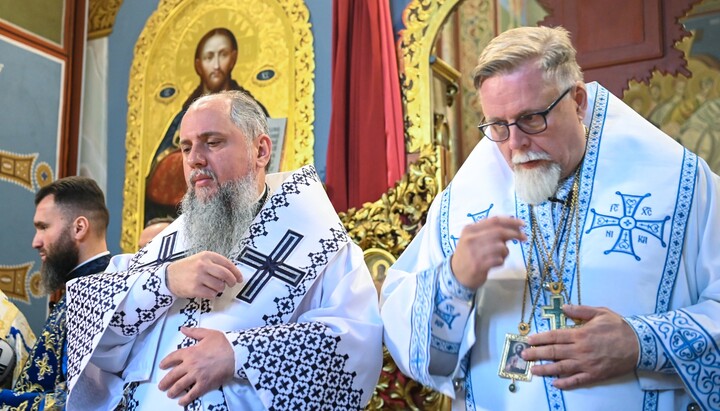
Archbishop of Helsinki together with Dumenko. Photo: OCU
The head of the Finnish Orthodox Church under the Ecumenical Patriarchate, Archbishop Elias, has officially declared that the American peace plan for Ukraine is unjust because it may include the rehabilitation of the UOC.
Calling the UOC “the Moscow Patriarchate,” he was outraged by one of the plan’s provisions requiring Ukraine to “correct its legislation on freedom of religion.”
“This requirement can only mean granting guarantees to the Moscow Patriarchate’s church structure in the country,” the hierarch protested, adding that he had been in Ukraine and saw for himself that no one persecutes the UOC.
“This condition is not based on facts. I know this because I have seen the truth with my own eyes,” the archbishop claimed.
A very weighty statement – at first glance. One might think the Finnish primate had done serious groundwork: met with the UOC leadership, visited at least dozens of communities that lost their churches, “saw the truth with his own eyes,” and formed an informed judgment based on firsthand observation.
But that impression is utterly false.
Because the archbishop then explains where his information actually came from.
“Our conversations with the head of DESS V. Yelensky and with the religious leaders of Lviv confirmed that freedom of religion in Ukraine is fully respected. Religious communities do not live in fear of one another but act freely,” the Constantinopolitan hierarch assured.
These words are staggering.
There are hundreds of videos documenting beatings carried out by OCU militants, footage of priests lying bloodied, and harsh reports by international human-rights bodies, including UN commissioners.
Yet Archbishop Elias notices none of this. He forms his judgment solely from conversations with a state official who has been persecuting the Church since Soviet times, and with OCU representatives who are currently intimidating and terrorizing parishioners.
His statement, published on the official website of the Finnish Church, concludes as follows: “A lasting peace cannot be built on injustice.”
So – ending the bloodshed and halting the crackdown on UOC believers is what he calls “injustice”? Out of the mouth of an Orthodox bishop this sounds like sheer mockery, or, to put it bluntly, absolute cringe. It’s the kind of twisted logic we’re used to hearing only from Dumenko and his troupe of “hierarchs.”
It is worth recalling that during his visit to Ukraine, the archbishop had close meetings with Dumenko and even concelebrated with him.
The Psalmist David warns of the consequences of such associations: “…with the pure you will show yourself pure, and with the crooked you will show yourself crooked.”
It seems that fellowship with the “crooked” never goes without leaving a mark.
Read also
Why is it legal to kill a person before birth but not after?
Children are the most privileged members of society. Yet that same society officially permits children to be killed – and on a massive scale.
Honoring the Bolsheviks’ successors at Kyiv Lavra
It was under the Reserve that the relics of the saints were desecrated, Lavra churches were turned into an atheism museum, and toilets were installed in sanctuaries.
"Degenerates" and "stupid animals": anti-UOC activists turn on children
Future historians will wonder how a vast country’s information agenda could have been shaped for so long by people so petty, vicious, and utterly contemptible.
Zelensky sees murder of Polish priest but not of Sviatohirsk monk
Why does Zelensky react so emotionally and swiftly to the murder of a Catholic cleric while remaining completely silent about the murder of an Orthodox monk?
UOC vs. OCU numbers: pollsters count, social media recount
Official polling suggests Dumenko’s structure has an overwhelming lead in the number of parishioners, while social media polls paint a very different picture. Which should we believe?
Who is working for the Kremlin in Poland? OCU, Uniates and Catholics versions
Who in the conflict between Poland and Ukraine is "an agent of the Russian Federation"? Zelensky, who gave the UPA name to an AFU special operations center? Nawrocki, who stripped him of an order for it? Polish MEPs?