"My brother, they are killing me!": Golgotha and miracles of St Philoumenos
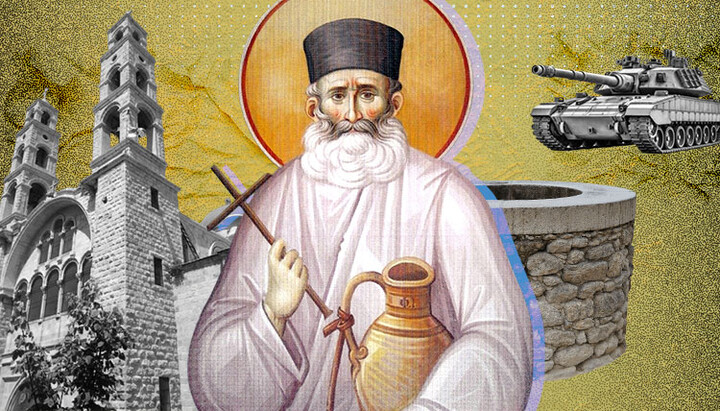
Hieromartyr Philoumenos of the Holy Sepulchre. Photo: UOJ
November 29 is the day of remembrance of the Holy Martyr Philoumenos of the Holy Sepulchre.
Saint Philoumenos was born on October 15, 1913, on the island of Crete in a pious large Christian family. In 1937, he took monastic vows and was ordained in the same year. He served in various monasteries and churches of the Jerusalem Brotherhood of the Holy Sepulchre. Everywhere he showed conscientiousness and spiritual sensitivity.
From him came a special peace and calm. Fr. Philoumen never argued with anyone, never judged anyone. He always kept his unforgettable, kind smile.
Golgotha at Jacob's Well
The last place of Fr. Philoumenos' spiritual feat was the city of Nablus in Samaria, a service at Jacob's Well. The area was under the control of Jewish adherents, who sought a way to seize the well. Fr. Philoumen was repeatedly threatened, yet he humbly carried out his obedience, as if nothing had happened.
On November 29, 1979, Fr. Philoumenos' body was found lifeless. Everything around was covered in blood. The martyr’s face was unrecognizable due to multiple wounds from beatings and an explosion. It later emerged that Jewish extremists had attacked Fr. Philoumen and, after prolonged torture, struck him on the head with an axe. Then, to conceal the traces of the crime, they threw a hand grenade.
At the time when Fr. Philoumenos was suffering martyrdom, his twin brother, Fr. Elpidios, was in his cell on Mount Athos. God revealed to him everything that was happening to his brother.
He saw Father Philoumenos and heard a voice addressed to him: "My brother, they are killing me. My brother, they are killing me. Do not be indignant, to the glory of God!"
Indelible blood
When the nuns arrived at the place of martyrdom to clean the church, they saw that everything was smeared with blood, but there was no smell of decay. They heated water and began cleaning, but no matter how hard they tried, the blood would not wash away. It felt as if it was seeping through the floor. The nuns cried and continued scrubbing...
After Fr. Philoumenos' death, his body was taken to Tel Aviv, and it was only on the sixth day that they were allowed to take it from the morgue.
Although it was the sixth day since his death, the body did not emit the slightest smell of decay and was very flexible.
The brothers could not bear the sight of Fr. Philoumenos' wounds, whose part of the skull was cut off with an axe, and only one monk named Sophronios dared to dress him. Here the first miracle happened. He addressed Fr. Philoumenos as if he were alive: "Father, help me dress you, because, as you see, I am alone." And then a miracle occurred. When Fr. Sophronios began to put the shirt on Fr. Philoumenos' body, he himself extended his hand to him. In the same way, he helped with his legs.
Protection of the Church: a bomb and tanks
Father Justin succeeded Father Philoumenos at Jacob's Well. He also faced many threats. One night, he saw the martyr Philoumenos in a dream, waking him for service.
"I woke up," Fr. Justin recounts,"looked at the clock and realized it was still early. And then I felt Father Philoumenos' hand resting on my shoulder. Now, not in a dream, but in reality, I heard Father Philoumenos' voice telling me to go to the church, but not through the left, but through the right entrance. As I descended into the church, I heard the ticking of a clock mechanism, and then I discovered the bomb itself, which was planted on the left side of the altar. I called the police, and the bomb was defused."
With the blessed assistance of the martyr Philoumenos, Fr. Justin managed to achieve the incredible - to complete the construction of the church of the Holy Martyr Photini over Jacob's Well, which began at the beginning of the twentieth century.
The miracles accompanying this construction were countless.
We will tell only one of them, which occurred after the completion of the work itself.
In 2005, the church was attacked by two Israeli tanks. What was built with such great effort could be destroyed in an instant. The first tank shot hit the bell tower. Fr. Justin, in despair, began to pray: "Father Philoumenos! If you are a saint, show it now!"
And the saint immediately came to help. Fr. Justin saw with his own eyes Fr. Philoumenos in his usual gray cassock on the church bell tower. He waved his hands three times as if throwing something away. Then it became clear: these were three shells fired from the tanks, but they did not reach their target. They fell without exploding and rolled along the pavement like empty bottles. After this, the tanks turned around and disappeared.
"This is our father"
Numerous miracles performed through prayers to the Holy Martyr Philoumenos have been documented, but it is impossible to describe even a small part of them.
Until August 2008, Father Philoumenos' relics were kept at the Patriarchal School on Zion. Even there, many miracles and healings occurred.
A decision was made to transfer the relics to the place of the righteous martyrdom, to the church of Jacob's Well.
And here, too, there was a miracle. The fact is that Fr. Philoumenos' relics were very fragrant, and this could attract the attention of Israeli soldiers at the border. Their reaction could be unpredictable. But as soon as the car with the martyr's relics approached the border checkpoint, the fragrance instantly ceased.
An Israeli soldier strictly asked the monks: "Who are you transporting?" If the soldiers had opened the tomb and seen the remains, the monks would have had serious problems crossing the border.
After a moment of prayerful silence, the abbot said: "This is our father."
And at that moment, all the brethren felt: Fr. Philoumenos was truly their father. The Israeli soldier, satisfied with the answer, allowed them to pass without further inspection.
Mystery of the silver Chalice
After many years in the walls of the Zion School, Fr. Philoumenos' relics returned to the place where the traces of his blood are still visible. Thirty years after his martyrdom, on November 29, 2009, the Holy Synod of the Jerusalem Church canonized the saint among the holy martyrs.
In 2009, shortly before Fr. Philoumenos' canonization, the abbot of the monastery, Fr. Justin, went down to the church at the Well to tidy up. In the altar, his attention was drawn to a communion cloth in a glass-fronted cabinet, covering a small object.
Fr. Justin was surprised, because no one else had entered the altar, and the cabinet was locked with a key that only he possessed. The abbot opened the cabinet and saw a miniature silver chalice in the form of a communion paten.
Fr. Justin was surprised because no one but him entered the altar, and the cabinet was locked with a key, which was also only with him. The abbot opened the cabinet and saw a miniature silver chalice in the form of a cup.
It was engraved with the text: "The chalice of the martyr's blood of the Holy Martyr Philoumenos of Cyprus, shed for the House of the Lord on November 16, 1979. The chalice I drink, you shall drink."
Hegumen Justin knew with certainty that neither he nor anyone else had placed the chalice there. Inside the chalice, fragments of the saint’s dried blood shed at the hour of his martyrdom were found. No one was ever able to explain the miraculous appearance of this chalice with fragments of blood in the locked cabinet, or the origin of the inscription on it…...
Read also
Golgotha in the midst of a pogrom
In the autumn of 1938, the Jewish artist Marc Chagall painted the crucified Christ. Synagogues burn and refugees flee around the cross, while the Crucified One Himself is wrapped in a prayer shawl.
Stories of the Early Church. Level of governance: patriarch
How did several episcopal sees rise above the rest, why did the Church’s administrative map come to mirror that of the empire, and is the patriarchate a sacred form of Church governance?
A Chronicle without an author
We are accustomed to calling The Tale of Bygone Years the work of St. Nestor. Yet another monk left his signature on it, while the chronicle itself passed from one generation of scribes to the next.
How a wedding stopped a war
The young princess of Slutsk was married off to keep two powerful noble families from drowning the city in blood. Soon afterward, a Uniate metropolitan complained that Orthodoxy had been reborn in Slutsk.
Man before the forces of nature
A solitary figure on the shore seems insignificant before the immense power of the sea, yet it is he who stands before the Creator.
The mysteries of Golgotha in the light of archaeology
The veil of centuries obscures what really happened in the fourth century. Archaeology and ancient texts shed light on the true history of one of Christianity’s greatest sacred sites.