What are the priests in Pochaiv talking about?
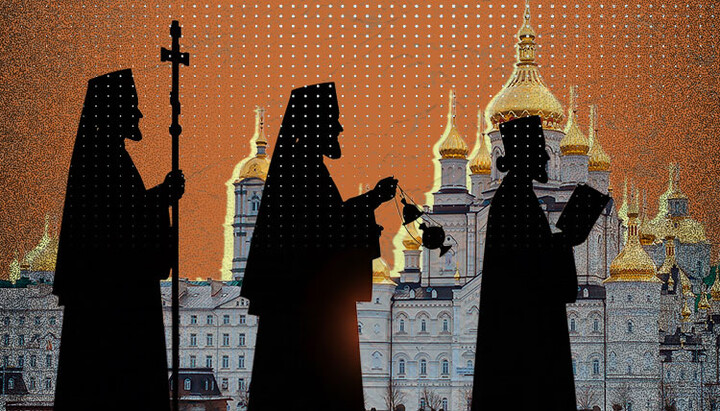
Reflections of pilgrims in holy orders. Photo: UOJ
Schism and political interference in Church life. Seizures of churches and persecution of the canonical Church, beatings and arrests of clergy. And finally – the war. What are the primary causes of these misfortunes?
These were the questions we posed to several UOC priests from different eparchies who had come to the Pochaiv Lavra with pilgrims and were staying in the Lavra’s guesthouse, where we had the chance to speak with them in a room reserved for the clergy.
Archpriest Vasiliy: “The state violated the Constitution back in 1992”
“I have been in holy orders for more than 30 years. And throughout these years, I have watched the turmoil within the Church life of Ukraine. I remember how we, students of the Moscow Theological Academy, lived through the schism of 1992, initiated by former Metropolitan Filaret (Denysenko), who created the so-called ‘UOC-KP,’ unrecognized by the entire Orthodox world.
At that time Filaret was fully supported by his godfather and friend – the first President of Ukraine, Leonid Kravchuk.
In essence, this was blatant state interference in the religious life of the country, a direct violation of the Constitution of Ukraine, which states that the Church is separate from the state, and the state from the Church (Article 35).
Kravchuk declared loudly in the Verkhovna Rada that the Kharkiv Council of the UOC in May 1992, which elected Metropolitan Volodymyr (Sabodan) as Primate, was unlawful, and that Filaret’s removal from office was also unlawful.
It was then that the media began to vilify our Church, while His Beatitude Metropolitan Volodymyr could not secure a meeting with Kravchuk until it became clear (to Kravchuk as well) that Filaret’s promises to unite the UOC with the autocephalists (UAOC) under the umbrella of the UOC-KP were nothing but bluff. Kravchuk eventually acknowledged his mistake. Yet to this day it remains unclear where the funds of the Communist Party of Ukraine, supposedly transferred by Kravchuk to Filaret’s accounts, actually went.
“May God grant the poor 96-year-old elder repentance before he departs this life… These are the fruits of that division, which we continue to reap even now. The war in the east of the country has similar spiritual causes…”
Archimandrite Veniamin: “Ethnophyletism triumphed over unity in Christ”
“The ecological catastrophe in Chernobyl did not occur by chance. It happened through God’s providence – as His permission. Through this tragedy, a line was drawn under the 70-year godless regime. As the Savior says in the Gospel of Luke: ‘Or those eighteen on whom the tower in Siloam fell and killed them… unless you repent, you will all likewise perish’ (Lk. 13:4–5).
And what then? Was there any nationwide repentance? After 1988, the spiritual revival of the once-persecuted Church of Christ began.
People – many of them former atheists – streamed into God’s temples. Thousands of baptisms and weddings. And yet? Ritualism began to replace genuine faith…
And politicians began to interfere in Church life; the national idea started to be implanted into the Church after the collapse of the Soviet Union in 1990… The words of the Apostle Paul – that ‘there is neither Greek nor Jew… but Christ is all and in all’ (Col. 3:11) – were ignored.
This phrase means that in the spiritual unity of those who believe in Christ, there can be no division by nationality, race, social status, or any other worldly trait. For those who have put on Christ, all are one in Him.
“Great resistance to the ideas of division along national lines was offered by the ever-memorable Metropolitan Volodymyr (Sabodan, +2014), who emphasized that all are united in Christ – both in the west and in the east of the country. Unfortunately, the idea of ethnophyletism prevailed… This also applies to the present political situation.”
Hieromonk Athanasiy: “Brother hates brother”
“His Beatitude Metropolitan Onufriy rightly calls everyone to repentance and to personal awareness of their own sinfulness. Unfortunately, the percentage of believers in Ukraine is very small. And what is more, people who call themselves believers include schismatics and sectarians.
What is astonishing is that no one touches the latter in this country. Only our One, Holy, Catholic, and Apostolic canonical Church is declared outside the law and persecuted.
What peaceful settlement can we speak of when brother hates brother?.. Every calamity has a spiritual cause.”
Archpriest Sergiy: “We build churches but forget the people”
“You know, in my sinful opinion, all our misfortunes arise from our own carelessness, complacency, and pursuit of material wealth.
It often happens like this: we build and gild churches, but forget about the suffering people.
Ask any priest: how many of his parishioners live below the poverty line? How many bedridden sick are there who cannot come to services? Not everyone will be able to answer. But we all know perfectly well how much miters and vestments cost, crosses and panagias… Forgive me – all these things are necessary for the beauty of worship, but they must not overshadow or take precedence over the needs of the simple, frail, suffering people…
“‘Where there is simplicity, there are a hundred angels,’ said Saint Ambrose of Optina. Let us be simpler, humbler, and people will be drawn to us. And the schismatics will fall away like dry, lifeless branches. And then there will be peace, and grace, and love, and prosperity…”
Read also
Prayer commemorations instead of loving embraces
At every Orthodox wedding, the choir sings a hymn to the martyrs. For families separated by war, these words carry a special meaning.
Honest atheism vs. spiritual hypocrisy
The 70th anniversary of Albert Camus’s Nobel Prize recalls an uncompromising challenge to Christianity. An honest unbeliever brings theology back to the mystery of the Cross.
The valley of trouble and the gateway of hope
One soldier buried an expensive cloak and some gold beneath his tent. Because of this, all Israel lost a battle. Why did one man’s sin bring disaster upon an entire nation?
From love spells to bishop's throne
Antioch’s most powerful sorcerer sent demons against a devout young Christian woman three times – and failed every time. In the end, a demon himself revealed the truth that led to his conversion.
The Weeping Queen of Blachernae
On the night of the Feast of the Protection, only two people witnessed the miracle in the Church of Blachernae. Everyone else prayed and saw nothing. Yet they, too, received grace.
Deadly spiral of human hatred
The tragedy of Lebanon's civil war lays bare how dehumanization and fear can turn human beings into monsters.