Orthodoxy and LGBT: Has the first domino fallen?
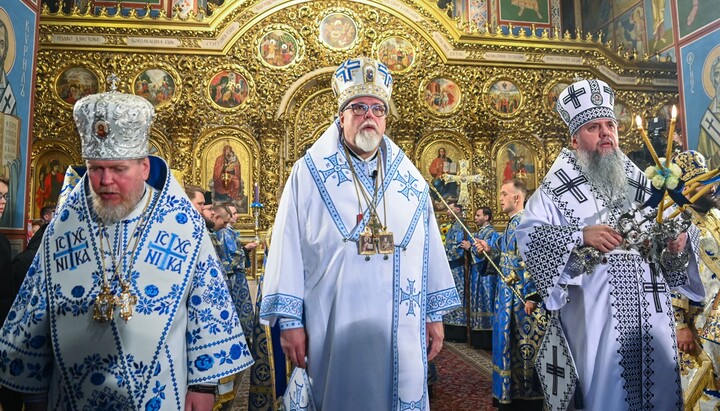
Archbishop Leo of Helsinki surrounded by Zoria and Dumenko. Photo: OCU
In early October, a delegation of Lutheran bishops from Scandinavian countries visited Ukraine, accompanied by the primate of the Finnish Church of the Constantinople Patriarchate, Archbishop Leo. As usual, they met with Serhii Dumenko and even attended a service at St. Michael’s, concelebrated by the Finnish primate and Dumenko.
At the time, the UOJ editorial office happened to notice one of the Lutheran bishopesses’ statements about LGBT issues – and decided to check the positions of the others. The results were unexpected: nearly all the guests, in one way or another, openly support LGBT ideology – attending “pride” marches, hanging rainbow flags in their churches, and even calling for the legalization of same–sex marriage.
Naturally, no one thought to check the position of the Finnish primate himself. As it turns out, that was a mistake.
At the end of November, the Council of the Finnish Church convened in Helsinki. Among other matters, it examined an “Initiative of the Church Council on the Recognition and Protection of the Rights of Sexual and Gender Minorities.”
The Council voted to approve the initiative.
Their reasoning was hardly original: the Church is the Body of Christ. Excluding homosexuals or “denying their identity,” they claim, “causes pain not only to these individuals but wounds the community, harms the Church, depriving it of its fullness and making it weaker.”
“In the Church, absolutely everyone – regardless of sex, sexual orientation, ethnic origin, skin color, state of health, social status, etc. – must feel safe,” the Council’s text reads.
In other words, a person who practices an openly sinful lifestyle is not required to address that sin. Instead, sin is placed on the same level as nationality, skin color, or health. And the Church, we are told, becomes “weaker” without such unrepentant sinners.
Not long ago, Archbishop Leo was outraged by the U.S. peace plan because it allegedly contained a requirement for Ukrainian authorities to stop persecuting the UOC. He interpreted that as an act of “injustice.”
This is the strange era we live in: an Orthodox primate objects to the right of millions of Christians to confess Christ in the faith of their fathers for a thousand years – yet warmly advocates for the “rights” of homosexuals within the Church.
And one more thing. It is hard to believe that an autonomous Finnish Church would adopt such a scandalous document without a nod from the Phanar. More likely, this is a test of tolerance. If the Orthodox faithful remain silent – similar council decisions should be expected elsewhere.
Read also
Why is it legal to kill a person before birth but not after?
Children are the most privileged members of society. Yet that same society officially permits children to be killed – and on a massive scale.
Honoring the Bolsheviks’ successors at Kyiv Lavra
It was under the Reserve that the relics of the saints were desecrated, Lavra churches were turned into an atheism museum, and toilets were installed in sanctuaries.
"Degenerates" and "stupid animals": anti-UOC activists turn on children
Future historians will wonder how a vast country’s information agenda could have been shaped for so long by people so petty, vicious, and utterly contemptible.
Zelensky sees murder of Polish priest but not of Sviatohirsk monk
Why does Zelensky react so emotionally and swiftly to the murder of a Catholic cleric while remaining completely silent about the murder of an Orthodox monk?
UOC vs. OCU numbers: pollsters count, social media recount
Official polling suggests Dumenko’s structure has an overwhelming lead in the number of parishioners, while social media polls paint a very different picture. Which should we believe?
Who is working for the Kremlin in Poland? OCU, Uniates and Catholics versions
Who in the conflict between Poland and Ukraine is "an agent of the Russian Federation"? Zelensky, who gave the UPA name to an AFU special operations center? Nawrocki, who stripped him of an order for it? Polish MEPs?