Sounding Silence: How Arvo Pärt taught the world to listen to God
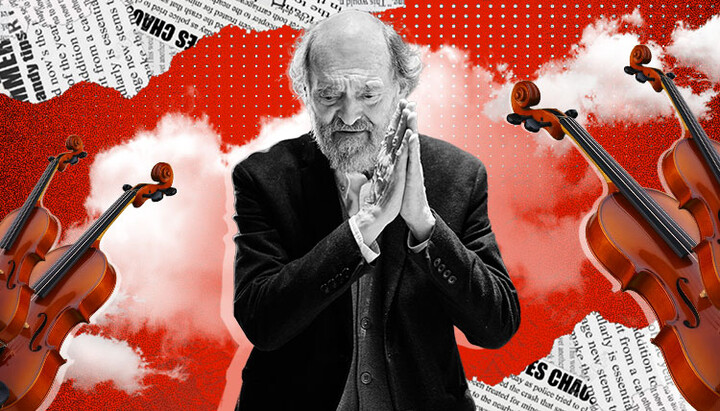
Arvo Pärt – the "theologian" of silence. Photo: UOJ
We live in an era of aggressive noise. Notification sounds, the hum of metropolises, endless rhythms from taxi and shopping center speakers. Silence has become a luxury, and a pause is a cause for anxiety. But in this roaring world, the most performed living composer on the planet is a person whose music barely moves and sounds like a faint whisper.
His name is Arvo Pärt. He is an Orthodox Christian who has proven through his work that modern man, even one far from the Church, desperately longs for God.
The paradox of silence
If you look at photos of Arvo Pärt, you are unlikely to take him for a world-class star. A high forehead, a full gray beard, and sad eyes.
He looks more like an Athonite elder or a hermit than a regular at European philharmonics.
His music matches his appearance. It has no complex passages, no desire to entertain or shock. It flows slowly, like time during an All-Night Vigil. And yet, the halls of Berlin, London, and New York, which usually gather audiences for bold experiments, fall silent when Pärt's music plays.
Why? Because the secular world is tired of its own noise. Pärt gives people what they have lost – the experience of the sacred. The experience of stopping. The experience of encountering Eternity, which in church tradition is called "sobriety".
Eight Years of Desert
Arvo Pärt was not always like this. In the 1960s in Estonia, he was the main musical rebel and avant-gardist. He wrote complex, dissonant music, experimented with collages, and provoked. It seemed his career was on the rise. But suddenly the composer fell silent.
This silence lasted eight long years – from 1968 to 1976.
Biographers call it a creative crisis, but in the language of asceticism, it was a "desert". Pärt realized that he had lost the Truth behind the complexity of form.
"I didn't know if I would ever be able to compose music again," Pärt later recalled. "During those years, I studied Gregorian chant and ancient polyphony. I realized: it is enough when a single note is beautifully played. This note, or a quiet beat, or a moment of silence comforts me."
It was during these years of "silence" that the main event of his life occurred. A Lutheran by birth, Pärt embraced Orthodoxy. It was not a tribute to fashion. It was a return to the roots, a search for the foundation on which not just music but life could be built. The change of faith gave him a new language.
The tintinnabuli style: the voice of the soul and the voice of the Angel
Emerging from seclusion in 1976, Pärt introduced the world to his own style, which he called tintinnabuli (from the Latin "bells").
At first glance, this music seems deceptively simple. But behind this simplicity lies deep Orthodox theology.
Pärt found a way to convey in notes the idea of synergy – the cooperation of man and God.
In most of his works, we hear two voices that intertwine but do not merge:
- M-voice (melodic voice). It moves step by step, transitioning from note to note. This is the image of the human soul, suffering, searching, sometimes erring, wandering earthly paths.
- T-voice (tintinnabuli voice). It moves only along the sounds of the triad (C-E-G). It is static, stable, and omnipresent. This is the image of God, grace, or the Guardian Angel.
The Angel's voice does not press on the human voice. It is simply always there. Wherever the melody-soul goes, the supporting sound of the Trinity always supports it. This is an acoustic icon: we hear how human weakness is accomplished in the power of God.
The Penitential Canon in a secular hall
In 1998, Pärt received a commission for the 750th anniversary of Cologne Cathedral. The organizers likely expected a solemn mass or oratorio. Instead, Pärt wrote a two-hour choral work, naming it Kanon Pokajanen.
This was the full text of the Penitential Canon of St. Andrew of Crete in Church Slavonic.
Imagine the scene: a huge Gothic cathedral in the center of Europe, a secular, often non-believing audience in expensive suits. And for two hours straight, the choir sings stern, ascetic words: "Have mercy on me, O God, have mercy on me." Without an orchestra, without special effects.
Pärt achieved the impossible: he brought a purely church, monastic prayer into the space of modern culture.
And culture accepted it with reverence. Listeners, not knowing the language, cried at concerts, feeling that very "joy-creating sorrow" of repentance that the holy fathers speak of.
Another masterpiece is Adam's Lament. It is based on the texts of St. Silouan the Athonite. Pärt turned into a universal tragedy the pain of Adam, who lost paradise, and the vision of God. It is not just a musical piece; it is a sermon about how the root of all our troubles lies in the rupture of the ties with the Creator.
Asceticism for the ears
Pärt's music is often called "sacred minimalism". But it would be more accurate to call it "musical hesychasm".
In it, pauses play a huge role. For Pärt, the silence between notes is as important as the notes themselves. It is the musical equivalent of the struggle with thoughts. To hear the beauty of a single sound, one must cut off all excess, stop fussing.
This music cannot be listened to "in the background" while driving, jogging, or washing dishes. It requires ascetic effort from the listener: to stop, to sit, and be. This is exactly what modern man fears and craves so much.
The bell that awakens the conscience
Arvo Pärt lives in seclusion, rarely gives interviews, and does not participate in social gatherings. He serves God with his talent, reminding us of the forgotten purpose of art.
In ancient times, culture emerged from the temple. Today, having made a huge circle, it often turns into anti-culture.
But Pärt's work is a bridge. His music is a kind of narthex of the temple for the secular world.
It does not replace the Liturgy, it is not a prayer in the strict sense of the word. But it takes the modern person by the hand, leads them out of the noise of the information flow, and places them in silence before the closed Royal Doors.
And then the choice is ours: to enter or stay outside. But not hearing this quiet call is already impossible.
Read also
Man before the forces of nature
A solitary figure on the shore seems insignificant before the immense power of the sea, yet it is he who stands before the Creator.
The mysteries of Golgotha in the light of archaeology
The veil of centuries obscures what really happened in the fourth century. Archaeology and ancient texts shed light on the true history of one of Christianity’s greatest sacred sites.
Zaporozhian Cossacks defend the persecuted faith
The story of how Cossacks drew their sabers to defend abused priests – while sometimes causing violent disturbances inside churches themselves.
A forgery at the foundation of Mohyla Academy
For centuries, historians have repeated an appealing story about a wealthy benefactor’s generous gift. Archival documents, however, paint a very different picture of what happened.
Theology of worn-out shoes
A painting of a pair of old shoes in a Dutch museum preserves the memory of an ordinary working person and a life of hard labor.
Everyday life and labors of the Lavra brotherhood
We are accustomed to seeing the Pechersk Monastery as it appears on picture-perfect postcards. Archival records from the 19th century take us back to the down-to-earth realities of monastic life.