Seven years of the OCU – what fruits has it borne?
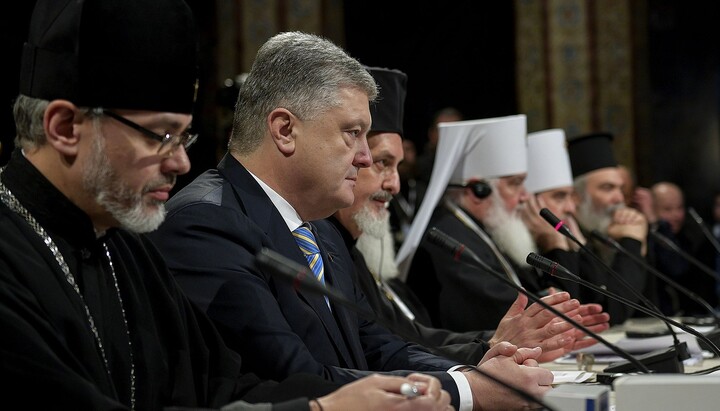
Petro Poroshenko at the head of the “Unification Council.” Photo: Wikipedia
December 15 marks the day of the so-called “Unification Council” of the UOC-KP and the UAOC, as a result of which the "holy church of Ukraine" – also known as the OCU – was created in 2018. The “fruits” of this event have long been evident. Its principal outcome has been the deepening of the schism within Ukrainian Orthodoxy. What were once isolated, sporadic conflicts between communities of the UOC and the UOC-KP have multiplied into the hundreds and thousands. Church seizures have become rampant and frequently accompanied by violence and bloodshed. In places where people once lived peacefully and in mutual accord, enmity and hatred have taken root.
Yet the OCU chooses demonstratively not to notice this. To mark the anniversary, Dumenko produced a bombastic statement that, judging by its content, appears to have been written in some parallel reality. Let us quote just a couple of passages.
“The Unification Council overcame the external artificial isolation of Ukrainian Orthodoxy and its internal divisions – we returned three divided branches into a single, canonically correct structure.”
As is well known, the UOC was not in any isolation – neither then nor now. And the “clergy” of the OCU (the UOC-KP and the UAOC) were regarded as people without valid priestly orders, and continue to be regarded as such by the overwhelming majority of the Local Churches. Even in those Churches that formally recognized the OCU – the Greek, Cypriot, and Alexandrian – a substantial part of the hierarchy and clergy still treat members of this structure as laypeople.
And the claim that the OCU united “three divided branches” is, of course, a blatant falsehood. Out of one hundred bishops of the UOC, only two joined the OCU. Moreover, a part of the UOC-KP itself, led by Filaret, left this structure almost immediately.
“These seven years of the OCU’s existence are not something new, but the logical continuation of its more than thousand-year history. The OCU is a good and blessed fruit of centuries of labor, prayer, and struggle. Therefore today, as an already established autocephalous Local Church, we continue the work of our predecessors.”
For several centuries, the Church on the territory of present-day Ukraine was part of the Moscow Patriarchate – this is a historical fact. Which “predecessors” is Dumenko referring to? What labor, and what struggle? Especially considering that in his other speeches he refers to all members of our Church since 1686 as “occupiers.”
But the most revealing part is the OCU’s “achievements” over these seven years. It is not the bringing of people into the Church, not the preaching of Christ among those of other confessions, and not even the filling of churches. According to Dumenko, the OCU has become “the foundation of the state,” “a factor of resistance to Russian aggression,” and has “earned the respect of international partners.”
And here, we fully agree with Serhiy Petrovych Dumenko – there is nothing to argue with.
Read also
Who destroyed and restored Kyiv Lavra? MinCulture's video reveals the truth
The Culture Ministry’s propaganda about the Kyiv-Pechersk Lavra has inadvertently revealed the truth.
Ternopil post on Feast of Intercession: Has calendar reformn failed?
A significant number of believers have rejected the new church calendar introduced by the OCU and UGCC with government support.
Shoulder straps or a cassock: who writes the script for UOC "fighters"?
Everything indicates that both Veliar and Pshenychny are ordinary performers of someone else's script. There is only one question – does the scriptwriter wear shoulder straps or a cassock?
Why is it legal to kill a person before birth but not after?
Children are the most privileged members of society. Yet that same society officially permits children to be killed – and on a massive scale.
Honoring the Bolsheviks’ successors at Kyiv Lavra
It was under the Reserve that the relics of the saints were desecrated, Lavra churches were turned into an atheism museum, and toilets were installed in sanctuaries.
"Degenerates" and "stupid animals": anti-UOC activists turn on children
Future historians will wonder how a vast country’s information agenda could have been shaped for so long by people so petty, vicious, and utterly contemptible.