How Uncle Kolya the janitor believed in God
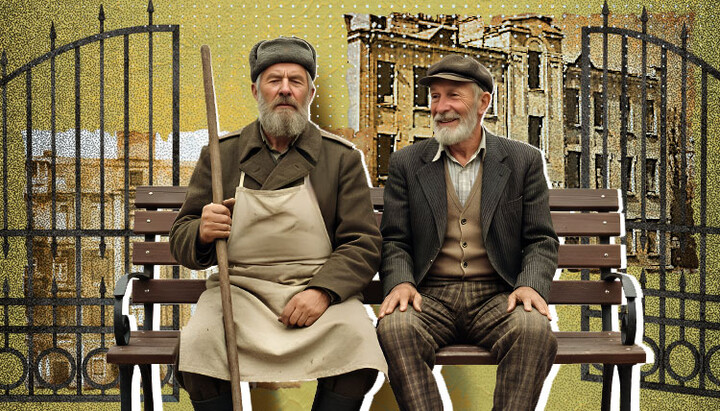
Uncle Kolya and Uncle Fima. Photo: UOJ
In the early 1960s I was about ten years old. We lived in a communal apartment on the fourth floor of an old pre-revolutionary house built before 1917, made of yellow “tsarist” brick, at 34 Zhylianska Street. The courtyard was locked by large wrought-iron gates with a massive barn lock on a chain. Every night, precisely at eleven, the gates were locked by the old janitor, Uncle Kolya.
With his black beard streaked with gray, wearing a black rubberized apron, heavy leather boots, gripping a huge broom, and with a ring of keys hanging on his chest, he inspired mortal terror in our childish souls. We were afraid of being caught by the ear under his thunderous bass voice: “Well then, you’re caught, you rascal!..”
“Rascals” was what we courtyard boys were called for any offense at all – climbing trees, running across the flowerbed in the middle of the yard, chasing away stray tomcats who had wandered in for a feline wedding, and for countless other childish mischiefs.
A friend from the Jewish bazaar and the little mare Rozochka
Uncle Kolya lived in a half-basement of a two-story wing attached to the wall by the courtyard gate. In his little storeroom he kept birch brooms, snow shovels, huge sleds, and all kinds of household tools.
A great holiday for us came whenever his friend from the shady Yevbaz (Jewish bazaar – Ed.) showed up – Uncle Fima. Uncle Fima never came alone, but on an old cart harnessed to our beloved little mare, Rozоchка. Under the cart seat Uncle Fima always had a bottle of vodka hidden away. He and Uncle Kolya would sit down at a small table by his little room, and we boys were allowed to ride around the courtyard on Rozоchка.
“Do you remember, brother Nikolai (full name for Kolya – Ed.),” Uncle Fima would say, savoring a drag on his cigarette after downing two shots, “our district policeman Stepan Ivanovich?.. He was a good man, took pity on us janitors… We were twenty years old when we started working as janitors, stood night watch, and even got bonuses in silver… Those were good times…”
“And I’ll tell you this, Fima,” Uncle Kolya would rumble in reply, “in tsarist times a janitor was a respected man. You ran off into the occupation after ’41 – otherwise you’d be lying in Babi Yar today. And I went through the whole war, from Kyiv to Warsaw, where I was wounded and awarded the Medal for Courage. Rokossovsky himself pinned it on me…”
“Oh come on, Kolya!” Uncle Fima would cry out. “And I was sewing felt boots for you soldiers out in Central Asia. That’s why Hitler never took Moscow, I’ll tell you in confidence. The Germans froze like naked cockroaches on the snow. And you held the line in my valenki, I’ll tell you that much…”
“And I’ll tell you that you Jews always knew how to settle well in life…”
“Oh vey, Kolya! If I knew how to land on my feet, I wouldn’t have worked as a janitor for fifty years…”
“Well, at least your Fayechka sews brassieres on the side – everyone knows that – and you sell them at Yevbaz on Sundays!..”
“Oh really! And you go to St Vladimir’s Cathedral every Sunday, then drink beer with dried fish on Bibikovsky Boulevard till evening… And how much money you’ve poured into that Vladimir’s, that even the metropolitan is your friend… You think that’ll be counted to your credit later?”
“I go to God, not to the metropolitan. And you go to Mammon…”
“Well, my Mammon gives me money. And what does your God give you?”
“Be quiet, heathen!” Uncle Kolya would snap, pouring full glasses. “He gives everything!.. The Kingdom of Heaven! The Heavenly Jerusalem!..”
“By the time you get there, brother Nikolai, my children have been living in Jerusalem for ages already – and thanking God.”
“With your money…”
And so they went on arguing for a long while, until Fima ran off to the grocery store for beer, and we had our fill of riding Rozоchка and feeding her warm bread from our hands.
Not long after that, Uncle Kolya died. His funeral service was held at St Vladimir’s Cathedral on Shevchenko Boulevard – which Uncle Kolya and Uncle Fima stubbornly called Bibikovsky.
Many residents of our courtyard came to the funeral – and we boys too. Around Uncle Kolya’s coffin stood priests in white vestments. The metropolitan censed the coffin, read the prayer of absolution, and then placed it into Uncle Kolya’s hand.
He lay there with a wreath on his head, looking younger, radiant, with a faint smile – as if he were already seeing his long-awaited Heavenly Jerusalem. And in the corner, behind a column, Uncle Fima stood quietly weeping, tears streaming down his face.
Read also
Why were holy monasteries turned into state prisons?
The history of Christian Europe preserves the memory of times when monasteries served as places of exile imposed by the state. Within their walls, the fates of monarchs and righteous men were decided.
A shepherd boy with a letter from Christ to French king
In the summer of 1212, thousands of pilgrims carrying staffs waited for the sea to part before them. Later chroniclers added ships, slave traders, and a pope's lament to their story.
Facade of bones and facade of light
Antoni Gaudí spent forty-three years building a church in Barcelona, knowing that this construction was for the ages.
Trial of a dead pope
Once in Rome, the body of a deceased pope was seated on the throne and put on trial. The accusation relied on a church canon that had once saved his see.
Monastery built in defiance of king
When Orthodox believers in Minsk were left with just one church, townspeople decided to build another – and even a royal decree did not stop them.
Young Mother and Sleeping Christ
Michelangelo carved a Virgin Mary who looks younger than her Son – and signed his name in marble for the only time in his life. Neither of these peculiarities was accidental.