When the ice breaks: Why winter cannot outlast spring
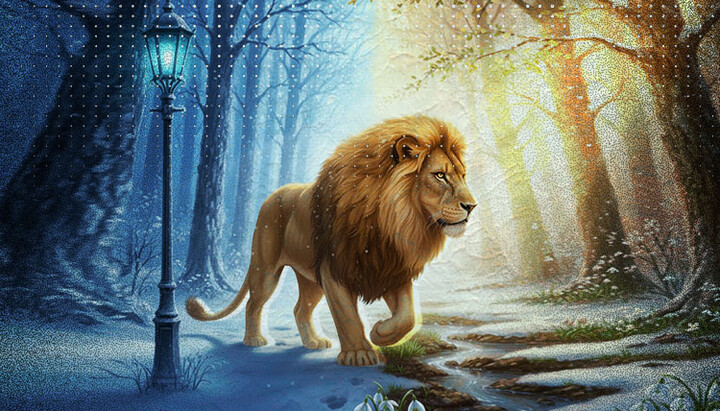
Aslan the Lion brings spiritual spring. Photo: UOJ
“Always winter and never Christmas.” When Clive Staples Lewis wrote these words, he was not inventing a pretty metaphor for a children’s fairy tale. He was making a diagnosis – perhaps the most precise diagnosis of a state of the soul in which all of us sometimes find ourselves. Especially now.
You wake up, and outside the window it is the same gray day, the same disturbing news, the same heaviness in your heart as yesterday.
It feels as though time has stopped. As though joy has been canceled by some heavenly decree, and hope has gone on indefinite leave. The world around us may even be beautiful in its harsh, icy beauty, but it lacks the essential thing – it lacks life.
We open an old book with a worn cover – The Lion, the Witch and the Wardrobe, one of The Chronicles of Narnia – not to escape from reality. We open it to understand how to survive in this reality. And, more importantly, how to defeat winter within it.
What lies behind the old fur coats?
For those who have not yet opened that door, let us recall the route. Four children – Peter, Susan, Edmund, and little Lucy – are evacuated from London to escape German air raids. In the huge old house of the Professor, while playing hide-and-seek, Lucy climbs into a wardrobe. She squeezes past rows of heavy fur coats smelling of mothballs and suddenly feels the fur give way to prickly fir branches, while the floor beneath her feet becomes crunchy snow.
Thus the children enter Narnia. It is a land of talking beasts, fauns, and dryads. But it is occupied. Power has been seized by the White Witch, who has bound this world in eternal ice. An ancient prophecy says that winter will end when two Sons of Adam and two Daughters of Eve ascend the throne at Cair Paravel.
Yet this is not merely a fairy tale about clashing swords. It is the drama of one family, where a brother betrays his siblings for a box of sweets. And it is the drama of an entire world that can be saved only by the return of its true creator – the lion Aslan.
The sterility of evil
Lewis brilliantly reveals the nature of evil through the image of the White Witch. Notice: her world is not a fiery hell with boiling cauldrons. Her world is perfect sterile order. It is absolute cold.
In Lewis, evil does not so much destroy as it preserves.
The Witch turns living beings into statues. She stops movement. She freezes life at a moment of fear or pride. This is strikingly similar to what despondency does to us.
When we fall into despair, we turn to stone. We stop feeling another person’s pain because we are too focused on our own. Prayer grows “cold.” Church services seem long and empty. The words of the Gospel feel like dry lines of text.
In the Witch’s world, there is a ringing silence. Snow absorbs all sound. One cannot laugh loudly there, cannot sing, cannot celebrate. It is the silence of total fear. Do we not recognize this cold? Do we not feel chilled now, when it seems that the forces of good have retreated and God is silent?
But Lewis, who had passed through the trenches of the First World War and wrote Narnia under the sound of bombings during the Second World War, knew a secret. He knew that evil is powerless before real Life.
The mud of hope
How is this eternal winter defeated? Not by armies – at least, not at first. It is defeated by a change in the atmosphere.
There is a remarkable moment in the book that we feel almost physically. It is the moment when the Witch’s sleigh begins to get stuck. At first it is just a sound – a strange, unfamiliar sound of dripping water. Drip. Drip. Then comes the rustle of settling snow. And then happens the thing the Witch hates most of all. Mud appears.
“The snow under the runners had turned to slush,” Lewis writes. And this is a great image.
We are accustomed to thinking that holiness and the victory of good are something clean, white, neatly pressed. But Lewis shows us that life is untidy. It is noisy. It smells of damp earth, rotting leaves, and meltwater.
Spring in Narnia comes not by the calendar, but because “Aslan is on the move.” The very name, whispered by the beavers in their burrow, makes the air warmer. We have not yet seen the Lion, but the ice has already begun to crack.
This is a lesson for us. When it seems that darkness has thickened to its limit, when the “sleigh” gets bogged down in the mud of everyday problems and sorrows, do not rush to complain. Perhaps this mud under your feet is a sign that the ice has broken. Perhaps tears are that very dripping that foretells spring.
God does not always enter our lives through the front door of success. Often He comes through the thawing of our icy heart, through the pain of coming alive, through the mud and slush of our mistakes that we have finally decided to correct.
The price of the snowdrop
Lewis is a Christian thinker – he cannot lie to us. He does not say, “Just wait, and everything will sort itself out.” No. Spring in Narnia has a price. And that price is terrible.
The boy Edmund was tempted by Turkish delight (how often do we sell our fidelity to God for the “sweets” of this world!) and became a traitor. For him to remain alive, someone must die. The law of the “Deep Magic from the Dawn of Time” is inexorable: sin demands death. The traitor belongs to the executioner.
And here we come to the Stone Table. This is the most piercing scene in the book. The Great Lion, the creator of Narnia, allows Himself to be bound. Not because He is weak, but because He has chosen it.
We feel this horror as we read how hideous creatures shear off His golden mane. How they spit on Him. How they put a muzzle on Him.
Lewis does not spare the reader. He shows us a humiliated, defenseless God who remains silent as He is led to slaughter.
Why is this so important? Because here lies the answer to the question of why winter cannot be eternal. Evil knows the laws of justice: “guilty – die.” But evil knows nothing of the laws of love.
“If she had looked a little further back, into the stillness and the darkness before Time dawned… she would have read there a different incantation. She would have known that when a willing victim who had committed no treachery was killed in a traitor’s stead, the Table would crack and Death itself would start working backwards.”
Spring comes into our hearts not because we “behaved well.” And not because we are strong. It comes because Christ voluntarily ascended the Cross in our place. The ice cracked on Golgotha. It was there, in darkness and pain, that the needle of eternal winter was broken.
Father Christmas in the trenches
It is interesting that Lewis introduces Father Christmas into the narrative – a stern, majestic old man. He comes to Narnia when the ice has only just begun to melt.
And what does he give the children? Not toys. Not sweets. He gives them weapons. A sword, a shield, a bow, a dagger. A strange Christmas gift, it would seem. But Lewis is utterly honest.
Christmas is not the end of the war. It is the beginning of the real battle. But now it is a battle not in darkness and cold, but in the light of the rising Sun.
Lewis wrote this fairy tale for children evacuated from London because of German air raids. These children lived in чужих homes, separated from their parents, in fear of the future. They knew what real “winter” was. And Lewis gave them not escapism, but medicine.
He told them: look, evil may seem enormous. It may freeze an entire world. It may last a hundred years. But it is finite. It has no future. It cannot stop spring, because it did not create this world.
We now, too, are a little like those evacuated children. We are afraid. We are cold. We want to hide in the wardrobe. But let us listen. Through the noise of the news, through the clamor of this world, through our own fear – do you hear it? Drip. Drip. Drip. It is the ice of our pride and our lack of faith melting. Aslan is on the move. And that means Christmas is inevitable.
Read also
Facade of bones and facade of light
Antoni Gaudí spent forty-three years building a church in Barcelona, knowing that this construction was for the ages.
Trial of a dead pope
Once in Rome, the body of a deceased pope was seated on the throne and put on trial. The accusation relied on a church canon that had once saved his see.
Monastery built in defiance of king
When Orthodox believers in Minsk were left with just one church, townspeople decided to build another – and even a royal decree did not stop them.
Young Mother and Sleeping Christ
Michelangelo carved a Virgin Mary who looks younger than her Son – and signed his name in marble for the only time in his life. Neither of these peculiarities was accidental.
Orthodox books from a Uniate printing press
In the 18th century, Uniate monks at Pochaiv printed books used in prayer by Orthodox Christians and Old Believers alike.
The story of the honey brotherhood
The Mogilev Brotherhood began with members pooling money to brew honey drinks for feast days – and eventually grew to have its own printing press.