The saddest parable: the tragedy of God’s unrequited love
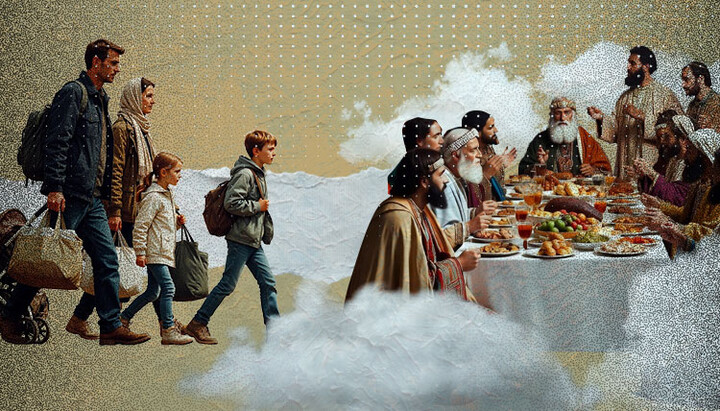
Refugees – today’s “chosen ones” for the wedding feast. Photo: UOJ
On this Sunday we will read one of the saddest parables of the New Testament – the parable of the wedding feast. It speaks of the tragedy of unrequited love on a cosmic scale, of the fact that for most people God is unnecessary.
Look at this parable with the eyes of the simplest person. Our Heavenly Father, from all eternity, prepared for His children a feast of eternal life. It is that world of which the Apostle Paul said: “Eye has not seen, nor ear heard, nor have entered into the heart of man the things which God has prepared for those who love Him” (1 Cor. 2:9).
The Father has set the table and given us not merely the best – but everything He has. He did not spare His beloved only Son, so that we might be able to come to this feast. Angels, with lowered wings, wait for our arrival, preparing to serve us at the table.
The devil and his followers once went mad and raised a rebellion against God when they learned that this wedding feast was being prepared not for angels, but for man.
The good angels, by contrast, accepted this will of God and with joy took up the service of people, despite surpassing us in every way.
And now everything is ready. The universal city waits for the opening of the gates of paradise and for the entry of the sons and daughters of mankind. This will be the beginning of a new, endless age. And what do people say? They say to God: “God, forgive me – I have things to do. I don’t have time.”
The language of shepherds and the “wrath” of God
The parable says that such an answer aroused God’s wrath. Yet this is not so. The truth is that God is not angry with anyone, judges no one, punishes no one. He always remains Himself. He is always love – and love unconditional toward all creation. In Him there is no shadow of change, not even a hint of rage, fury, and the like.
But in the Bible we read very different narratives. The reason is that the Hebrew language knew nothing of abstract philosophical categories. It did not even have words to designate them. In Christianity, such concepts emerged only four hundred years after the Nativity of Christ.
And the Savior had no way to explain spiritual realities in the language of Plato and Aristotle. The Jews simply would not have understood Him.
Therefore every Gospel parable is the most accessible way to bring abstract, contemplative spiritual truths to the mind of a simple shepherd, fisherman, or farmworker.
And there was no other way to portray the sufferings a person will endure if he refuses to follow God’s will except by depicting “the wrath of God.” Imagine that a prophet decided to tell the Jews not to drink water from a dirty source:
... And he proclaimed a commandment: “If you drink from a filthy puddle, an invasion of acid-resistant strains of Shigella will cause a cytopathic effect, leading to necrosis of epithelial cells, desquamation of the mucous membrane, and the development of acute erosive-ulcerative hemorrhagic colitis.”
Of course the prophet would not speak like that. He would say that if you drink dirty water, God will punish you with diarrhea. That is clear and understandable. Such is the ordinary principle of biblical language.
The host’s “wrath” is not about God ceasing to be love. It is about the consequences people face when they point God to the door of their own heart.
We imagine that only obvious sinners will end up in hell. And it never occurs to us that beyond the fence of the Kingdom of God there may be a great many very busy people.
The tragedy of possession
The parable gives three reasons for refusing to come to the wedding feast: the tragedy of possession, the narcotic of action, and the idol of happiness.
The first is: “I have bought a piece of land.”
This is the power of space, the thirst to possess. Buying land is an attempt to expand one’s “I” through territory. A person thinks he owns the land, but in fact the land owns him. It is attachment to “mine” that makes entry into God’s realm impossible.
Pakhom, from Leo Tolstoy’s story How Much Land Does a Man Need?, ran all day to mark out the borders of his property – and in the end drove himself to death and fell lifeless. He received exactly as much as he truly needed: three arshins of earth for his grave.
In the parable, the invited man begins to lie to God from the very first words: “I must go and see it.” But land is not ice cream on a stick – it will not melt, it will not go anywhere, it will not run away. There is no urgent necessity here. The honest answer would be: “My land interests me more than Your feast.”
A man possessed by land would rather die of a stroke on a pile of money, never having had time to live, than stop tending to his business.
The narcotic of action
The second reason is the oxen.
Oxen are the means of production – work, career, technology. The modern person defines himself by what he does, not by who he is. Here the goal is replaced by the instrument. Life becomes an endless function, a race in which there is no room to stop.
The narcotic of activism is more relevant now than ever.
A successful, competitive specialist is a professional who has no time for silence. In the most technologically advanced country in the world, Japan, people die from being overworked.
Corporate culture demands total devotion to the company. Overtime hours, refusal of vacations, and colossal stress lead to burnout. A high standard of living exists – but there is no meaning and no happiness in such a life.
The idol of happiness
The third reason is the young wife.
This is the power of kin and flesh. Here belong social bonds, biology, procreation, the family as a self-enclosed system. It is the justification of refusal by biological determinism. Love for the creature becomes higher than love for the Creator.
“I, my home, my family, my little world” becomes a closed ego-system.
It is the mother who has made an idol out of her child; the lovers who have closed in on each other and say to God: “I cannot come” (Lk. 14:20).
This is a very heavy temptation, because it seems to a person that it makes him almost holy. After all, I refused not for myself, but for another – this is in the name of love. C. S. Lewis, in The Great Divorce, describes a woman who “loved” her son so much that this love turned into a suffocating egoism that closed the road to paradise.
Such a person says to God: “I do not need Your love – I have my own, small, warm, earthly love.” He tries to quench the thirst for the ocean with a sip from a puddle. But the puddle will sooner or later dry up, and he will be left in an absolute desert.
The battle inside the mind
In the tradition of hesychasm this parable is described as a battle within the mind – within the nous. The field is the mind’s earthboundness. The mind that should soar in contemplation becomes “of the soil,” heavy. It cannot tear itself away from thoughts of the material world. Such attachment to the earth gives birth to despondency and heaviness of heart.
The five yoke of oxen are the five pairs of senses: sight, hearing, smell, touch, taste (paired, because they act both bodily and spiritually).
The one who refuses the wedding feast because he wants to try out his oxen is the mind wholly dependent on sensory experience. He lives only by what is external and tangible. The hesychast, however, seeks to bring the mind inward into the heart, freeing it from the tyranny of the senses.
The young wife, in the hesychast reading, is sensuality and attachment to the flesh. Here we are speaking of the passive element of the soul that seeks pleasure. The mind that has “married” the flesh cannot stand before God.
Guests from the roadside of life
And then, in the parable, comes the good news for those who have already lost every hope and every support in the earthly world. The host says: “Bring in here the poor and the maimed and the lame and the blind” (Lk. 14:21). These are those whose world has collapsed. The one who has been given a diagnosis of “stage-four cancer” no longer needs a field.
It is the one who has been fired, thrown out of the world, forgotten like a broken tool. Oxen no longer interest him. It is the husband or wife who has buried their other half. It is, in general, all those whom the world calls failures. The poor, whose earthly supports have been destroyed (land, work, family). In the broad sense, this is the majority of ordinary people in my country.
In the parable, the Host (God) gathers those who lie “by the hedges.” Today such “hedges” are our ruined homes, basements, bomb shelters, trenches. The maimed and the lame are tens of thousands of soldiers, civilians, children left without arms and legs.
The blind in this parable are those blinded by grief after losing everyone close to them. The poor are the millions of refugees who yesterday had a “home and a job,” and today stand with a single bag in a чужой railway station. They are, today, God’s chief guests.
Christ in the basement
Christ is not now in the shining churches of well-fed capitals. He is in the basement under shelling. He is a refugee. He is a wounded child. The satiated world does not need God. We need Him. The satiated world is not interested in God, but in geopolitics – it needs territories, resources. The world divides influence while innocent people are dying.
Its oxen are the economy, gas, oil, stocks – and of course money. Its wife is comfort and prosperity. These are precisely the “invited” who will not taste Truth, because they chose comfort instead of compassion. For them we are merely expendable material – fertilizer for a fat life. But for God we are the desired guests of the feast.
While the whole world dances and makes merry, hell yawns open beneath our feet.
But if we do not fall into despair, living with our mind in this hell, it will lead us into paradise. Perhaps God even takes away our “oxen,” our “fields,” our wives, husbands, and children so that we may finally lift our heads upward.
He destroys our cardboard little houses so that we might enter His Eternal House. He “compels” us by sufferings to tear ourselves away from the pull of the earth. Christ opens for us the door that leads to the wedding feast.
There, within – is light and fullness of life, beside which all our earthly joys are like a dim match against the Sun.
And we still stand on the threshold, clutching our small dusty toys in our hands: our resentments, our plans, our pride, our “busyness.”
God whispers: “Drop it. All of it will burn. Come to Me. I have waited for you an eternity. Do not leave My house empty.”
The most terrible tragedy will not be that God condemns us. It will be that we ourselves, freely, say to Eternal Love: “I don’t have time,” – and step into the cold darkness of night with our five yoke of oxen.
Read also
From love spells to bishop's throne
Antioch's greatest sorcerer sent demons against a humble Christian girl three times and was defeated three times. A demon himself led him to the truth.
The Weeping Queen of Blachernae
On the night of the Feast of the Protection, only two people witnessed the miracle in the Church of Blachernae. Everyone else prayed and saw nothing. Yet they, too, received grace.
Deadly spiral of human hatred
The tragedy of Lebanon's civil war lays bare how dehumanization and fear can turn human beings into monsters.
Woe to expectant mothers – or to those of little faith?
God commanded one prophet not to have children, yet told his people in exile to bear sons and daughters. What does this apparent contradiction tell us today?
The help God never asked for
Uzzah wanted only to keep the Ark of the Covenant from falling into the dust. Why did this well-intentioned act cost him his life, and who was really responsible for his death?
Freedom begins when there's nothing left to take
Fear of persecutors takes root in our attachment to possessions. We turn to St. Basil the Great to understand why the prefect's threats held no power over him.