God in Flanders' snows: Why Brueghel the Younger dressed the magi in rags
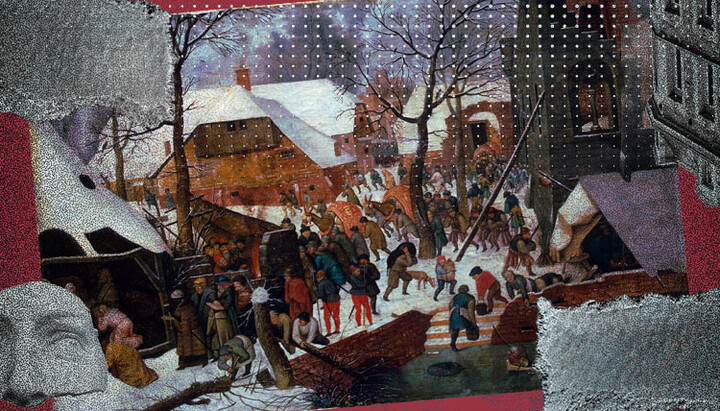
Pieter Brueghel (the Younger). The painting “The Adoration of the Magi.” Photo: UOJ
Do you feel that cold? It is not the festive kind, not the one drawn on glossy postcards dusted with glitter. This is real Flemish frost – damp, heavy, seeping through to the bone. The air feels leaden, and the sky hangs low, indifferent. We shiver with the figures in the painting; we wrap ourselves in imagined cloaks, sensing fingers go numb and faces stiffen in the wind.
Pieter Brueghel the Younger, following the testament of his brilliant father, paints “The Adoration of the Magi” and relocates Christmas from sunlit Judea to the harsh reality of a northern winter. And he does so with such conviction that the distance of four centuries dissolves. What stands before us is not scenery, but life – caught unprepared.
A curtain woven of silence
The first thing that strikes you, when you begin to truly look, is the snow. The Brueghels were among the first who dared to depict it not merely as a white carpet on the ground, but as a process, a force. Falling flakes – thousands of tiny white points – fill the entire space. This is not just a technical device. Here snow acts like a living curtain, a half-transparent veil separating eternity from everyday bustle.
Look at how this snowy filter changes our perception. It swallows unnecessary sound. We almost hear that ringing quiet in which the shouts of drivers and the barking of dogs are muffled and drowned. The blizzard makes the world intimate; it forces us to focus on the essential, cutting away everything extraneous. Snow here is the asceticism of nature itself – its way of cleansing the space for an encounter with God.
In this white noise we recognize our own condition. Is this not how we often feel today – lost in a storm of news, anxieties, and domestic troubles?
It seems to us that behind this curtain there is nothing at all. But Brueghel gently takes us by the hand and shows us: the Light has not vanished. It simply asks for silence – and an attentive gaze.
Wisdom in wet wool
Now let us find, in this crowd, those for whom everything was set in motion. Where are the majestic kings of the East? Where are their camels, their gold-embroidered coverings, their retinues of a hundred servants?
They are not here. Or rather, they are here – but the reality of the road has altered them beyond recognition.
Brueghel’s magi are not fairy-tale figures. They are tired, worn travelers.
Their costly cloaks have soaked through and grown heavy with snow. Their shoulders have hunched beneath the weight of years lived and miles crossed. Here the sages look almost like beggars, like refugees searching for shelter. There is not a grain of arrogance in them – only an utter, ringing reverence.
This detail strikes straight into the heart. We often imagine that one must come to God “in full dress” – successful, strong, impeccable. But the sages in the painting show another way. They brought not only gold, frankincense, and myrrh. They brought their weariness, their weakness, their rain-slick boots. And it is precisely in this state of “poverty of spirit” (Mt. 5:3) that they become truly great.
Gold on dirty snow
Notice the contrast the artist creates. In the middle of a gray, unremarkable village, beside a sagging shed, gold suddenly flares.
These are the gifts of the magi – elegant vessels of fine workmanship that seem almost alien in this severe, everyday world.
That gold against the gray snow is a powerful metaphor of divine presence.
God enters the thick of our “gray” daily life, into our disordered days, into our cold. And that presence transfigures everything around it. Even the dirtiest straw, in the light of that gold, becomes holy.
Something extraordinary happens here – a synthesis. Shepherds have come to the manger, people simple and direct, living by instinct and a clean heart. And the magi have come – people of intellect, of science, of higher learning. God reveals Himself to both paths. He awaits those who merely heard the angels’ call, and those who for years calculated Truth by the stars.
In the painting we see the moment when human intellect admits its own insufficiency.
All the wisdom of the world, accumulated over centuries, bends its knee before the defenselessness of an Infant.
Learned men understand: all their books and reckonings were only preparation for this single fact – the Incarnation. “And when they were come into the house, they saw the young Child with Mary His mother, and fell down, and worshiped Him” (Mt. 2:11).
A point of stillness
In our world, torn by conflict and noise, this painting becomes a quiet harbor. It does not promise that the blizzard will stop or that tomorrow will be warm. It speaks of something else.
Brueghel creates a space where the world holds its breath. Though life continues around – someone carries water, someone argues by a fire – in the lower left corner of the canvas a vortex of silence forms. There, under a roof full of holes, the living Heart of the world is beating.
It is therapy by silence. The painter teaches us: to find consolation, you do not need to flee your “winter.” You do not need to wait until circumstances become ideal.
You only need to find, in the falling snow, a “point of gold.” To find the Infant who came to share with us this cold – and this weariness.
We stand before the painting, and breathing becomes easier. The snow keeps falling, covering over our fears and grievances. And only this strange, illogical sense of warmth remains, in the midst of Flemish ice. For the Light shines in the darkness (John 1:5). And the storm cannot quench it.
Read also
A shepherd boy with a letter from Christ to French king
In the summer of 1212, thousands of pilgrims carrying staffs waited for the sea to part before them. Later chroniclers added ships, slave traders, and a pope's lament to their story.
Facade of bones and facade of light
Antoni Gaudí spent forty-three years building a church in Barcelona, knowing that this construction was for the ages.
Trial of a dead pope
Once in Rome, the body of a deceased pope was seated on the throne and put on trial. The accusation relied on a church canon that had once saved his see.
Monastery built in defiance of king
When Orthodox believers in Minsk were left with just one church, townspeople decided to build another – and even a royal decree did not stop them.
Young Mother and Sleeping Christ
Michelangelo carved a Virgin Mary who looks younger than her Son – and signed his name in marble for the only time in his life. Neither of these peculiarities was accidental.
Orthodox books from a Uniate printing press
In the 18th century, Uniate monks at Pochaiv printed books used in prayer by Orthodox Christians and Old Believers alike.