"The UOC doesn’t hold funerals for soldiers": a lie-manufacturing machine
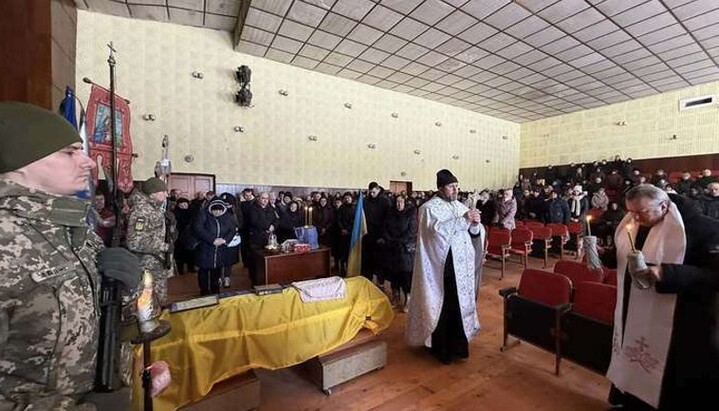
“Funeral service” by the OCU in the village cultural center of Banyliv-Pidhirnyi. Photo: Facebook / R. Hryshchuk
One of the most widespread fakes about the “Moscow” UOC is the claim that it “refuses to bury” Ukrainian soldiers. The insinuation is always the same: the priests are supposedly so eager to curry favor with the Kremlin that they deny grieving families the Church’s final prayer over their dead heroes. The OCU repeats it, the media amplifies it, MPs chant it, activists echo it – and the story is served as “obvious truth.”
We want to show a textbook example of how such fakes are produced. At the end of December, the internet exploded with indignation over an alleged refusal by UOC clergy to hold a funeral for a soldier in the Bukovynian village of Banyliv-Pidhirnyi. What happened?
Every media outlet insisted that the UOC “wouldn’t let the procession with the body into the local church,” and therefore OCU clerics were “forced” to conduct the funeral in the village cultural center. A disgrace, they said. How could anyone not be furious?
But in reality, everything was “a little” different.
The soldier’s family originally wanted the funeral service in the UOC’s Ascension Church and agreed on an exact time with the rector. Then the OCU “patriots” stepped in. A “priest” called the rector and demanded to be allowed in to “concelebrate.” When he was refused, he moved straight to threats: during the service, he said, the body would be carried out and the church would be seized. And this is not hearsay – there is a recording of the conversation.
After that, pressure was put on the soldier’s mother, pushing her to consent to a funeral rite led by an OCU cleric. Somehow, that consent was obtained. And here is the key point: the Dumenko people did not take the hero’s body to one of their two churches in the village. They chose to stage their “service” in the cultural center. Why? The answer is obvious – for the suffering-photo-op. So they could say: look, good people, see how these “Muscovites” treat Ukrainian heroes – they won’t even let the family say farewell in a church.
And it worked. Photos from the village cultural center were blasted across the media, deliberately stirring outrage and hatred in readers.
But the soldier’s mother still managed to stand her ground. Her son was taken from the cultural center to the UOC’s Ascension Church, where twenty priests served the funeral for the fallen soldier. About that, of course, nobody reported a word. That silence added one more brushstroke to the manufactured portrait of the “FSB church” that supposedly “hates our heroes.”
And if you dig into any of these cases – “refused to serve a funeral,” “hid weapons,” “wouldn’t pray for heroes” – you will find the same pattern, with minor variations: lies wrapped in manipulation, staged into an image, and sold as reality.
One day, people will start saying this out loud.
But not today.
Read also
Why is it legal to kill a person before birth but not after?
Children are the most privileged members of society. Yet that same society officially permits children to be killed – and on a massive scale.
Honoring the Bolsheviks’ successors at Kyiv Lavra
It was under the Reserve that the relics of the saints were desecrated, Lavra churches were turned into an atheism museum, and toilets were installed in sanctuaries.
"Degenerates" and "stupid animals": anti-UOC activists turn on children
Future historians will wonder how a vast country’s information agenda could have been shaped for so long by people so petty, vicious, and utterly contemptible.
Zelensky sees murder of Polish priest but not of Sviatohirsk monk
Why does Zelensky react so emotionally and swiftly to the murder of a Catholic cleric while remaining completely silent about the murder of an Orthodox monk?
UOC vs. OCU numbers: pollsters count, social media recount
Official polling suggests Dumenko’s structure has an overwhelming lead in the number of parishioners, while social media polls paint a very different picture. Which should we believe?
Who is working for the Kremlin in Poland? OCU, Uniates and Catholics versions
Who in the conflict between Poland and Ukraine is "an agent of the Russian Federation"? Zelensky, who gave the UPA name to an AFU special operations center? Nawrocki, who stripped him of an order for it? Polish MEPs?