A poet’s vow: Why Brodsky wrote a poem to Christ every year
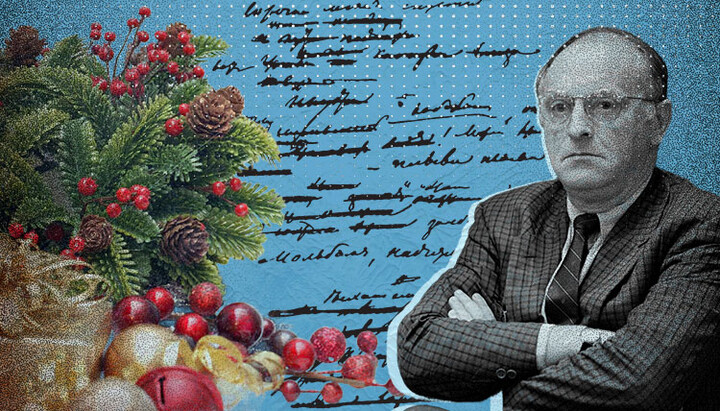
The poet who wrote hymns to God. Photo: UOJ
Winter. At this time of year the air grows dense, like cooled metal. It smells of damp wool coats, gasoline, and the premonition of something that must happen in defiance of the calendar. We move through twilight, tucking our chins into our scarves, and feel time thicken, turning into a viscous silence.
It is precisely in this silence that Joseph Brodsky, year after year, fulfilled his strange, almost impossible vow.
Beginning in 1963, he set himself a task: to write one poem for every Christmas. He did not call it a prayer. He called it a birthday gift.
Brodsky reasoned simply and soberly: when we come to a celebration for someone, we bring a gift. He had nothing but words – hard, exact, stripped of the familiar churchy “glitter.” His poems became an annual tribute from a man to his Creator – a kind of tax that mortal time pays to Eternity.
At Christmas we are all Magi – a little
We are used to seeing fairy-tale kings on Christmas cards – velvet, gold, grandeur. With Brodsky, everything is different. His Magi are you and me: wanderers in a dark, not always welcoming world. In the poem “January 1, 1965,” the poet describes the feeling with unsettling precision: we drift past shop windows, past random faces, hauling behind our shoulders invisible packs loaded with worries and anxiety.
“At Christmas we’re all Magi – a little.
In the food stores – slush, elbows, a shove.
Faces – a swarm. And no road is visible
to Bethlehem – only grainy snow above..”
For him, being a Magus is not a rank. It is a movement of the eyes. Anyone who, in the grind of weekdays, among queues and exhaustion, finds the strength to lift his head and look toward the star becomes a participant in that procession. We, too, are those “Magi” of 2026. We carry our gifts – not gold, but fidelity, patience, the courage to remain human when the circumstances give us every reason not to.
Brodsky shows that the miracle does not cancel the slush underfoot. It happens right there, inside it. Light falls on dirty snow, on the brick walls of the outskirts, on our bewildered faces. And it is precisely this contrast that makes the Nativity real. It is not “somewhere else,” framed in gold. It is here – on an overcrowded bus – if we dare to get off at the right stop.
Loneliness in the cave
Brodsky’s poetry is astonishingly honest about loneliness. We often try to disguise it with festive noise, but the poet leads us inward, into the Bethlehem cave where the cold reigns.
In his vision, Christmas is the feast of one loneliness meeting another loneliness. The loneliness of Mary, for whom “there was no room in the inn.” The loneliness of the Child, who has only just entered a world that has already prepared nails and wood for Him.
Brodsky felt with painful clarity that the Birth of Christ is the first moment in history when God becomes a victim. This is not the triumph of an earthly king. It is the moment of God’s utmost vulnerability. He entered history through its back door – tiny, defenseless.
At that point our personal loneliness suddenly stops being hopeless. We recognize ourselves in that Child who is cold. We understand that God became man so that we would never again be lonely “completely.” Even in the darkest cave of our soul, Someone is now there.
Language as an instrument of truth
Many ask: why was a poet who did not always follow church canons so bound to this theme? The answer lies in the nature of his gift. Brodsky understood that ordinary words – “happiness,” “peace,” “light” – get worn down by constant use. They become flat, like coins long withdrawn from circulation.
For him, a poem was a way to speak of the Miracle without reducing it to a children’s story. Look at his “Christmas Star” (1987). There is no bombast there. There is an “optical axis,” a “gaze out of emptiness.” He describes Christmas as a physical event: the star’s light strikes the Child’s pupil, binding the infinity of the cosmos to the human body.
“Carefully, without blinking, through scattered clouds,
from far away, from the depth of the universe,
from its other end, the star stared into the cave
at the Child lying in the manger.
And it was the Father’s gaze.”
His poems, like “Flight into Egypt,” smell of sand and fatigue. They are tactile. We feel that dry desert wind on our skin. Brodsky’s poetry is an inhalation of meaning: it clears the lungs and forces us to breathe the rarefied air of Eternity. He teaches us that faith is not a set of cozy truths, but a demanding – and at times painful – structure of honesty.
A gift without wrapping
Each year Joseph Brodsky brought this gift of verse. No bright wrapping, no ribbons. Just words placed in the only order that could hold.
What does it give us today? In a world so full of imitation, Brodsky reminds us of the value of a personal offering.
God does not need our elegant gestures. He needs our readiness to be near Him.
The poet stands in the wind of history and simply bears witness: the star is burning. It burns above our ruined homes, above our quarrels, above our fear. It burns because the Creator has come to His creation.
We stand by the window. Outside is the same slush, the same twilight. But somewhere beyond the layers of cloud and the soot of cities, a point of light is searching for our pupil. And there is only one thing left for us to do – simply to admit it: God is born.
Read also
Golgotha in the midst of a pogrom
In the autumn of 1938, the Jewish artist Marc Chagall painted the crucified Christ. Synagogues burn and refugees flee around the cross, while the Crucified One Himself is wrapped in a prayer shawl.
Stories of the Early Church. Level of governance: patriarch
How did several episcopal sees rise above the rest, why did the Church’s administrative map come to mirror that of the empire, and is the patriarchate a sacred form of Church governance?
A Chronicle without an author
We are accustomed to calling The Tale of Bygone Years the work of St. Nestor. Yet another monk left his signature on it, while the chronicle itself passed from one generation of scribes to the next.
How a wedding stopped a war
The young princess of Slutsk was married off to keep two powerful noble families from drowning the city in blood. Soon afterward, a Uniate metropolitan complained that Orthodoxy had been reborn in Slutsk.
Man before the forces of nature
A solitary figure on the shore seems insignificant before the immense power of the sea, yet it is he who stands before the Creator.
The mysteries of Golgotha in the light of archaeology
The veil of centuries obscures what really happened in the fourth century. Archaeology and ancient texts shed light on the true history of one of Christianity’s greatest sacred sites.