State and Churches: For Catholics – restitution; for Orthodox – confiscation
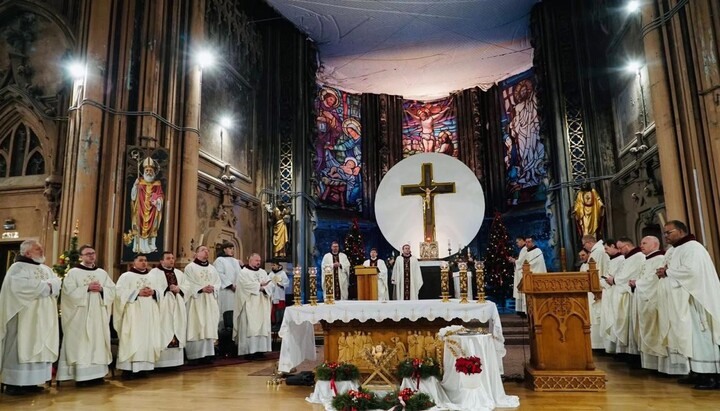
An event at St. Nicholas Church. Photo: DESS
On January 7, a ceremonial handover took place at Kyiv’s St. Nicholas Roman Catholic Church. The entire administrative elite turned up – the prime minister, the minister of culture, deputy heads of the Presidential Office, the head of DESS, and so on. Under the USSR, the church was turned into an organ hall. It remained under the Ministry of Culture even after independence. Since the 1990s, Catholics have tried to get it back, but only now have they managed to do so – and even that came after a string of scandals.
The Catholics are not entirely satisfied with what they received, because this is not the church being returned, but rather a rent-free lease for fifty years. Still, in today’s conditions even that is a major achievement: no one can say what will stand here half a century from now.
There is something else worth noticing. DESS says the transfer of the church is “an important milestone in the process of restoring historical justice and the violated rights of believers.” The agency also assures the public that it “defends the need to return religious buildings and property expropriated by the communist regime to believers.”
There is no doubt that this is a wise, state-minded position. The question is – why is it applied only to Catholics?
Shouldn’t DESS be fighting to have the Kyiv Caves Lavra returned to the Church after the Bolsheviks drove the monks out a hundred years ago and set up a “museum town” there? Of course it should. But the state not only refuses to return the monastery – it is now expelling the monks itself. It is also driving Orthodox communities out of ancient churches in Chernihiv, Volodymyr, and Kremenets.
Let us underline this again: it is not returning churches to believers – it is throwing them out. The special cynicism lies in the fact that it does so after people restored these churches at their own expense.
What is the difference between Roman Catholic believers and believers of the UOC? In theory – none. They hold the same Ukrainian passports. In practice, however, everything looks different.
We are glad for the Catholics who have received their church. But it is impossible not to see that the current authorities are dividing believers into categories in the most blatant way. Catholics and Uniates belong to the first. UOC believers are not even treated as second- or third-class. Rather, they are pushed to the very bottom.
But we are not complaining. We remember Christ’s words: whoever was last will become first.
Read also
Who destroyed and restored Kyiv Lavra? MinCulture's video reveals the truth
The Culture Ministry’s propaganda about the Kyiv-Pechersk Lavra has inadvertently revealed the truth.
Ternopil post on Feast of Intercession: Has calendar reformn failed?
A significant number of believers have rejected the new church calendar introduced by the OCU and UGCC with government support.
Shoulder straps or a cassock: who writes the script for UOC "fighters"?
Everything indicates that both Veliar and Pshenychny are ordinary performers of someone else's script. There is only one question – does the scriptwriter wear shoulder straps or a cassock?
Why is it legal to kill a person before birth but not after?
Children are the most privileged members of society. Yet that same society officially permits children to be killed – and on a massive scale.
Honoring the Bolsheviks’ successors at Kyiv Lavra
It was under the Reserve that the relics of the saints were desecrated, Lavra churches were turned into an atheism museum, and toilets were installed in sanctuaries.
"Degenerates" and "stupid animals": anti-UOC activists turn on children
Future historians will wonder how a vast country’s information agenda could have been shaped for so long by people so petty, vicious, and utterly contemptible.