Prophecies of water: Why the Jordan parted, and fire descended on the water
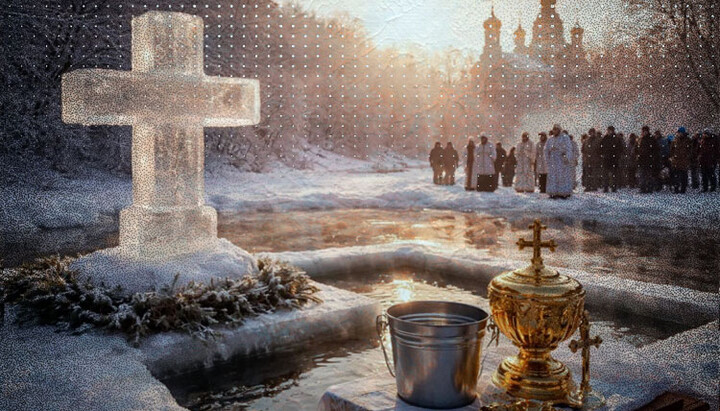
The triumph of Theophany. Photo: UOJ
On the Eve of Theophany, just like on Christmas Eve, a special service is held—the Great Hours, or, in common parlance, the Royal Hours. And although we no longer see a king at this service, we do hear many instructive and edifying biblical readings.
The cycle of Old Testament readings at the First Hour begins with Isaiah’s prophecy about the transformation of the arid desert and uninhabited land (Isaiah 35:1-10). According to the prophet, the land that once withered and dried up will come alive with the arrival of God the Savior: “And the ransomed of the Lord shall return, and come to Zion with singing, with everlasting joy on their heads. They shall obtain joy and gladness, and sorrow and sighing shall flee away” (Isaiah 35:10).
The saints see this spiritual transformation, accomplished through Baptism, in a twofold way: both public and personal.
St. Cyril of Alexandria explains: “The desert is called paganism, which was deprived of knowledge of God and existed in extreme barrenness… But this desert will rejoice when it receives the waters of Divine teaching.” And Saint Basil the Great adds: “The desert will flourish like the lily, for the grace of the Holy Spirit, poured out in Baptism, transforms the barrenness of human nature into a blooming garden of virtues.”
Cleansing of the soul
At the Third Hour, the prophecy of Isaiah (Isa. 1:16–20) is also read, but it already takes on a didactic tone. The prophet is convinced that the mere fact of the transformation of the world and man is not enough. It must be accompanied by deep repentance, followed by a virtuous life.
“Wash yourselves, make yourselves clean; put away the evil of your doings from before My eyes. Cease to do evil, learn to do good; seek justice, rebuke the oppressor; defend the fatherless, plead for the widow” (Isa. 1:16–17), instructs Isaiah.
Saint John Chrysostom comments on this passage as follows: “The Lord does not command mere bodily washing, but the cleansing of the soul from all defilement of sin. For what benefit is it to wash the body if the soul remains unclean?” St. Ephrem the Syrian writes: “When He says ‘wash yourselves,’ He points to the mystery of Baptism, and when He adds ‘make yourselves clean,’ He refers to repentance after Baptism.”
At the Sixth Hour, we again encounter the prophet Isaiah. He continues to proclaim to people the joy of Baptism. Now the prophet’s word is addressed to those who have already received spiritual grace. What is the result of such spiritual awakening? “With joy you will draw water from the wells of salvation” (Isa. 12:3), Isaiah answers.
Saint Gregory the Theologian explains: “The wells of salvation are the gracious gifts of the Holy Spirit, poured out in Baptism. Whoever approaches these waters with faith draws not merely water, but the grace of God.” St. Theophylact of Ohrid adds: “These wells are the sacraments of the Church, the foremost of which is Baptism, where a person is born into new life.”
The Holy Fathers highlighted that spiritual life is always dynamic.
It is not enough to stop at the mere reception of Baptism. A single act of repentance is also insufficient, as Protestants often emphasize. The soul must be continually nourished by the Sacraments, as by sustaining food, without which it would simply die.
Favorable time
The service of the Royal Hours concludes with the Ninth Hour, during which God’s address to humanity is read, spoken through the lips of the “Old Testament evangelist”. “In a favorable time I have heard You, and in the day of salvation I have helped You; I will preserve You” (Isa. 49:8), assures the believer their Creator.
St. Athanasius the Great comments on these words: “The favorable time is the time of the Savior’s coming, when He appeared for the salvation of all peoples. In the Lord’s Baptism, the path to adoption by God was opened for all humanity.”
And again, joy and exultation! The Lord did not come to earth merely to save us but also to make us His beloved children. This is yet another reminder that God never abandons us in our distress.
No matter who we are – sinners or the righteous – He loves us equally. From some, He expects repentance and amendment; from others, growth and steadfastness in virtue. To each, He gives a unique talent and entrusts a special spiritual portion. It is entirely up to us whether we will become worthy workers in His vineyard.
Cosmos and water
The services of the Feast of Theophany begin as early as the morning of the Eve of Theophany. After the Liturgy of S.t John Chrysostom, the Great Vespers is celebrated, during which thirteen readings from the Old Testament (paremias) are read, revealing various spiritual aspects of the feast.
The first festive paremia (parable) is taken from the Book of Genesis (Gen. 1:1–13) and recounts God’s creation of the world. You might ask, what does the process of the world’s ordering have to do with Baptism? Direct and immediate. On the very first day of creation, water appeared on the earth, over which the Spirit of God hovered. And water, as we know, is the primary element of the Sacrament of Baptism.
St. John Chrysostom says: “Just as in the beginning the Spirit hovered over the waters, so at Baptism the Spirit descends upon the waters, sanctifying them for the new creation of man.” The “waters under the firmament” and the “waters above the firmament” described in the Book of Genesis exist in different physical states: liquid and gaseous.
Such a comparison is made by the author of the Book of Genesis not by chance. It prefigures the two states of the human soul before and after Baptism: the old, sinful state, and the new one – sanctified and enlightened by Divine grace.
The sea parts
The second and third readings are borrowed from the law-giving Book of Exodus. Both are devoted to the miracles performed by Moses during the 40-year wandering of the Israelites in the desert.
At the beginning, the text describes the crossing of the Red Sea by the chosen people “on dry ground” and the destruction of the pursuing Egyptians in its waters (Exodus 14:15–18, 21–23, 27–29). “The sea, which parted before Moses, prefigured the font of Baptism, in which the imagined Pharaoh – the devil with his host – perishes,” writes St. Ephrem the Syrian.
The Israelites crossed to the other shore of the sea unharmed and dry. Likewise, the baptized person, having received grace in the Sacrament, remains unharmed by the snares of the evil one. Even if temptations befall them in life, they do not bring deadly harm.
The next reading is also devoted to water. It tells of the sweetening of the bitter waters of Marah by casting a tree into the spring (Exodus 15:22–16:1). This event prefigures how immersion in the font, through the image of Christ’s Cross, makes the waters of Baptism healing. St. Cyril of Alexandria notes: “The tree that sweetened the bitter waters is a symbol of the life-giving Cross, by which the waters of Baptism are sanctified.”
The Jordan parts
The fourth baptismal reading is taken from the Book of Joshua (Josh. 3:7–8, 15–17). The fact that the personality of the Israelite leader prefigured the person of the Lord Jesus Christ requires no further comment. The main achievement of the army under his command was the conquest of the Canaanite city of Jericho – the stronghold of the Promised Land.
During this victorious campaign, the soldiers needed to cross the turbulent waters of the Jordan (again alluding to the site of the Lord’s Baptism). By God’s Providence, the same miracle occurred here as at the Red Sea. First into the water went the priests carrying the chief sacred object – the Ark of the Covenant – and the waters parted before them.
Blessed Theodoret of Cyrrhus resumes: “Just as Joshua led the people into the Promised Land through the Jordan, so Christ leads us into the Kingdom of Heaven through Baptism.”
The next two readings are also connected with the waters of this river. The fifth reading (2 Kings 2:6–14) presents the image of the prophet Elijah passing on spiritual authority to his successor Elisha during the crossing of the Jordan. Elijah removes his mantle (the distinctive cloak of Israelite prophets), strikes the water with it, and the waters part again before the righteous. After this miracle, Elisha asks his teacher: “Let the spirit that is in you rest upon me twice as much” (2 Kings 2:9).
So it happened after Elijah was taken up to heaven in a fiery chariot. Elisha became the possessor of his mantle and performed the same miracle on the Jordan with it. “The mantle of Elijah, which divided the Jordan, prefigures the grace of Baptism, which separates the old man from the new,” affirms St. Gregory the Theologian.
Healing of leprosy
The text of the sixth reading is also taken from the Fourth Book of Kings. But here we see a different hero – Naaman the Syrian. He was a commander of the king’s army, yet he suffered from a severe illness – leprosy.
The commander turned to the prophet Elisha for healing. Knowing the miraculous properties of the Jordan, the prophet instructed the sufferer to immerse himself seven times in its waters, after which the disease was cured. From that moment, Naaman radically changed his life, renounced idolatry, and believed in the God of Israel.
St. Ambrose of Milan explains the miraculous healing in this way: “Just as Naaman was cleansed of leprosy in the waters of the Jordan, so we are cleansed of the leprosy of sin in the waters of Baptism.”
The following readings are devoted to the stories of the Jewish patriarchs and judges. The eighth reading at the Baptismal Vigil tells us of Jacob’s encounter with angels and their taking him under heavenly protection (Gen. 32:1–10).
This story reminds the believer that after Baptism, the constant guardians of the soul become the angels of God.
“In Baptism, a person receives angelic protection to fight against spiritual adversaries,” St. Ephrem the Syrian believes.
The city where this revelation appeared to Jacob was called Mahanaim (Hebrew: “two camps”). Presumably, this was because the patriarch encountered two angels. St. Cyril of Alexandria sees in the image of the double camp a double Divine protection for the baptized: both heavenly and earthly.
An infant in a basket
The ninth reading is again taken from the Book of Exodus (Exod. 2:5–10). It recalls the childhood of Moses and the story of how, while still an infant, he was saved from the waters of the Nile by Pharaoh’s daughter. She had the child’s mother brought to the palace – the very woman who had placed her son by the river in a reed basket so that the Egyptians would not kill the Hebrew child. The one who was saved was then given the name Moses, which means “taken out of the water”.
St. Gregory of Nyssa notes: “Just as Moses was saved from the waters, so we are saved by the waters of Baptism.”
The tenth reading takes us back to the era of the Judges, when the Israelites were ruled by military and spiritual leaders who proclaimed to them the will of God. One of these leaders was Gideon, a military commander who fought against paganism and defeated the hostile tribe of the Midianites.
The Book of Judges (Judg. 6:36–40) recounts the miracle of Gideon’s spiritual strengthening before the battle against the pagans. The leader spread out a wool fleece on the threshing floor and promised the Lord that if in the morning, only the fleece was wet with dew while the ground around it was dry, Gideon would march forth victoriously against the enemy.
In the morning, the ground was dry, but from the fleece the commander wrung out a whole bowl of water. The next morning, the miracle occurred in reverse: the fleece was dry, and the ground around was wet with dew. Then Gideon fully entrusted himself to God and won the desired victory.
A spiritual interpretation of the symbolism of the dew on the fleece was offered by St. Augustine. “The dew on the fleece is an image of the grace of the Holy Spirit, which is abundantly poured out in Baptism,” he writes.
Since then, the phrase “dew-wet fleece” has become a theological metaphor, often used in spiritual literature and akathists.
The Holy Fathers also see in the image of the wet fleece the Most Holy Theotokos, upon whom the Holy Spirit rested. Thus, St. Dimitry of Rostov devoted one of his books to the history and miracles of the Chernihiv–Ilyinsk Icon of the Mother of God, giving it the same title – “The Dew-Wet Fleece”.
Fire upon the water
The concluding paremias of the Vespers of the Feast of the Lord’s Baptism are once again devoted to the prophet Elijah and his faithful disciple and successor Elisha. The eleventh reading recounts the miraculous descent of fire upon the altar to the God of Israel in response to the prayers of Elijah (3 Kings 18:30–39).
During a prolonged drought, people began to realize that no one but the higher powers could help them avoid famine. Thus began a religious contest between the college of priests of the god Baal and Elijah, who was spiritually strengthened by the Creator of the Universe Himself.
The essence of the contest was to build two altars: one for the One True God and one for Baal, to offer prayers and rituals before them, and then observe the natural phenomena. The true God would be recognized as the One whose altar would ignite with a fiery glow. After the prophet’s fervent prayers, interspersed with the incantations of the pagans, Elijah's altar was set aflame. This miracle became the starting point for the destruction of the Baal cult that was dominant in Israel at the time.
What is the connection between this story and the Sacrament of Baptism? St. John Chrysostom explains: “Just as fire descended upon Elijah’s sacrifice, so the Holy Spirit descends upon the waters of Baptism.” This comparison is also Bible-based. Let us recall the descent of the Holy Spirit upon the apostles on Pentecost in the form of tongues of fire.
The next parable again focuses on the miracles of Elisha by the waters of the Jordan (2 Kings 2:19-22). The state of the water in the river near Jericho had deteriorated, which affected the irrigation of the nearby lands. The prophet chooses a rather effective way to prevent an ecological disaster – to throw salt into the Jordan. “I have made this water healthy; from now on it will no longer cause death or barrenness” (2 Kings 2:21), Elisha comforted the townspeople.
St. Cyril of Jerusalem compares the prophet to Christ and speaks of how the purification of the Jordan River with salt became a pre-image of their sanctification during the Baptism of the Lord.
Finally, the concluding 13th parable is the loud and joyful proclamation of the prophet Isaiah about the coming of the Lord, Who "has comforted His people, and will have mercy on His afflicted." (Isaiah 49:13). "This prophecy is fulfilled in Baptism," states St. Athanasius the Great, "where God makes a new covenant with us and grants the comfort of salvation."
Reading these lines, one begins to understand that all our sufferings take on an entirely different meaning.
We despair, lose hope, and suffer not because God does not love us, but because we do not love God. Not because God does not want to free us from our sins, but because we ourselves do not want to turn away from them.
The triumph of the Feast of the Lord’s Baptism has already begun! "Let us purify our senses, and we shall behold” Him – the sinless God, humbly descending into the waters of the Jordan to sanctify them. And together with them, to sanctify us, servants of sin, who sincerely and wholeheartedly wish to become servants of God.
Read also
The Weeping Queen of Blachernae
On the night of the Feast of the Protection, only two people witnessed the miracle in the Church of Blachernae. Everyone else prayed and saw nothing. Yet they, too, received grace.
Deadly spiral of human hatred
The tragedy of Lebanon's civil war lays bare how dehumanization and fear can turn human beings into monsters.
Woe to expectant mothers – or to those of little faith?
God commanded one prophet not to have children, yet told his people in exile to bear sons and daughters. What does this apparent contradiction tell us today?
The help God never asked for
Uzzah wanted only to keep the Ark of the Covenant from falling into the dust. Why did this well-intentioned act cost him his life, and who was really responsible for his death?
Freedom begins when there's nothing left to take
Fear of persecutors takes root in our attachment to possessions. We turn to St. Basil the Great to understand why the prefect's threats held no power over him.
The bride in the window frame
The author of the earliest account of St. Thecla’s life was defrocked. Yet it was his book that preserved the only ancient description of the Apostle Paul’s appearance.