Can a Christian betray?
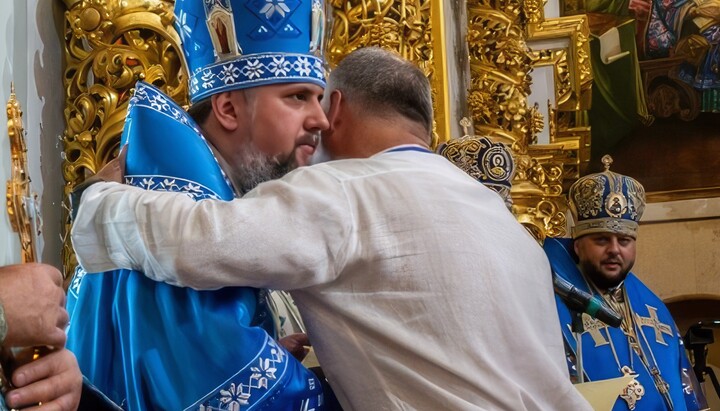
Dumenko embraces Ostapenko. Photo: OCU
In court, recordings from NABU are being played – conversations with an unknown MP in which Tymoshenko is visibly anxious that she might be recorded and takes every possible precaution. The deputy who brought the recording device listens, nods sympathetically, and keeps recording. He knows that because of these tapes Tymoshenko could end up in prison for many long years, and yet he does it anyway. Yes, what Tymoshenko is doing (and is it only her?) is criminal and wrong. But how should we judge the deputy’s act?
A reader might say that at the top levels of power such behavior is normal – people with a different moral code simply do not climb that high. But how should we react when the same behavior is displayed by people in cassocks?
On January 15, the head of the Lavra reserve once again became Maksym Ostapenko. He is an open enemy of the Church and a loyal ally of the OCU, who has done a great deal to strengthen this structure in the Kyiv-Pechersk Lavra. Yet here is the paradox: after Ostapenko was unexpectedly dismissed in May 2025, the OCU leadership immediately poured tons of filth on him.
Back then, Zoria wrote that Ostapenko had been making efforts “so that the Lavra could not function fully as a Ukrainian monastery, so that there would be as few services as possible”; that “at all meetings and in all memos he spoke about the fact that the OCU ‘does not want, does not wish, is not capable.’” In short, the OCU accused Ostapenko of lobbying “the Russian world” in the Lavra. We may laugh – but for “patriots” this is a serious accusation. And it was made, let us recall, not in open conversation, but as a stab in the back to a dismissed official. What moral standard do we see here?
Exactly the same one we saw in the case of Filaret Denysenko. Dumenko and Zoria – whom he raised and “brought into the world” – deceived him and paraded him as a senile old man. Yes, Filaret is hardly a model of honesty and virtue himself, but that does not cancel one simple fact: his closest disciples betrayed him. And returning to Tymoshenko’s trial, one wants to ask: how do the actions of the people in her case differ from the actions of the OCU leadership? In principle – not at all. As the saying goes: nothing personal – just business.
Only where, in all this, is Christianity?
Read also
Shoulder straps or a cassock: who writes the script for UOC "fighters"?
Everything indicates that both Veliar and Pshenychny are ordinary performers of someone else's script. There is only one question – does the scriptwriter wear shoulder straps or a cassock?
Why is it legal to kill a person before birth but not after?
Children are the most privileged members of society. Yet that same society officially permits children to be killed – and on a massive scale.
Honoring the Bolsheviks’ successors at Kyiv Lavra
It was under the Reserve that the relics of the saints were desecrated, Lavra churches were turned into an atheism museum, and toilets were installed in sanctuaries.
"Degenerates" and "stupid animals": anti-UOC activists turn on children
Future historians will wonder how a vast country’s information agenda could have been shaped for so long by people so petty, vicious, and utterly contemptible.
Zelensky sees murder of Polish priest but not of Sviatohirsk monk
Why does Zelensky react so emotionally and swiftly to the murder of a Catholic cleric while remaining completely silent about the murder of an Orthodox monk?
UOC vs. OCU numbers: pollsters count, social media recount
Official polling suggests Dumenko’s structure has an overwhelming lead in the number of parishioners, while social media polls paint a very different picture. Which should we believe?