Megapolis desert: How to find God in the roar of news and the hum of thoughts
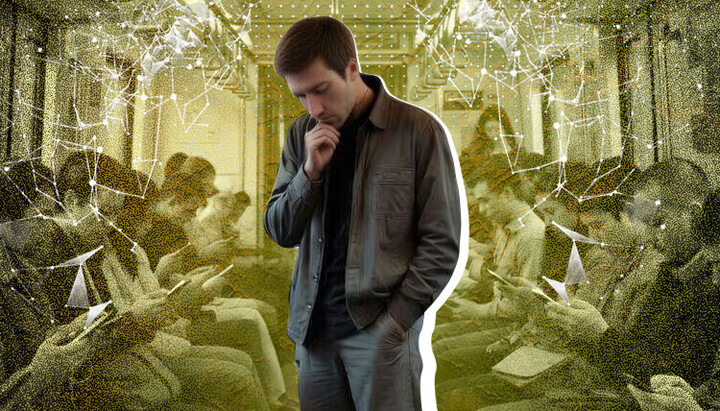
The desert of the megapolis. Photo: UOJ
“The beginning of the Gospel of Jesus Christ, the Son of God” – with these words the Sunday reading of Scripture begins. Mark, unlike Matthew or Luke, omits the genealogy and the Nativity and goes straight to the heart of the matter. The Bible begins with the words “In the beginning.” The word “beginning” (ἀρχή (arche)) also opens the Gospel according to Mark.
But if in the Old Testament “the beginning” signified the emergence of matter and time, here “the beginning” means the invasion of the Eternal into the temporal. And the place where the Eternal lays the beginning of the unveiling of His design is the desert.
Everything a Christian does in life is the laying of a beginning to an encounter with God. We seek this encounter in church, in public or personal prayer, in hope of the life of the age to come, or in the sorrows of the present age.
The noise that steals God
But what is important to understand is this: the place of that encounter can only be the desert. In the noise of the megapolis it is impossible to find God. People talk about Him there endlessly. Preachers advertise Him there – preachers who have never seen Him. And this concerns not only the outer world, but also the inner megapolis.
The piercing roar of commuter trains – thoughts hurtling past at full speed; the countless car horns of news feeds; the neon glare of emotions that cuts the eyes – all of it blinds and deafens. The megapolis steals from us “the beginning,” replacing it with unending noise, notifications, and social roles. In that din our mind is shattered into a thousand fragments and sinks into the deepest distraction.
This is a kind of “hell” – a place where the bond with eternity has been severed.
John the Forerunner in the desert ate locusts and wild honey. And we feed on the internet’s “emotional fast food.” It does not satisfy. In the desert of the megapolis, the “wild honey” of grace can be found only in very harsh places – there, where you can descend into the very depths of human suffering, pain, and grief. The chance to serve Christ in a suffering person – that is the food of the desert. It is bitter as locusts, but it gives strength to our spirit.
The desert of indifference
In the Sahara you are alone because there is no one there. In the city you are alone because there are too many people – and yet there is no one you can call in the middle of the night when you are in need. There may be plenty who are ready to share with you the joy of Tabor, but there is no one willing to stand beside you when you suffer on the Cross.
This is the desert of indifference. In it people stuff themselves with external bustle in order to drown out the inner emptiness.
The philosopher Meister Eckhart once said something remarkable about this: “God finds no place in you as long as you are full of yourself.” While we are packed to the brim with our thoughts, feelings, and desires, fear will live in us – and fear gives birth to hatred. So what are we to do?
The rule of small pauses
We must learn to create the space of the desert in everyday life – and retreat there, if only for a little while. In the middle of the day, at work or at home – it does not matter where – “die” to everything and everyone, if only for a brief time. When you ride the subway or a minibus, do not reach for your phone. Stop scrolling the news feed or watching short videos.
In practical theology this is called “the rule of small pauses.”
Find time in your day for complete inner silence. Without the phone, without music, without thoughts. Let this be your daily descent into the depths of the spiritual heart.
The desert is not sand. It is inner quiet, where there are no thoughts, no desires, no fears – where you are alone with yourself. In that solitude your inner “voice of one crying in the wilderness” is born. In that moment become like a mother who has lost her child in a crowded Eastern market. She does not “utter words” – she cries out with her whole being, hoping to find her child.
So should our cry to God be. It may be the Jesus Prayer, or some other. It is the cry of a perishing man whose only hope is that Heaven will hear him and answer.
Citadels of silence
In hesychasm this is called “noetic work,” the work of the mind. You do not need a cell on Athos for it – it can be the passage between subway stations, or a city bus stop. Even in a big city there are always places where the density of informational noise is lower.
Nature is the first “text” written by the Creator.
Find a tree or a bench in a park, or a place in a library reading room. These rooms are the last citadels that still preserve their astonishing silence and the energy of concentration. The Jesus Prayer is perfect for the city. It easily synchronizes with steps and breathing.
Try spending one hour a day in a state of “informational fasting.” Simply walk down the street, contemplating the mysterious faces of passersby – icons. St. Theophan the Recluse advised us to “shut ourselves up in the cell of the heart.” Inside us there is a mysterious room. In that room there is a door that leads into another world. Behind it lives God.
A speck of dust on sandals
Imagine you are standing alone, in darkness, on the roof of a giant skyscraper. Below – millions of lights, noise, commotion. Above you – the silent, starry sky. And in that moment you understand that everything we considered ours – education, savings, social status – is a thin cobweb blown away by the wind of time.
Our very “I” is only a tiny speck of dust on the sandals of Him who came to be baptized in the Jordan.
That is what the Forerunner felt, standing before Christ. John the Baptist – the possible limit of human perfection – falls down at Christ’s feet because he knows: the difference between his holiness and the Godhead is infinity. The distance between John and Christ is an ontological abyss that a human being cannot cross by himself. He can only humbly beg that God would stretch out to him a hand of help. But we live otherwise.
The mystery of the unloosed sandal
In a world where everything is available with a click, a person has lost the sense of distance before Eternity. He decided to subdue “God” as well – to bend Him to his desires and make Him convenient. The saints felt something entirely different. The closer they stood to the Light, the more clearly they saw their nothingness in comparison with the Divine majesty. The more sinful they considered themselves. This is not self-abasement, but reality as a person experiences it when standing before the glory of God.
That is why John the Forerunner says: “I am not worthy to loosen the strap of Your sandals…” In these words lies the long-forgotten foundation of Christian leadership.
The higher a person stands in the spiritual hierarchy, the more he recognizes his nothingness before God – and the more sincere is his desire to become a servant to others.
Let us stop considering ourselves the center of the universe and thinking that all events of world history revolve around our fate. Let us learn to loosen the sandals of those whom our ego considers beneath us. For every person bears the image of Christ.
Read also
From love spells to bishop's throne
Antioch's greatest sorcerer sent demons against a humble Christian girl three times and was defeated three times. A demon himself led him to the truth.
The Weeping Queen of Blachernae
On the night of the Feast of the Protection, only two people witnessed the miracle in the Church of Blachernae. Everyone else prayed and saw nothing. Yet they, too, received grace.
Deadly spiral of human hatred
The tragedy of Lebanon's civil war lays bare how dehumanization and fear can turn human beings into monsters.
Woe to expectant mothers – or to those of little faith?
God commanded one prophet not to have children, yet told his people in exile to bear sons and daughters. What does this apparent contradiction tell us today?
The help God never asked for
Uzzah wanted only to keep the Ark of the Covenant from falling into the dust. Why did this well-intentioned act cost him his life, and who was really responsible for his death?
Freedom begins when there's nothing left to take
Fear of persecutors takes root in our attachment to possessions. We turn to St. Basil the Great to understand why the prefect's threats held no power over him.