Dragon's lair: Why did the Jordan reverse its flow?
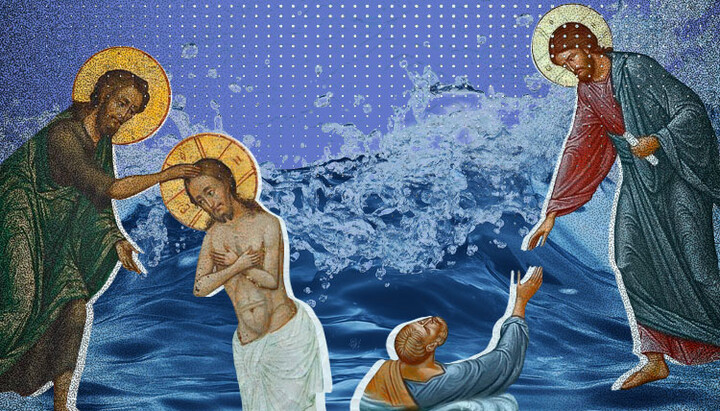
God - the Conqueror of the elements. Photo: UOJ
If you go on social media on January 19, your feed will be flooded with photos of happy people in ice holes. The Baptism of the Lord has transformed in mass consciousness into a mixture of winter wellness and folk folklore. We go after holy water as if it were an energy drink, plunge into the icy jordan to "recharge our health" for the year ahead. It all looks beautiful and… completely safe. But if we look at ancient icons of the feast, we begin to feel uneasy.
Look closely at Byzantine frescoes of Theophany. Often at Christ's feet, in dark waters, iconographers depicted strange, frightening figures: little people fleeing in panic, or serpents coiled in rings. These are not decorative fish. These are inhabitants of the abyss.
The ancient Church saw in the events on the Jordan not a peaceful washing, but the beginning of a fierce battle. God enters enemy territory. He invades the element that for centuries belonged to death and chaos, to strike at the very heart of darkness.
Water as a threat
For modern man, water is comfort. It's a warm shower, a beach, a cooler in the office. But for a person of the biblical era, great water is always fear.
In Old Testament consciousness, the sea and depths were associated not with rest, but with death and uncontrolled chaos.
Water is the element that destroyed the first world during the Flood. This is Tehom – the great abyss, where Leviathan and other monsters hostile to man live.
The geography of the Jordan only intensifies this dark symbolism. Have you thought about where this river flows? The Jordan originates in the heights and rushes downward, flowing into the Dead Sea. This is the lowest point on the planet's surface, a deep depression where there is no and cannot be life. The Jordan is literally a stream flowing into death, into the underworld of the earth.
Christ descends into this "death loop". He goes there not as a tourist admiring the views, and not as a pilgrim wishing to be cleansed. He doesn't need purity – He Himself is the Source of purity. He enters this murky, heavy, seething mass, as a sapper enters a mined basement. Water at that moment was not just the chemical compound H₂O. This was a concentrated substance of human fear, sin and hopelessness, accumulated over millennia. And somewhere there, at the bottom, in this metaphysical darkness, ancient evil lurked.
Panic of the elements
Sacred Scripture describes nature's reaction to this invasion very emotionally. In the Psalter, there are amazing lines that we hear in church, but rarely think about their meaning: "The sea saw it and fled; the Jordan turned back." (Ps. 114:3).
Why did the river flow backward? Romantics would say – from joy. Theologians would say – from horror.
The element, accustomed to being a bearer of death, suddenly encountered the Author of life.
Darkness cannot bear Light of such intensity. The waters of Jordan "fled," trying to push out of themselves the One who was for them a foreign, burning element.
This was a meeting of two worlds. The fallen world, where the law of the strongest and the law of decay rule, and the Kingdom of Heaven, which burst into our reality. The Church, speaking of this day, emphasizes the global nature of the event: "Today the Master hastens to Baptism, to raise humanity to the heights." But to raise to the heights, one must first descend to the very bottom.
Hunting Leviathan
The main purpose of this descent is not simply to "bless water", making it suitable for drinking and sprinkling apartments. The goal was far more formidable. Saint Cyril of Jerusalem in his "Catechetical Lectures" formulates this with the utmost clarity of a warrior: "Since the dragon nested in the waters, He descended into the waters to bind the strong one."
Christ goes into the water to meet this "dragon" face to face. This is a direct reference to the prophecy of King David: "You divided the sea by Your strength; You broke the heads of the sea serpents in the waters." (Ps. 74:13). Note: not "petted," not "tamed," but broke.
Theophany is an act of demilitarization of evil. The devil, who considered matter and death his domain, his impregnable bunker, suddenly discovers that it no longer has a safe place.
God finds it even under the thickness of waters. Christ destroys the power of evil in its own lair. He transforms water from a grave into a source of life. What previously killed (flood, storm, abyss) now becomes the matter of Sacrament. Water becomes a conductor of grace, because the Victor has been in it.
Light in our chaos
What does all this mean for us? We understand like no one else what chaos is. War, uncertainty, fear for loved ones – this is our "dark water". Sometimes it seems that this black icy thickness closes over our heads, and there's nothing left to breathe. We feel like grains of sand carried by the mad stream of history to some Dead Sea of our own.
The Baptism of the Lord is the most powerful message of hope precisely for such a situation.
God does not stand on a safe, dry shore, shouting instructions to us: "Swim harder!" He doesn't throw us a life ring from the deck of a distant ship. He dives to us.
He enters our icy flow. He descends into our basements, into our trenches, into our destroyed homes. There is no depth of despair where God is not present. There is no darkness too dense for Him.
If Christ was not afraid to enter the Jordan, teeming with spiritual monsters, then He is not afraid to be in our lives, no matter how badly they may be mangled by war. He is here to "break the heads of the sea serpents" – our fears, our hatred, and our helplessness.
Don't seek magic and fear chaos
When you come to church for holy water, remember: this is not a magic potion. Water acquired special power not because an "incantation was read" over it, but because it was touched by the Victor.
Don't fear the dark water around. Don't fear chaos. The Lord Himself has already descended into this abyss and paved a path through it. The dragon is defeated. The Jordan reversed its flow. Death lost its last word.
Read also
Prayer commemorations instead of loving embraces
At every Orthodox wedding, the choir sings a hymn to the martyrs. For families separated by war, these words carry a special meaning.
Honest atheism vs. spiritual hypocrisy
The 70th anniversary of Albert Camus’s Nobel Prize recalls an uncompromising challenge to Christianity. An honest unbeliever brings theology back to the mystery of the Cross.
The valley of trouble and the gateway of hope
One soldier buried an expensive cloak and some gold beneath his tent. Because of this, all Israel lost a battle. Why did one man’s sin bring disaster upon an entire nation?
From love spells to bishop's throne
Antioch’s most powerful sorcerer sent demons against a devout young Christian woman three times – and failed every time. In the end, a demon himself revealed the truth that led to his conversion.
The Weeping Queen of Blachernae
On the night of the Feast of the Protection, only two people witnessed the miracle in the Church of Blachernae. Everyone else prayed and saw nothing. Yet they, too, received grace.
Deadly spiral of human hatred
The tragedy of Lebanon's civil war lays bare how dehumanization and fear can turn human beings into monsters.