Perfection trap: A conversation with Saint Nektarios about “holy” egoism
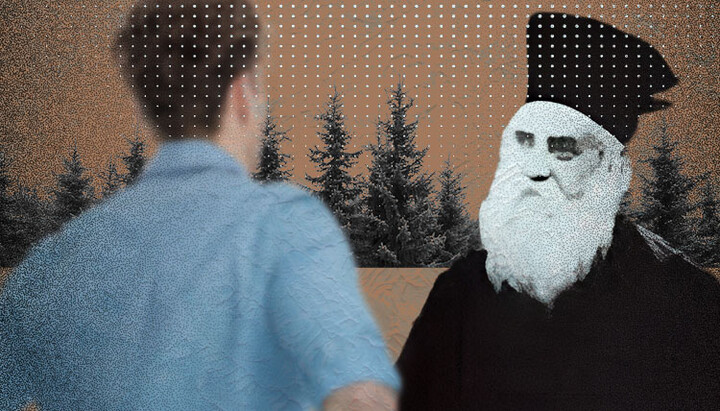
"Your hysteria is not repentance." Photo: UOJ
In Saint Nektarios’s cell, the air smells of old paper and lamp oil. Beyond the window the sea murmurs – dull, rhythmic, as if some enormous animal were breathing in its sleep. The hierarch himself sits at a plain wooden table, carefully copying the notes of Byzantine hymns. The scratch of his pen is the only sound breaking the stillness – until I burst into that stillness.
I did not come for wisdom. I came because something inside me is tearing apart. Only this morning I gave myself my word: don’t get irritated, don’t judge, be a real Christian. A day passed – and I fell again. I snapped at those close to me, condemned a colleague, drowned in petty resentments.
“Geronda, it’s useless,” I almost collapse onto the rough bench by the door. “I’m hopeless. I make promises to God and then break them right away. I’m a rag. Maybe I should stop going to church altogether, so I don’t disgrace Christ with my hypocrisy.”
The bishop sets down his pen. He does not rush to comfort me, does not pat my head. He looks at me attentively over his glasses, and in his gaze there is not pity, but the calm curiosity of a researcher.
“Tell me, my child,” his voice is quiet, but every word falls with the weight of stone, “for whom are you weeping so bitterly right now? For Christ, whom you have saddened? Or for yourself – who turned out not as beautiful and strong as you imagined?”
A shattered mirror
The question knocks the breath out of me. I fall silent. Nektarios rises, goes to the shelf, and takes a small mirror in a simple frame.
“Look,” he says. “All our life we build an idol inside ourselves. We mold a statue called the ‘Ideal Me’. This idol is pious; it never gets angry; it is wise and self-possessed. We admire that image. And when we commit a sin, we weep not because we have betrayed Love. We weep because our beloved idol has fallen and shattered.”
He sets the mirror before me.
“Your hysteria is not repentance. It is wounded pride.”
You were certain you were an A-student, a spiritual athlete. And it turns out you are a weak man who can barely stand. What hurts you is not the sin, but the fact that reality did not match your fantasies of your own holiness.
I remember Judas and Peter. Both betrayed. Both made a catastrophic mistake. But Judas looked at himself, recoiled from what he saw, and could not live with it – he went into the night and hanged himself. Peter also looked at himself – and then he lifted his eyes to Christ. And he ran not to a rope, but to the Teacher.
“Excessive sorrow for one’s sins, reaching the point of despair, comes from pride and arrogance,” the saint continues.
“The humble man is not surprised by his fall. He knows he is weak. He knows that without God he can do nothing. And so, when he falls, he does not lie in the mud cursing himself – he simply gets up, shakes himself off, and says: ‘Lord, forgive me. Again I could not manage on my own. Help me.’”
God loves the weak
“But doesn’t God want us to be perfect?” I ask. “Isn’t it disgusting to Him to look at my filth?”
Nektarios smiles, and the creases at his eyes gather into warm rays.
“God does not need your sterility,” he says. “He needs your heart. Do you know why the Lord allows us to fall? So that we do not become demons. If everything worked out the way you planned, if you could fulfill every commandment with ease, within a month you would become so proud that no one could come near you. You would look at sinners the way one looks at insects.
“That is why God sometimes withdraws His hand and lets us fall – so that we understand: we are not sources of light; we are only mirrors. And a mirror does not shine by itself; it only reflects the sun.”
He takes a book of the Apostle Paul from the table and reads: “But He said to me, ‘My grace is sufficient for you, for My strength is made perfect in weakness’” (2 Corinthians 12:9).
“Do you hear it? In weakness! Not in your heroic feats, but in your honest confession of frailty. When you say, ‘I cannot,’ God answers, ‘But I can.’ Your perfectionism builds a wall between you and Heaven. You are trying to earn salvation like wages, handing God a list of achievements. But salvation is a gift. It is not given to straight-A students, but to those who know how to accept help.”
Learn to walk
Outside, dusk thickens. The sound of the sea grows louder. I sit in the cell’s half-dark and feel the heavy stone in my chest begin to crumble into sand.
“Imagine a child learning to walk,” Nektarios says, taking up his pen again. “He takes a step and flops down. What does he do? Does he sit on the floor and engage in self-flagellation? Does he analyze the trajectory of his fall? No. He reaches his hands toward his father to be lifted up. And the father is not angry. The father rejoices that his son is learning.
“‘Holy’ egoism is when I want to be holy for my own sake – so that I can be pleased with my reflection. True holiness is when I forget myself and look only toward God.”
“Go, my child,” the hierarch says, dipping his pen into the inkwell. “And do not fear your mistakes. Fear getting stuck admiring them. ‘A broken and contrite heart God will not despise’ (Psalm 50:19). A contrite heart is not one crushed by despair. It is one that has broken its pride so that it may let Christ in.”
I step out into the cool Greek night. The stars hang low, like little lamps before icons. I am the same weak man, who tomorrow may stumble again. But I no longer fear it. Because I know: God is waiting for me not on a pedestal of honor, but down there – ready to catch me the moment I call.
Read also
Faith is not a checker piece in a spectator sport
Arguments about faith on social media increasingly resemble no-holds-barred fights. We turn to a saint who, sixteen centuries ago, knew how to speak to those interested only in turning theology into a combat arena.
The metropolitan who fought with a pen
St. Cyprian of Kyiv was robbed, expelled, and barred from his see. He answered with letters, books, and canons – and before his death, forgave everyone.
Loneliness under one roof
Spouses can share a home for years, raise children, and faithfully attend church – yet remain strangers to each other.
The cross – the deepest healing of the human soul
Emotional exhaustion and anxiety have become a way of life. Ancient Christian tradition offers an unexpected way out – embracing one's own cross.
The Prophet Elisha and the mystery of the Bethel massacre
The story of the prophet Elisha and the two bears seems to be the harshest in the Bible. But in reality, it carries a profound theological meaning.
Why does God remain silent in times of trial?
After months of praying for a loved one’s healing and salvation, we hear nothing from the Creator but agonizing silence. How can we endure the long wait for an answer?