Refuse to endure no power and heat? You’re an "FSB-MP agent"
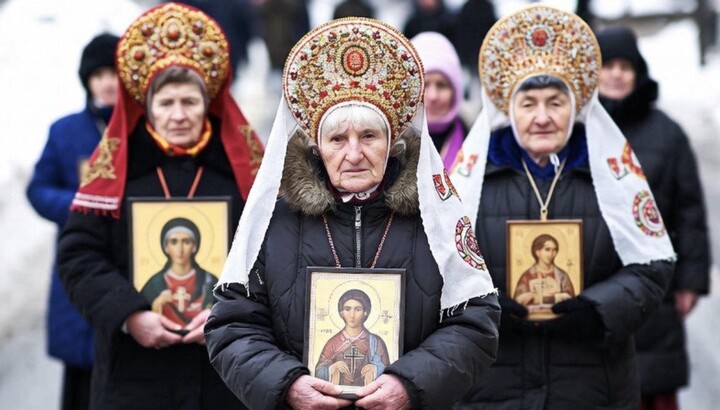
An AI-generated image posted by the secretary of the Khmelnytskyi city council. Photo: Didenko's Facebook
The government's policy of turning the UOC into "enemies of the people" has reached a new level. Now officials are calling not real UOC parishioners "FSB agents", but those who need to be discredited.
In Khmelnytskyi, local residents organized a rally against unfair electricity blackout schedules, according to which residents of some districts receive power for only a couple of hours. Local authorities are accused of corruption and unprofessionalism.
And how do you think the authorities reacted? Did they report on the energy situation? Did they present a plan to improve the situation? Of course, not. City Council secretary Didenko simply called the protesters "parishioners of the Mosparhate," and consequently – "FSB agents".
Why did he write this? The answer is simple – over recent years, the authorities, with media support, have turned UOC parishioners into enemies. Therefore, everyone who needs to be discredited today will now be called "Mosparchate" by officials. The logic is simple: if you don't agree to silently endure cold and blackout – then you're not a patriot, you're an enemy.
Khmelnytskyi residents were outraged by this on social media.
"I understand that everyone who disagrees with the authorities' actions – they're all FSB and KGB, a very convenient excuse for the authorities," wrote Andriy Khamsky.
"In our country, you're either a victim or FSB, how conveniently they came up with that," writes Vadim_ka.
"Such a number of people – and all FSB in one place? Who will believe this?" asks Valentyn Melnyk.
"Yes, women with small children – these are exactly FSB agents, and their children are FSB bosses," ironically writes Nadya Ponomarenko.
"Excuse me, but what does the UOC-MP have to do with this? Did people come out with signs saying 'we're from the UOC-MP'? Or maybe there were priests there? What stupid people. Doesn't anyone understand that Didenko simply shifted the blame from power outages to the UOC-MP," writes a commenter with the nickname S.
"What are you talking about, have you lost your minds, what kind of dog nonsense is this, what FSB MP? What does faith have to do with it, the question is about electricity," Galya Shvets is outraged.
"Considering how the regional energy company and local authorities are committing genocide against Khmelnytskyi residents – they are exactly the FSB agents," writes Vadim.
"What? Did it hit its head? Now everyone who is against corrupt authorities – they all serve rushka? Vile scoundrel," wrote Sasha M.
"Whoever dared to speak out is a spy, FSB, traitor and generally – a subhuman. When they say that fascists are in power, perhaps today, as of 2026, there is some truth in this, unfortunately," writes Mr. J.
There are much harsher comments that show: Ukrainians are not as stupid as the brazen officials are used to considering them. And the propaganda about "FSB agents" from the UOC doesn't "work" on them.
The system is cracking.
Read also
Ternopil post on Feast of Intercession: Has calendar reformn failed?
A significant number of believers have rejected the new church calendar introduced by the OCU and UGCC with government support.
Shoulder straps or a cassock: who writes the script for UOC "fighters"?
Everything indicates that both Veliar and Pshenychny are ordinary performers of someone else's script. There is only one question – does the scriptwriter wear shoulder straps or a cassock?
Why is it legal to kill a person before birth but not after?
Children are the most privileged members of society. Yet that same society officially permits children to be killed – and on a massive scale.
Honoring the Bolsheviks’ successors at Kyiv Lavra
It was under the Reserve that the relics of the saints were desecrated, Lavra churches were turned into an atheism museum, and toilets were installed in sanctuaries.
"Degenerates" and "stupid animals": anti-UOC activists turn on children
Future historians will wonder how a vast country’s information agenda could have been shaped for so long by people so petty, vicious, and utterly contemptible.
Zelensky sees murder of Polish priest but not of Sviatohirsk monk
Why does Zelensky react so emotionally and swiftly to the murder of a Catholic cleric while remaining completely silent about the murder of an Orthodox monk?