A road that leads nowhere: Why the film “Repentance” is a diagnosis for us
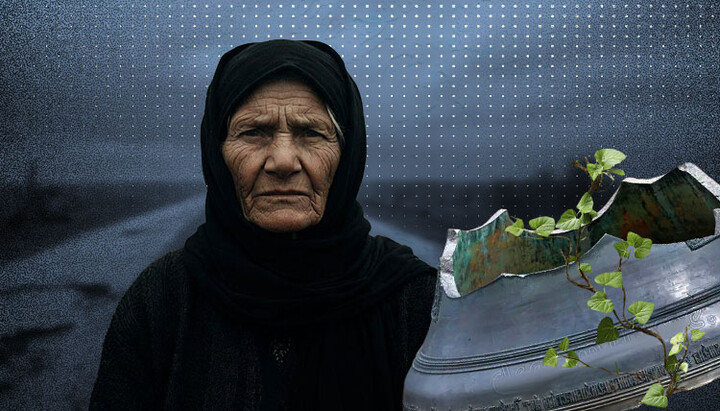
A difficult path to God. Photo: UOJ
The history of recent decades feels like an endless journey along a dry, dusty road. We are afraid to look back, because there – in the loose soil of the past – lies a corpse we never dared to bury properly. We merely covered it with earth, hoping that time itself would become the best gravedigger.
These days we remember Saint Nina, Equal to the Apostles. The Enlightener of Georgia came to Iberia not with a sword, but with a cross woven of grapevine branches entwined with her own hair. It is a symbol of life breaking through suffering, a symbol of organic, living faith.
There is, however, another reality – the one captured by Repentance, directed by Tengiz Abuladze.
There, instead of the grapevine, we see barbed wire; instead of the Cross – a monumental tomb of a dictator. It is a clash of two paths, two ways of existing within history. Today, it seems, we once again stand at such a crossroads.
What the film is about
An important man dies – the city’s mayor, the “father of the nation,” universally respected Varlaam Aravidze. He is buried with pomp, speeches, an expensive coffin. His relatives weep; the city pretends to mourn.
The next morning, Varlaam’s corpse is found in the courtyard of his son’s house.
The dead man stands leaning against a tree, almost smiling. They bury him again. Deeper. Under concrete. Guards are posted. It is useless. He returns to the living. He refuses to lie in the ground – or rather, the ground refuses to accept him.
Soon the “culprit” is caught – a woman named Ketеvan Barateli. Once, Varlaam destroyed her father, an artist, in the camps. She is put on trial, and in court she says, “I will dig him up as many times as necessary – until you admit whom you have buried with honors.” What follows is the story of her life – how this “kind” mayor Varlaam annihilated her family.
A face assembled from shards of darkness
We would be mistaken if we tried to identify Varlaam Aravidze with some specific tyrant from a history textbook. Abuladze emphasized in interviews: this is not a portrait, but a distillation. He has Hitler’s mustache, Beria’s pince-nez, and Mussolini’s black shirt. It is a universal surrogate of power, without nationality, but always with the same aim – to burn out a person’s inner freedom.
Varlaam is an anti-Christian project, an attempt to build paradise after first turning the earth into a morgue.
At times it feels as though we are still sitting in that damp, echoing basement, waiting for Varlaam to finish his operatic aria. His powerful voice fills the entire space, drowning out the dull thuds and hoarse gasps of those being tortured behind the wall.
This is a terrifying form of blasphemy – when high culture, art, and aesthetics are used to muffle the sounds of suffering. Varlaam’s system does not merely kill; it sings over the corpse. And that voice still resonates in many lofty offices – and in our own souls.
The sweet taste of sacrilege and the mute fish
There is a scene in the film that induces nausea, though not a single drop of blood is shown. The characters are eating cake – a massive festive cake shaped like a church. We watch the knife confidently slice through sponge domes, spoons pierce creamy walls, people smilingly devour sugary altars. It is the taste of vanilla sacrilege.
This is a precise metaphor for the collective consumption of faith.
We have turned the Church into décor, into an ornament for a corporate celebration or a state banquet. We “consume” the holy without allowing it to change us, without letting it burn our conscience. We want a God who is pleasant to the taste and demands no repentance.
We ate our own temple, converted it into calories for the maintenance of our ego – and then we wonder why there is only heaviness and emptiness inside us.
Beside this “sweet temple,” a fish constantly appears in the film. An ancient Christian symbol, here it always looks the same – mute, dead, gutted fish on a platter amid crystal and silver. Tyrants eat it with cold appetite.
We often ask why God is silent when madness reigns in the world. These frames answer: it is we who made Him a “mute ornament.” God is present in our reality precisely in this way – as a dead symbol unable to raise His voice, because we ourselves stripped Him of the right to speak in our hearts.
Why God summons the past
The main heroine, Ketеvan Barateli, digs up Varlaam’s corpse three times. She performs an act of “spiritual exhumation,” refusing to let the earth conceal what must be named as evil. We are often told that we should “leave the dead alone,” that time heals all wounds, that the past should not be stirred. Scripture says otherwise: “That which has been is now; and that which is to be has already been; and God will call the past to account” (Ecclesiastes 3:15).
This biblical truth is the film’s central nerve. God summons the past not to punish, but to restore truth.
A crime against a human being does not disappear, does not dissolve in the soil. It accumulates there, poisoning the underground waters from which our children will drink.
Digging up Varlaam is not revenge – it is hygiene. It is a refusal to recognize monumental falsehood as something sacred. We cannot take a single honest step forward while the tyrant’s corpse is considered an honored resident of our memory. For repentance is heavy, dirty labor – the clearing of territory from idols we ourselves erected.
A hereditary disease: when grandchildren pay the bill
The most devastating blow comes near the end. Varlaam’s grandson, Tornike, upon learning the truth about who his grandfather really was, shoots himself. This gunshot is a verdict on the entire system of “hidden evil.” Sin proves to be a hereditary disease. If the fathers ate sour grapes, the children’s teeth will inevitably be set on edge.
Tornike could not bear the weight of the sin the family tried to pass on to him under the guise of “ancestral greatness.” When the mask falls and a looter appears where a hero once stood, the world collapses.
We often attempt to bequeath our unrepented mistakes to our children, covering them with words about “difficult times” or “necessity.” We force them to carry our coffins, hoping they will never look inside. But truth always breaks through – and it destroys those unprepared to face it. Without the repentance of fathers, children are doomed to spiritual barrenness or catastrophe.
Why do we need a road?
In the legendary final scene, an old woman knocks on Ketеvan’s window. She is looking for the way.
“Tell me, does this road lead to the church?” she asks.
“This is Varlaam Street. It does not lead to the church.”
“Then why is it needed? What is a road for, if it does not lead to the church?”
We may build eight-lane highways, erect skyscrapers, and implement artificial intelligence – but if God does not stand at the end of that path, we are merely circling the perimeter of a prison yard.
A road named after a tyrant is always a dead end. It will lead us back to the basement where Varlaam sings his endless aria over the screams of the tortured.
Repentance is not about tears. It is a change of route – a decision to step off Varlaam Street onto a narrow, stony path that leads upward. It is hard. It is frightening. It requires admitting that for decades we have been walking in the wrong direction. Are we afraid to dig up Varlaam precisely because we fear seeing our own reflection in his features?
We stand at a crossroads. On one side – the familiar comfort of an unrepented past, where everything is explained and justified by “higher interests.” On the other – a blinding truth that demands idols be dragged into the light. Saint Nina brought a living vine so that we might bear the fruit of love. Varlaam built concrete vaults so that we might live in fear. Which path will we choose today?
The road to God does not begin with gilded domes. It begins with the first step away from the dictator’s grave – a grave we have too long, out of habit or cowardice, called an altar.
Read also
Facade of bones and facade of light
Antoni Gaudí spent forty-three years building a church in Barcelona, knowing that this construction was for the ages.
Trial of a dead pope
Once in Rome, the body of a deceased pope was seated on the throne and put on trial. The accusation relied on a church canon that had once saved his see.
Monastery built in defiance of king
When Orthodox believers in Minsk were left with just one church, townspeople decided to build another – and even a royal decree did not stop them.
Young Mother and Sleeping Christ
Michelangelo carved a Virgin Mary who looks younger than her Son – and signed his name in marble for the only time in his life. Neither of these peculiarities was accidental.
Orthodox books from a Uniate printing press
In the 18th century, Uniate monks at Pochaiv printed books used in prayer by Orthodox Christians and Old Believers alike.
The story of the honey brotherhood
The Mogilev Brotherhood began with members pooling money to brew honey drinks for feast days – and eventually grew to have its own printing press.