Why are the authorities seizing churches and monasteries from the UOC?
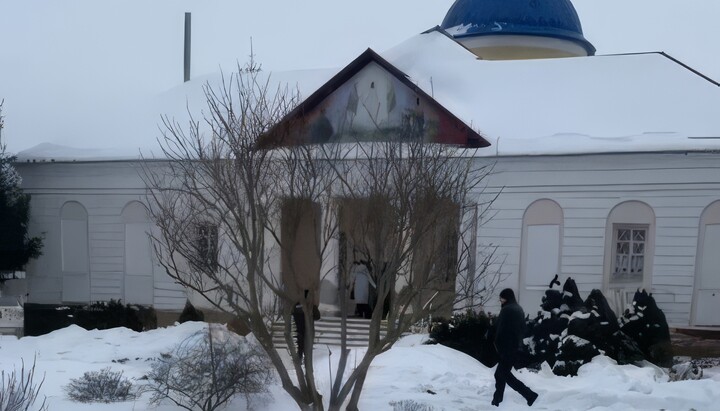
The expulsion of the nuns from the Krupytsia Monastery. Photo: UOJ
On January 27 the authorities took away from the UOC the Krupytsky Monastery and St Michael’s church in Krasnokutsk, Kharkiv region. In the first case, security forces threw the nuns out into the мороз and sealed the church together with the cells. In the second, they have – for now – simply transferred the church into state ownership.
We will not dwell at length on the moral side of how one can expel the women residents of a monastery from their own abode – an abode they rebuilt with their own hands from Soviet ruins in the 1990s. Let’s ask a simple question instead: why is the state doing this at all? Why does it need Orthodox churches?
The example of the Kyiv–Pechersk Lavra can be explained somehow. It is a sacred place known worldwide, right in the center of the capital. Here Зеленский can stage a pompous “military breakfast,” the Ministry of Culture can hold the presentation of a sociological survey, a cooking show, or a folk-dance concert (apparently there is nowhere else to do it).
But why would the state need the Krupytsky Monastery in Osyche? It’s a tiny village with a population of 200 people, lost in the wide spaces of the Chernihiv region. How are you going to use the church and the cells after you’ve thrown the nuns out into the cold? You can’t hold a concert there, you can’t stage a “presentation.” Will you turn it into a grain warehouse or a cowshed, the way your predecessors did a hundred years ago?
One more question. Kharkiv prosecutors, while taking away from believers a nineteenth-century church in Krasnokutsk, insist they are doing it to “protect historical heritage.” But in reality everything is the other way around.
Practically any historical church that was returned to the Church after the devastation of the Soviet era, people turned into a “cocoon” – they rebuilt it, restored it, and brought it into a state of благолепие. At the same time, buildings that remained under state management almost always look depressing. In January 2026 a blogger drove around such churches in Lviv region and showed terrifying footage: caved-in roofs, peeling walls, garbage, and abandonment. Even in the Kyiv–Pechersk Lavra, when you climb from the Lower, “monastic” section to the Upper, “museum” one, the contrast is immediately striking: literally “licked clean,” well-kept buildings with fresh repairs give way to flaking walls and crumbling plaster. And there is no need even to mention that in the Upper Lavra, crosses fall from churches on their own.
That is why there is no doubt that the Krupytsky Monastery, St Michael’s church, and all the other cathedrals, churches, and monasteries the authorities are now taking from believers are headed for ruin and desolation. They are not being seized because someone wants to “protect historical heritage” – no, that even sounds laughable. Believers are being driven out simply in order to drive them out.
We are now being told that Soviet persecutions of the Church in Ukraine were arranged by “Moscow occupiers.” That the Kremlin enslaved Ukrainians and deliberately inflicted all manner of harm on them – including persecution of the faith. And if not for the occupiers, Ukraine would have been a “garden city.”
Well, it is a beautiful version. But then why is the same thing happening today?
Read also
Ternopil post on Feast of Intercession: Has calendar reformn failed?
A significant number of believers have rejected the new church calendar introduced by the OCU and UGCC with government support.
Shoulder straps or a cassock: who writes the script for UOC "fighters"?
Everything indicates that both Veliar and Pshenychny are ordinary performers of someone else's script. There is only one question – does the scriptwriter wear shoulder straps or a cassock?
Why is it legal to kill a person before birth but not after?
Children are the most privileged members of society. Yet that same society officially permits children to be killed – and on a massive scale.
Honoring the Bolsheviks’ successors at Kyiv Lavra
It was under the Reserve that the relics of the saints were desecrated, Lavra churches were turned into an atheism museum, and toilets were installed in sanctuaries.
"Degenerates" and "stupid animals": anti-UOC activists turn on children
Future historians will wonder how a vast country’s information agenda could have been shaped for so long by people so petty, vicious, and utterly contemptible.
Zelensky sees murder of Polish priest but not of Sviatohirsk monk
Why does Zelensky react so emotionally and swiftly to the murder of a Catholic cleric while remaining completely silent about the murder of an Orthodox monk?