Iron freedom: What the Apostle Peter's chains are ringing about
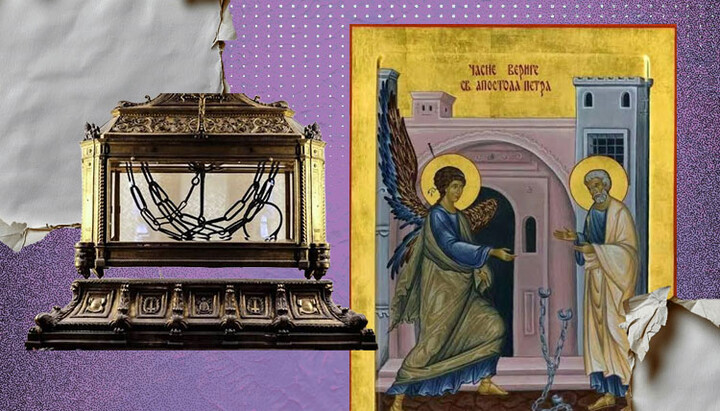
The Chains of the Apostle Peter. Photo: UOJ
First there was sound. In the absolute silence of an underground prison, any rustle becomes thunder. Iron scraping against damp limestone. A rhythmic clank that accompanies every breath, every movement.
If you have ever worn even five kilograms of raw, crudely worked metal on your body, then after an hour it begins to feel like part of you; after three, it rubs your skin down to weeping blood; after a day, it becomes an inescapable reality.
We descend into the crypt of the Basilica of San Pietro in Vincoli in Rome.
Here, beneath the main altar, in a crystal reliquary crafted by Giuseppe Valadier, lies what the official registers record as the “honorable chains.”
Two chains. Coarse, rusted, gnawed by time. Nearly two meters of the cold, stubborn will of the Roman Empire.
The empire always bets on iron. It believes in bolts, bars, and manacles. But if you step closer, it feels as though this metal still trembles from the shock it suffered two thousand years ago.
Death row
Jerusalem. The year 44. Herod Agrippa I, grandson of the very Herod who hunted the Infant, is clearing the political field. The Apostle James has already been executed. The Apostle Peter is in prison.
This was “maximum security.” Four watches of guards, four men each. Sixteen professional killers for one fisherman from Galilee.
But the Acts of the Apostles gives a detail that makes a historian uneasy: “Peter was sleeping between two soldiers, bound with two chains” (Acts 12:6).
Tomorrow is execution. At dawn they will drag him into the square and cut off his head. Any normal man on such a night would tear at his hair, pace the cell, or at least pray in spasms. But Peter is sleeping.
This is not merely sleep. Either it is the limit – even the beyond-limit – of physical exhaustion after interrogations, or it is that total trust which cancels the instinct for self-preservation.
At times it feels as though all of us today are sitting in that cell. Crushed between circumstances, as Peter was between two legionaries. We are waiting for a dawn that promises nothing good. And we sleep – from terror, from fatigue, from the impossibility of changing anything. But the point is that the Angel is already here. We simply need to be properly jabbed in the ribs.
The Angel’s surgery
In the Greek text of Acts there is a striking verb – pataxas. Translators politely render it as “touched him on the side,” but it is, in fact, “struck him.” The Angel did not stand on ceremony. Peter’s sleep was too deep, almost lethargic. He had to be ripped out of that stupor by force.
And there is another detail that gives away the ultimate pragmatism of the God who sent the Angel. He commanded: “Gird yourself and put on your sandals” (Acts 12:8).
The Angel does not lead him out merely “in spirit.” He makes sure the fugitive puts on his footwear. God knows there are sharp stones and thorns on Jerusalem’s streets. He knows the apostle will need to tie his laces.
The chains fell away by themselves. Without clatter. Without noise. Like dry onion-skin. That is how iron capitulated before Grace.
An inquiry in Rome: A basilica and a legend
But how did those chains end up in Rome? It is a remarkable story of feminine perseverance and imperial logistics. In the fifth century, the empress Eudocia (wife of Theodosius II) received as a gift in Jerusalem the very chains with which Peter had been bound under Herod. One chain she kept in Constantinople, and the other she sent to Rome to her daughter – also Eudocia – the wife of Valentinian III.
In Rome, another chain was already kept – the one with which the Apostle Peter had been bound in the Mamertine Prison before his execution under Nero.
Legend says that when Pope Leo I brought the Jerusalem chain near the Roman one, they, of themselves and without a blacksmith’s furnace, welded into a single whole. The links braided into an unbreakable knot.
Science may speculate about metal diffusion or later alterations. But the fact remains: from that day onward, these two stories – the Eastern and the Western, suffering and deliverance – have been inseparable.
Chrysostom’s envy
Saint John Chrysostom, in his homily on the chains, writes things that are hard for a modern person to grasp. He confesses that he would rather see the Apostle Peter not so much in heaven, seated upon a throne, as in those chains.
Chrysostom – a great intellect and a brilliant orator – envied the shackles. Why?
Because in those chains is the highest dignity of man.
We often ask God to free us from “bonds.” We want comfort. But Chrysostom saw in the chains a “diamond diadem.” For him, iron that had touched an apostle’s body for the Name of Christ was worth more than all the crowns of Byzantium.
Because gold is merely a metal that can be stolen. But faithfulness proven by prison is capital that does not depreciate in eternity.
Witnesses of powerlessness
Why do we venerate these bits of iron today? Do we love suffering? Does the Church preach sadomasochism? No.
We kiss these chains because they are the chief witnesses for the prosecution against evil. They are physical proof that for God there are no locked doors, no final verdicts, and no hopeless basements.
An empire can forge the thickest links. It can set the most disciplined guards at the door. It can place seals. But when the Angel comes, iron becomes wax.
The chains of the Apostle Peter are a “check” from a heavenly bank confirming: the ransom for our freedom has been paid.
And when we feel the shackles of circumstance tightening around our ankles; when someone among us is waiting for loved ones from captivity; when we are choking in the cell of our own fear – let us look at that rusted metal in Rome.
It unclasped. And ours, I am sure, will unclasp as well.
Read also
Why holy monasteries turned into state prisons
The history of Christian Europe has preserved the memory of times when monasteries became places of state exile. The fates of monarchs and righteous men were decided there.
A shepherd boy with a letter from Christ to French king
In the summer of 1212, thousands of pilgrims carrying staffs waited for the sea to part before them. Later chroniclers added ships, slave traders, and a pope's lament to their story.
Facade of bones and facade of light
Antoni Gaudí spent forty-three years building a church in Barcelona, knowing that this construction was for the ages.
Trial of a dead pope
Once in Rome, the body of a deceased pope was seated on the throne and put on trial. The accusation relied on a church canon that had once saved his see.
Monastery built in defiance of king
When Orthodox believers in Minsk were left with just one church, townspeople decided to build another – and even a royal decree did not stop them.
Young Mother and Sleeping Christ
Michelangelo carved a Virgin Mary who looks younger than her Son – and signed his name in marble for the only time in his life. Neither of these peculiarities was accidental.