Elite's escape: how Orthodox bishops fled to Rome from their people
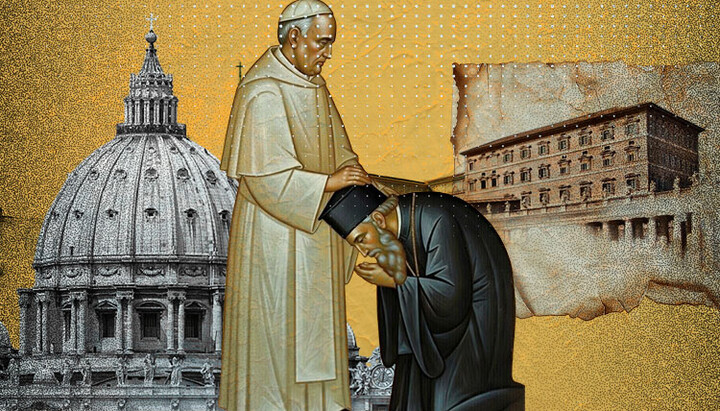
Orthodox bishops bowing to the Pope of Rome. Photo: Union of Orthodox Journalists
Cyril Terlecki sat by the window, looking at the road. A dusty road, broken by carts, leading from Lutsk to Vilno. Three weeks earlier, Patriarch Jeremiah II of Constantinople had traveled along it. Penniless, exhausted, with an outstretched hand. He had come to beg for alms – the Turks were strangling the Church with taxes. He left chaos behind him
Terlecki poured himself Hungarian wine. Expensive wine. The kind that an Orthodox bishop in the Polish-Lithuanian Commonwealth could only afford in secret, so as not to anger the brotherhood members. He drank and thought: just a little more – and those very brotherhood members, blacksmiths and merchants, would be telling him when to rise for prayer and which books to read.
Terlecki finished his wine and wrote a letter. An addressee – Rome. Content – betrayal.
Inferiority complex in golden vestments
1589. Jeremiah II's visit to the Polish-Lithuanian Commonwealth exposed the main problem of the Orthodox hierarchy: they were outcasts in their own country.
Catholic bishops were members of the Senate, spiritual princes with the right to vote before the king. Their residences were palaces with marble floors and Flemish tapestries. Their word carried weight at court. They were feared and respected.
Orthodox bishops were "schismatic priests," whose voice in politics equaled zero. Their churches were cramped, cold, with peeling plaster. Their authority rested on tradition, which the king considered a relic of dark times.
The contrast was glaring. Hypatius Pociej, a former senator who became an Orthodox bishop, knew the price of this humiliation. He remembered the spacious halls of the Sejm, the light from tall windows, the smell of freshly cut grass in the gardens of magnate estates. Now he served a liturgy in a church that smelled of dampness and cheap wax.
And a kilometer away stood a Jesuit church. Baroque, gleaming, with an organ whose sounds echoed throughout the entire city. That was where the nobility went. There was European polish, education, and ties to Rome and Paris.
For him, Orthodoxy breathed provincialism. Poor, dark, stubborn provincialism.
The patriarch who came at the wrong time
Jeremiah II came for money but began to restore order. This was a fatal mistake.
First, he deposed Kyiv Metropolitan Onisiphor Devochka. The reason was digamy, double marriage. For canon law, it was a verdict. For the local bishops, it was a shock.
If the Patriarch could remove a metropolitan for violating church rules, what would stop him from removing someone else? Terlecki was accused of criminal offenses. Pociej was a recent layman, his ordination raised questions. The others also had sins behind them that could be dug up and presented if desired.
Constantinople was weak. The Patriarch sat under the Turkish yoke, begging for money from Orthodox kings and magnates. But he was canonically strong. He had the right to judge. And he granted that right to the brotherhoods.
The Lviv Brotherhood received stauropegial status in 1586. Now blacksmiths, merchants, and teachers could control the bishop, check his sermons, demand an account of income, and judge him for unworthy behavior.
For the bishops, this was a catastrophe. A social explosion.
The world had turned upside down: those who should have been silent and obedient received a voice. And those who should have ruled found themselves under control.
Terlecki and Pociej understood: it was impossible to live with such a patriarch. They needed a different boss. One who was far away, rich, and wouldn't interfere in local affairs. Rome fit perfectly.
Secret congress in Belz: deciding the fate of the Church
June 24, 1590. Belz, a small town on the border of the Polish-Lithuanian Commonwealth. People in cassocks gathered in the bishop's residence. Officially – to discuss church affairs. In reality, – a conspiracy.
No protocol was kept. There were no witnesses. But the result is known: the bishops agreed on union with Rome.
The logic was simple. Constantinople was poor, weak, and dangerous with its canonical strictness. The brotherhoods, having received from the Patriarch the right to judge bishops, had become a thorn in their side. Rome, however, offered a deal: keep your rites, recognize the Pope as head of the Church, and receive seats in the Senate, the king's protection, money, and status.
This was not a theological discussion. This was trade. The bishops were selling their flock for political comfort.
1594. Secret declaration: the bishops were ready to accept union on the condition that they kept their rites and obtained seats in the Senate. Not a word about Christ, about dogmas, or about Tradition. Only about seats in Parliament.
1595. Cyril Terlecki and Hypatius Pociej traveled to Rome to be received by Pope Clement VIII. They kissed his shoe. This was a humiliating ritual, but behind it – a promise of power.
October 1596. The Council of Brest. An official proclamation of the Union. The bishops got what they wanted. The people got a schism that tore the country apart for two centuries.
Why this matters now
We live in an era when elites again fear their own people when it's more convenient to seek an external master than to rely on one's own.
In the 16th century, Orthodox bishops feared the poor Patriarch and "insolent" brotherhood members. They chose wealthy Rome and comfortable Senate seats.
Today, we see the same thing. When the church (or self-proclaimed church) elite loses faith in its people, they seek protection with politicians, external powers, and the “European choice.” When hierarchs fear laypeople more than God, they begin to trade.
The Union of 1596 is not a story about dogmas. It's a story about fear. Fear of losing status. Fear of control from below. Fear of poverty and canonical strictness.
Read also
Facade of bones and facade of light
Antoni Gaudí spent forty-three years building a church in Barcelona, knowing that this construction was for the ages.
Trial of a dead pope
Once in Rome, the body of a deceased pope was seated on the throne and put on trial. The accusation relied on a church canon that had once saved his see.
Monastery built in defiance of king
When Orthodox believers in Minsk were left with just one church, townspeople decided to build another – and even a royal decree did not stop them.
Young Mother and Sleeping Christ
Michelangelo carved a Virgin Mary who looks younger than her Son – and signed his name in marble for the only time in his life. Neither of these peculiarities was accidental.
Orthodox books from a Uniate printing press
In the 18th century, Uniate monks at Pochaiv printed books used in prayer by Orthodox Christians and Old Believers alike.
The story of the honey brotherhood
The Mogilev Brotherhood began with members pooling money to brew honey drinks for feast days – and eventually grew to have its own printing press.