Why instigators of hatred against the UOC should be in prison
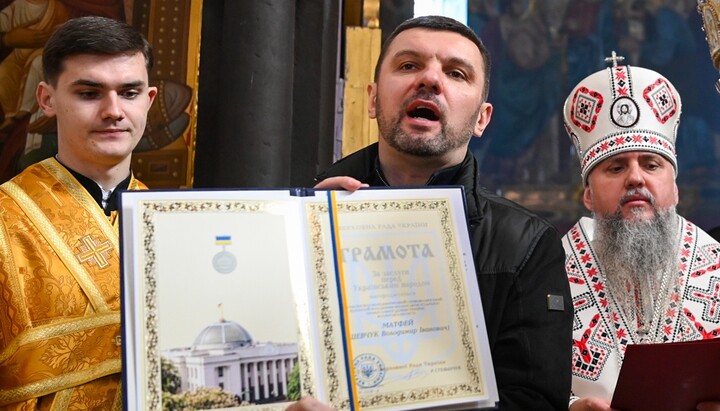
Huz at the ambo of the Dormition Cathedral in Volodymyr. Photo: OCU
On January 31, in the Dormition Cathedral in Volodymyr – taken from the faithful of the Ukrainian Orthodox Church – a well-staged ceremonial event was held. About 300 people were brought in from all the Orthodox Church of Ukraine churches of the city and from other localities. Epifaniy (Dumenko) led the “first liturgy in the Ukrainian language.” He was accompanied by the top tier of the local authorities, as well as Member of Parliament Ihor Huz. Standing on the cathedral’s ambo next to Epifaniy, Huz delivered a speech, which was not about “patriotism.” It was a concentrated, brazen lesson in how to ignite religious hatred.
Here is what was said – listed as the core of the message:
• When the Dormition Cathedral belonged to UOC believers, it was supposedly “under Moscow’s rule.”
• UOC believers were branded “katsaps.”
• Driving the UOC out and handing the cathedral to the OCU was presented as a decisive step toward Ukraine’s military victory over Russia.
• A fresco depicting the Royal Passion-Bearers was singled out as something to be destroyed – and only then, we were told, would a “Ukrainian spirit” “reign” in the church.
• The Volodymyr Chapel next to the cathedral was declared the next target – it, too, should be taken from the UOC and transferred to the OCU.
• The abbess of Zymne Monastery was urged to “voluntarily” move to the OCU – and if she did not, there was a barely veiled hint of force.
One of Huz's main theses is that the Dormition Cathedral suffered for centuries under the oppression of Russian tsars, and now Ukrainian authorities have liberated it. Fine – everyone is entitled to an opinion. But let us present well-known historical facts.
By the end of the 19th century, the ancient Assumption Cathedral, following the Uniate period, was almost completely destroyed and consisted of ruins with a collapsed dome and fallen walls. And who revived it? You will be surprised, but it was Russian Tsar Nicholas II, depicted on the temple's fresco. He allocated about 60,000 rubles for the restoration of the cathedral and later additionally announced a fundraising campaign across all churches of the Russian Empire. As a result, 127,550 rubles were collected, and by 1900 the Dormition Cathedral had been rebuilt by Russian architects in its present magnificent form.
The same "betrayal" applies to the Volodymyr Chapel, which Huz demands be given to the OCU. It was built to commemorate two events related to the royal family: the rescue of Tsar Alexander III and his family after a train crash, and the rescue of Nicholas II following an assassination attempt in Japan. That is, if not for the “yoke of Moscow,” there would have been neither the chapel in Volodymyr nor, most likely, the Dormition Cathedral. There would have been nowhere for Epifaniy to “return Ukrainian prayer.”
But the most important thing is not even the argument about history.
What matters is this: these churches were not built as props for political victory. They were not raised so that one nation could swagger over another, or so that anyone could declare some “spirit” to be the rightful owner of stone and fresco. They were built for prayer – for repentance, for mercy, for the slow and difficult growth of Christ’s love within a people.
And when we hear a politician standing in a holy place, spitting out contempt, dividing citizens into “ours” and “not ours,” stamping believers with slurs, and openly sketching out the next seizures – we recognize it for what it is. It is not “defense of the nation.” It is the deliberate manufacturing of hatred.
So let's call it by its real name: this is incitement to religious enmity. Under the law, that is a crime. And if the law means anything at all, those who inflame hatred against the Ukrainian Orthodox Church should stand before a court – not before an altar.
Read also
Why is it legal to kill a person before birth but not after?
Children are the most privileged members of society. Yet that same society officially permits children to be killed – and on a massive scale.
Honoring the Bolsheviks’ successors at Kyiv Lavra
It was under the Reserve that the relics of the saints were desecrated, Lavra churches were turned into an atheism museum, and toilets were installed in sanctuaries.
"Degenerates" and "stupid animals": anti-UOC activists turn on children
Future historians will wonder how a vast country’s information agenda could have been shaped for so long by people so petty, vicious, and utterly contemptible.
Zelensky sees murder of Polish priest but not of Sviatohirsk monk
Why does Zelensky react so emotionally and swiftly to the murder of a Catholic cleric while remaining completely silent about the murder of an Orthodox monk?
UOC vs. OCU numbers: pollsters count, social media recount
Official polling suggests Dumenko’s structure has an overwhelming lead in the number of parishioners, while social media polls paint a very different picture. Which should we believe?
Who is working for the Kremlin in Poland? OCU, Uniates and Catholics versions
Who in the conflict between Poland and Ukraine is "an agent of the Russian Federation"? Zelensky, who gave the UPA name to an AFU special operations center? Nawrocki, who stripped him of an order for it? Polish MEPs?