Dumenko’s “dialogue” appeal to the UOC: sincerity or strategy?
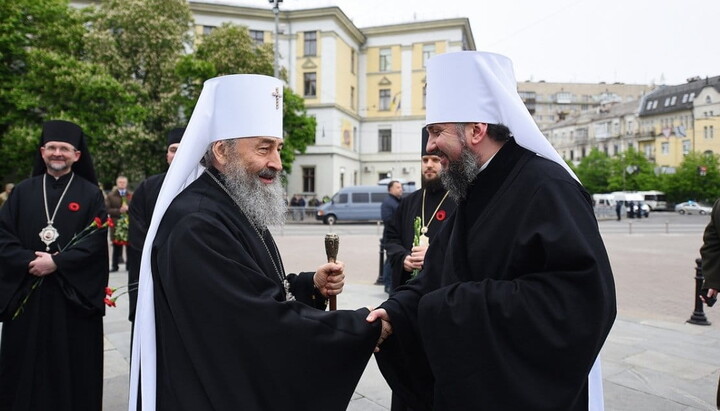
A chance encounter between His Beatitude Metropolitan Onufriy and Serhii Dumenko in Kyiv. Photo: OCU
On February 2, the OCU published a synodal Address to the UOC, signed by Serhii Dumenko. Below is a brief analysis of the document to see how sincere it really is.
The very title already gives everything away: it is addressed to “Orthodox believers, clergy, and hierarchs in Ukraine who depend on the position of the Russian Patriarchate.”
When two people are in conflict and one proposes a step toward reconciliation, does he repeat the insults that caused the hostility in the first place? No. And yet that is exactly what we see here.
The name “Ukrainian Orthodox Church” is the official designation that has been used in Ukraine and abroad for more than three decades. But the OCU refuses to call the UOC by name. Instead, it uses a deliberately aggressive label: “those who depend on the position of the Russian Patriarchate.” On what “position” of the ROC do the faithful and clergy of the UOC supposedly depend? Dumenko does not say – because there is nothing to clarify. It is accusation for accusation’s sake, a stamp meant to brand the UOC as “Russian” from the very first line.
And the most telling detail is not even the insult. It is that the UOC has no real reason to respond to the text at all – because the OCU is, strictly speaking, addressing no one in particular. Perhaps it is meant for the UOC–KP? Or perhaps Dumenko is speaking to his own “hierarchs,” four of whom, according to the article, hold Russian passports.
2. The OCU claims it has spent seven years sending “letters and appeals” to the UOC calling for dialogue, yet during all that time it allegedly received “not only no positive response, but not even a formal reply from the official leadership.”
This point is staggering in its brazenness.
“Not even a formal reply”? Then we must remind the forgetful OCU “synodals” that the decisions of the UOC Council in Feofania on May 27, 2022 include a separate point specifically about dialogue with the OCU. It contains direct calls: to stop seizures of UOC churches, to resolve the issue of missing ordinations, and to acknowledge the imperfect character of the OCU’s autocephalous status. A Church Council is the highest governing body. To claim that such a decision amounts to “not even a formal reply” is too much even for Dumenko and his colleagues.
But we also know something else: even the “easiest” of those appeals – stop the seizures – was not merely ignored. The seizures, according to the article, were intensified many times over.
3. The OCU complains that bishops and clergy ignored the OCU’s “unification council” in 2018, and that “only two metropolitans” came.
Let us simply recall that for years after the creation of the OCU, Serhii Dumenko repeatedly assured everyone that his structure had unified all Ukrainian Orthodoxy. Has the concept changed today? Or has reality, at last, broken through the slogans?
4. In 2023, commenting on the question of unification with the UOC, Dumenko said he saw no point in it: “We don’t need collaborators in our ranks who hate everything Ukrainian.”
So why were they “not needed” then, but are suddenly “needed” now? What changed?
The answer lies in Dumenko’s most recent visit to the Phanar, where Bartholomew I publicly demanded that he “seek ways of rapprochement with UOC bishops through dialogue.” And note: even His Holiness does not call the UOC “those who depend on the position of the Russian Patriarchate.”
If the OCU truly wanted dialogue, it would have made a decision to put an end to violent church raids and return what was taken. Or at least announce a moratorium on new “transfers.” That would have been a real step toward unity – concrete, costly, and unmistakable.
But we have seen nothing of the sort.
And that is why, the article concludes, the OCU’s present Address is not a bridge to reconciliation, but a convenient alibi – a document written not for the UOC, but for Constantinople: “We tried. We reached out. But they refused.” And once that excuse is filed away, everything continues as before – only with more pressure, more seizures, and more force.
Read also
Why is it legal to kill a person before birth but not after?
Children are the most privileged members of society. Yet that same society officially permits children to be killed – and on a massive scale.
Honoring the Bolsheviks’ successors at Kyiv Lavra
It was under the Reserve that the relics of the saints were desecrated, Lavra churches were turned into an atheism museum, and toilets were installed in sanctuaries.
"Degenerates" and "stupid animals": anti-UOC activists turn on children
Future historians will wonder how a vast country’s information agenda could have been shaped for so long by people so petty, vicious, and utterly contemptible.
Zelensky sees murder of Polish priest but not of Sviatohirsk monk
Why does Zelensky react so emotionally and swiftly to the murder of a Catholic cleric while remaining completely silent about the murder of an Orthodox monk?
UOC vs. OCU numbers: pollsters count, social media recount
Official polling suggests Dumenko’s structure has an overwhelming lead in the number of parishioners, while social media polls paint a very different picture. Which should we believe?
Who is working for the Kremlin in Poland? OCU, Uniates and Catholics versions
Who in the conflict between Poland and Ukraine is "an agent of the Russian Federation"? Zelensky, who gave the UPA name to an AFU special operations center? Nawrocki, who stripped him of an order for it? Polish MEPs?