Do Ukrainians without heat and eeectricity really do nothing but rejoice and dance?
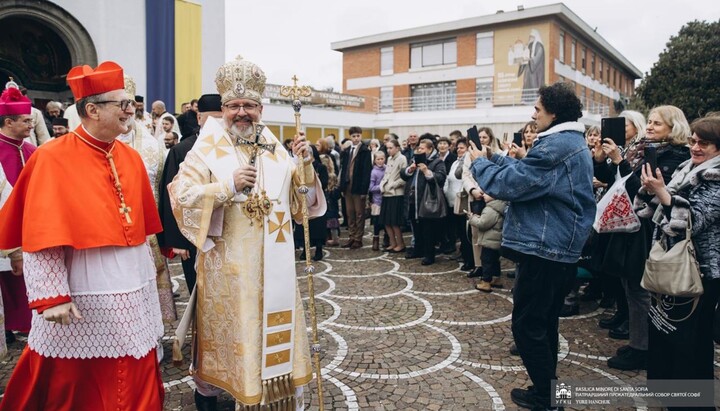
Sviatoslav Shevchuk in Rome. Photo: UGCC
In Rome, UGCC head Sviatoslav Shevchuk declared that “unbreakable” Ukrainians respond to the loss of heat and light with joy, songs, and dancing. He said that Kyiv residents, while sheltering at warming centers, “did not weep in despair, but sang and danced.”
“This image of people who are freezing, yet singing and dancing to music, has already become historic and has astonished the whole world,” Shevchuk asserted. “And today I can confirm that this strange endurance, this joy of a nation that looks death in the face every night, does not come from man – it is a gift of the Holy Spirit.”
He even quoted a five-year-old girl who allegedly told him, “If I defeat the cold – then Ukraine will win.”
At first glance, these are lofty words from a pastor who sees in the people’s resilience the action of divine power. But look again – and the picture darkens.
Yes, those Kyiv residents who try to find even a sliver of light in today’s brutal hardship deserve respect. But what, precisely, is Shevchuk telling Europe? The message is starkly simple: Ukrainians can endure without heating and electricity for as long as it takes. Keep the war going. Keep the pressure on. Keep the funding flowing. They will endure.
Is that true?
Are we really expected to believe that a small child – spending weeks in darkness, cold, and hunger (and on Kyiv’s Left Bank many homes rely on electric stoves) – would speak in solemn, triumphant slogans about “defeating the cold” for the sake of national victory? With all due respect, this sounds less like a child’s voice and more like a carefully staged parable.
And it matters because Shevchuk’s rhetoric does not exist in a vacuum. He has more than once criticized the U.S. plan for achieving peace in Ukraine. This statement belongs to the very same line: Ukrainians are ready to suffer for as long as necessary; they are being destroyed, yet they are cheerful; they freeze, yet they sing and dance.
But from the mouth of a structure whose one half lives abroad and whose other half is concentrated in the west of the country, far from the front, these words land with a chill of their own. They sound not uplifting – but eerily detached. Not pastoral – but painfully convenient.
Because the signal being sent to the world is unmistakable: the Ukrainian people are doing fine. They are coping. They are “unbreakable.” Just send more money – and they will keep enduring.
Only one question remains, sharp as ice and impossible to ignore. Not a question for donors. Not a question for diplomats. A question for the people themselves:
Are you really ready to be spoken of this way – as if your suffering is effortless, as if your grief is a hymn, as if your freezing nights are a spectacle for foreign applause?
Or is it time to stop turning pain into propaganda – and finally ask the nation, honestly, what it can bear, and what it should never be asked to bear at all?
Read also
Why is it legal to kill a person before birth but not after?
Children are the most privileged members of society. Yet that same society officially permits children to be killed – and on a massive scale.
Honoring the Bolsheviks’ successors at Kyiv Lavra
It was under the Reserve that the relics of the saints were desecrated, Lavra churches were turned into an atheism museum, and toilets were installed in sanctuaries.
"Degenerates" and "stupid animals": anti-UOC activists turn on children
Future historians will wonder how a vast country’s information agenda could have been shaped for so long by people so petty, vicious, and utterly contemptible.
Zelensky sees murder of Polish priest but not of Sviatohirsk monk
Why does Zelensky react so emotionally and swiftly to the murder of a Catholic cleric while remaining completely silent about the murder of an Orthodox monk?
UOC vs. OCU numbers: pollsters count, social media recount
Official polling suggests Dumenko’s structure has an overwhelming lead in the number of parishioners, while social media polls paint a very different picture. Which should we believe?
Who is working for the Kremlin in Poland? OCU, Uniates and Catholics versions
Who in the conflict between Poland and Ukraine is "an agent of the Russian Federation"? Zelensky, who gave the UPA name to an AFU special operations center? Nawrocki, who stripped him of an order for it? Polish MEPs?