“If I stay alive, I’ll go to Pochaiv Lavra!”: The story of an elder who planted spruces and slept in the frost
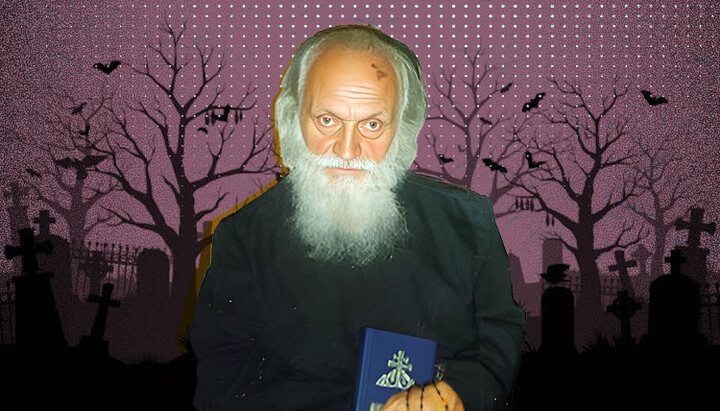
Elder Sergiy (Solomka). Photo: Union of Orthodox Journalists
We met in the mid-1990s by the walls of the Kyiv Caves Lavra. He had come to pray there from his native Pochaiv, where he had entered the monastery in 1947 as a novice, returning from the Second World War front.
As the elder recounted, during a terrifying barrage at the фронт – when bullets poured down like hail around him and his comrades fell as if cut down – he cried out to God: “If I stay alive, I’ll go to the Pochaiv Lavra!”
In the Pochaiv Lavra, the 93-year-old hieroschemamonk Sergiy (Solomka, + June 1, 2012) labored in asceticism until his death – and it is hard to believe it – for a full 64 years.
The heavenly host
As you step through the gate of the monastic cemetery, you understand at once – and you feel – that you have entered a land of holy repose, where the bodies of Pochaiv strugglers lie, men who have reached the Kingdom of Heaven. As the rector of the Pochaiv Seminary, Bishop Iov, once told me, the Lavra’s burial ground holds a heavenly host – men who, through monastic struggle, reached the chief goal: to be with Christ and His holy angels.
A Pochaiv novice, Sergiy Frych – a professional photographer and the author of Orthodox books and albums – created an extensive website, a photographic chronicle where he collected pictures and birth-and-death dates for hundreds of clergy from different periods, including the many Pochaiv abbots and brethren of the Lavra, fools-for-Christ and blessed laypeople who were revered in Pochaiv during their lifetime. For practically every day of the year, you can see a photograph on the day of repose of some monk, priest, or hierarch of our Church.
For in truth – and we often forget it – the day of death for every believer is the most important birthday: birth into Eternity, the crown of one’s life, labors, and prayerful struggles.
The Pochaiv cemetery astonishes you with the beauty of its orderly rows of graves, each marked by the same stone cross, and with the church standing in the center. The grounds are framed by neatly trimmed evergreen arborvitae, carved into arches for benches, where you can see pilgrims praying with prayer books in hand. The cemetery lies along the road to the Pochaiv Skete – several kilometers away, now functioning as an independent monastery – and everyone hurrying there from the Lavra will not fail to bow at the holy graves of the departed brotherhood.
Once, the novice Sergiy led us through the cemetery as though telling a whole story, bringing us to the graves of renowned spiritual fathers and ascetics. For example, at the burial place of Venerable Amphilochius of Pochaiv – where he rested before the discovery of his relics – akathists and molebens are served regularly, and many sick people receive healing. The Pochaiv monastic cemetery truly deserves a separate account.
But for now, let us return to the grave of Fr. Sergiy (Solomka), about whom these brief notes are written.
Night prayers
Let us put it this way: Fr. Sergiy was a Pochaiv confessor who suffered for Christ during Khrushchev’s persecutions. After attempts to close the Lavra in the early 1960s, he, together with several other brethren, was imprisoned and served a sentence in a penal colony on the basis of a fabricated criminal case.
After returning from imprisonment, the authorities refused to allow him to be registered at the Lavra and ordered him to depart for an Odessa monastery by decree of the former Metropolitan Filaret. Instead, he, like other brethren stripped of rights, categorically refused to leave his native Pochaiv – and at night, in winter, they slept in crates in the monastery’s attics.
Fr. Sergiy had no formal theological education. His school was the example of monks who had lived in the monastery since Tsarist times. And the teachings of the holy fathers were his books of daily bread.
He knew The Ladder of St. John Climacus nearly by heart and could quote the Philokalia and other patristic writings for hours. He never slept on bed linen. In his cell lay a sheepskin coat. He never took off his cassock – for no one knows when “the Bridegroom comes at midnight, and blessed is the servant whom He shall find watching…”
At night, together with the other monks and novices who were in hiding, he would go into the empty cathedral, and with prostrations they would say the Jesus Prayer. Once, Igumen Isaiah (Karavay, +2011), Fr. Sergiy’s spiritual friend – a former hermit of the Abkhaz mountains – was leading such a nocturnal prayer rule for young novices when, in the dark, empty church, a loud crash of shattering glass suddenly rang out. “It’s demons!..” the igumen said calmly, without turning around, reassuring the youth. In the morning the novices examined the whole church and the choir lofts, but they found no shards of glass at all.
The battle for the spruces
In labors and prayers Fr. Sergiy’s life went on. The harsh Khrushchev years passed. He was elected the Lavra’s steward. His holy dream was to plant, at the foot of the Dormition Cathedral, evergreen spruces of rare varieties, which he ordered from different nurseries across Ukraine – “for the brotherhood’s rest,” as he put it, and for the healing scent of conifers. Today those are enormous spruces – an ornament of the Lavra. The older monks still remember him – “little Sergiy” (he was short) – dragging heavy hoses of water to irrigate his saplings.
It happened that in the early 1990s the Lavra’s administration was forced to cut down a row of trees, clearing space for economic activity permitted by the authorities. The tireless former steward, Hieromonk Sergiy, rose up against these plans and went to Kyiv “to seek justice,” carrying the drawings of his plantings. That is where we met him.
Learning that he was dealing with a journalist, he poured out an entire torrent of information, demanding publication in the press – and left me thoroughly bewildered. Moreover, the late Beatitude Metropolitan Volodymyr explained to him that it was improper for a monk to complain to secular authorities, and that he should humble himself and remain in obedience to the Lavra’s superior.
A monk on a construction site
But that was not the end of it. Fr. Sergiy refused to return to the Lavra. He lived in the Sunday school of our parish, which was building the St. Michael Cathedral in memory of the victims of the Chornobyl disaster, in Darnytsia at 16 Myru Avenue, and he helped our headman with construction and with collecting donations from various institutions in Kyiv. In this way we communicated closely with Fr. Sergiy for more than a year.
I remember him sitting with a Psalter and a stack of commemoration notes in his hands under a heap of crushed stone behind the construction fence. Having taken off his cassock, he was basking in the sun, and his torso had turned a bronzed shade. “You have to stock up on sunshine for winter – for my old bones,” he would explain, raising a finger upward.
And the headman often took him along to meet with factory directors, hoping to obtain donated funds for building the church. Entering an office, Fr. Sergiy would sit meekly on a chair and, in a pause in the conversation, open his mouth and say: “It is a great work of God to build a temple! The Lord will preserve everyone for this and forgive them at the Dread Judgment!..” Then he would lift his finger again, pointing to heaven. The sight of a gray-haired, humble little monk with a cross on his chest moved people’s hearts, and such visits often ended in success.
Returning home
Fr. Sergiy quickly became beloved by our parishioners – especially by the elderly women, who waited for him after services with warm pots of food for the trapeza. In his cell at the Sunday school he never sat idle: one moment he was gluing together old service books, the next repairing shoes or darning a cassock, the next caulking a window for winter. In church he would sing along on the kliros in a light tenor voice, and afterward ask, “Well, how is it? Am I helping the choir well?” – and then withdraw, satisfied, into his little cell.
With time, evidently out of humility, he recognized his mistake in protesting over the felled trees (and not many had been cut), and he returned to Pochaiv, where he was already enrolled in the Pochaiv Skete. There he received the great schema, keeping the name Sergiy, and finished the course of his life.
A prophecy of peace
Once we asked him about the fate of the contemporary schism in the Church and all the political turmoil in Ukraine. He answered:
“I think there will still be a war and a new schism from Istanbul, but our new martyrs and the Venerable Fathers of Pochaiv and the Kyiv Caves in Heaven will put an end to this lawlessness – and peace will reign among us.”
All of this returned to my memory when I last visited the monastic cemetery and stood by his humble grave.
Read also
Brother of tax collector and brother of Lord
The Gospel is silent about the son of Alphaeus, and commentators have argued for centuries over who he was. And the Church commemorates two apostles named James in close proximity.
Prayer commemorations instead of loving embraces
At every Orthodox wedding, the choir sings a hymn to the martyrs. For families separated by war, these words carry a special meaning.
Honest atheism vs. spiritual hypocrisy
The 70th anniversary of Albert Camus’s Nobel Prize recalls an uncompromising challenge to Christianity. An honest unbeliever brings theology back to the mystery of the Cross.
The valley of trouble and the gateway of hope
One soldier buried an expensive cloak and some gold beneath his tent. Because of this, all Israel lost a battle. Why did one man’s sin bring disaster upon an entire nation?
From love spells to bishop's throne
Antioch’s most powerful sorcerer sent demons against a devout young Christian woman three times – and failed every time. In the end, a demon himself revealed the truth that led to his conversion.
The Weeping Queen of Blachernae
On the night of the Feast of the Protection, only two people witnessed the miracle in the Church of Blachernae. Everyone else prayed and saw nothing. Yet they, too, received grace.