When saints could not forgive one another: The story of three teachers of the Church
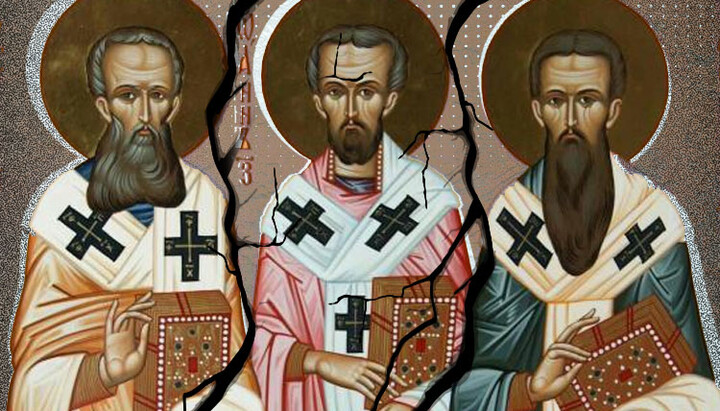
A quarrel between saints, resolved by love. Photo: UOJ
On the icon they stand together – three venerable elders with similar beards and halos, almost like brothers: Saints Basil the Great, Gregory the Theologian, and John Chrysostom. Three luminaries of Orthodox theology, three pillars of the faith.
But look more closely at their lives, and another story emerges – one of a deep friendship broken against the stone of ecclesiastical politics. One in which a saint could not forgive another until death. One in which the unity we see on the icon was anything but simple.
It began with Sasima – a dusty postal station at the crossroads between Caesarea and Tyana. A place where traders changed horses and hurried on. No temple, no library, not even a proper source of water. Only toll collectors and bandits waiting for stragglers.
Saint Gregory the Theologian was appointed there – a subtle poet and melancholic who had longed all his life for the silence of the desert and the freedom to compose theological verse. The appointment came from his closest friend, Basil the Great.
It was not merely an unfortunate posting. It felt like betrayal. And Gregory experienced it as such.
Later, in an autobiographical poem rarely quoted in textbooks, he would write with undisguised bitterness: “Such was your friendship, Basil… A throne in Sasima! A place without water, without greenery, full of dust and noise… inhabited by vagabonds and executioners… You sacrificed me for your power.”
A saint writes to a saint. And between the lines one hears the cry of a man who felt used – transformed from friend into a pawn on the chessboard of church politics.
Three unlike men
To understand how this happened, one must see how different they were.
Basil the Great was a man of action and iron will – an administrator who governed his diocese as a seasoned minister governs a state department. He built the Basiliad – a vast complex of hospitals and shelters, a prototype of public healthcare. He drafted rules, composed dogmatic formulas, organized the Church with relentless energy.
When the Arian emperor Valens tried to coerce him into renouncing Orthodoxy, Basil answered with such firmness that the imperial prefect marveled: “No one has ever dared to speak to me like this.”
Basil burned himself out in this service. He died at forty-nine, already resembling an old man. Illness, overwork, sleepless nights over documents – he became a living sacrifice to his own sense of duty.
Gregory was his opposite. An introvert, a poet, a man who physically suffered from noise and administrative bustle. He was ordained against his will – twice.
First, his own father dragged him into the altar and made him a presbyter. Later, Basil appointed him bishop of that very Sasima. Both times Gregory tried to flee, to hide, yet returned out of obedience.
He is the only Church Father who wrote autobiographical poems about his depressions and disappointments – not polished hagiography, but honest testimony of pain.
John Chrysostom, who lived later and never met the other two personally, embodied a third type – the orator and the conscience of his age.
He told the rich to their faces what others dared not whisper: your marble baths are built on the bones of the poor; the second cloak in your wardrobe was stolen from someone who has none.
A radical ascetic, he was exiled twice for his sermons. On the second journey he died before reaching his destination, whispering, “Glory to God for all things.”
Three men. Three temperaments. Three ways of serving God.
If the Church had been composed only of men like one of them, it would have become either a bureaucratic apparatus, a philosophical circle, or an unceasing blaze of revolution.
The wound of Sasima
But why did Basil send his friend to such a place?
In 372, Emperor Valens divided Cappadocia into two provinces, stripping Basil of half his territory. It was a geopolitical maneuver. Basil urgently needed loyal bishops in new cities – men who would stand firm in councils.
Sasima was one of those cities. Basil chose the man he trusted most: his closest friend.
He knew Gregory would suffer there. He knew his temperament, his longing for quiet. Yet political necessity outweighed personal affection.
Basil judged that the interests of the Church were more important than his friend’s happiness. Strategically, he may have been right. But Gregory could not forgive him.
He never set foot in Sasima. Formally he remained its bishop, but he refused to go. A silent protest – a saint’s passive strike against what he perceived as injustice.
The resentment remained until Basil’s death.
When Basil died in 379, worn down by labor and illness, Gregory came to the funeral and delivered his famous Oration in honor of Basil – one of the most luminous texts of patristic literature. He called him the greatest saint of his time. He spoke with love and with grief.
Death reconciled them.
There is something profoundly human – and profoundly Christian – in that. Forgiveness came not because the offender asked for it – we do not know if he ever did – but because death stripped away the trivialities. The pain dissolved before the truth that this man had given his life for the Church.
A feast that had to be invented
Seven centuries later, in 1084, Constantinople was torn by a strange dispute. Byzantine intellectuals divided into parties: Johannites, Basilians, Gregorians. Each insisted their saint was the greatest. Families quarreled; neighbors stopped greeting one another.
Metropolitan John Mauropous, unable to bear the division, had a vision. All three saints appeared to him and said: We are equal before God. Stop dividing us on earth when we are united in heaven.
He established a new feast – the Synaxis of the Three Hierarchs. The quarrel subsided.
But the irony is striking. The feast had to be invented because people could not accept that saints had disagreed in life. They needed an icon where all three stood peacefully together. The reality was more complex – full of wounds that healed only in eternity.
Unity born through pain
The icon tells the truth – but not the whole truth. It shows the result: their place in the Kingdom, where resentments are gone and differences transfigured. It does not show the process – the painful road through misunderstanding and fractured friendship.
And that may be the most important lesson.
Holiness is not the absence of conflict. It is not flawless relationships or perpetual agreement. Holiness is the capacity to remain within the unity of the Church, before the same Chalice, even when pain and misunderstanding persist.
Gregory could not forgive Basil during his lifetime. Yet he remained in the same Church, served the same Liturgy, confessed the same Christ. That proved more important than personal grievance.
We live in an age when the Church is again divided into parties. Some speak of strictness and discipline; others of theological depth; others of social justice.
Different emphases breed tension, suspicion, accusation. The story of the Three Hierarchs reminds us that such tensions have always existed – even among saints. They, too, struggled to agree. Serious conflicts arose between them.
But they remained in one Church.
The feast established seven centuries after their deaths teaches something simple and demanding.
Unity is not automatic. It is an ascetic feat. It requires the constant overcoming of our urge to divide people into right and wrong.
We may wound one another, as Gregory was wounded by Basil. We may differ in temperament and calling. Yet if we stand before one Chalice, we remain one – even if that unity is forged through pain and self-denial.
Read also
Honest atheism vs. spiritual hypocrisy
The 70th anniversary of Albert Camus’s Nobel Prize recalls an uncompromising challenge to Christianity. An honest unbeliever brings theology back to the mystery of the Cross.
The valley of trouble and the gateway of hope
One soldier buried an expensive cloak and some gold beneath his tent. Because of this, all Israel lost a battle. Why did one man’s sin bring disaster upon an entire nation?
From love spells to bishop's throne
Antioch’s most powerful sorcerer sent demons against a devout young Christian woman three times – and failed every time. In the end, a demon himself revealed the truth that led to his conversion.
The Weeping Queen of Blachernae
On the night of the Feast of the Protection, only two people witnessed the miracle in the Church of Blachernae. Everyone else prayed and saw nothing. Yet they, too, received grace.
Deadly spiral of human hatred
The tragedy of Lebanon's civil war lays bare how dehumanization and fear can turn human beings into monsters.
Woe to expectant mothers – or to those of little faith?
God commanded one prophet not to have children, yet told his people in exile to bear sons and daughters. What does this apparent contradiction tell us today?