Potemkin villages of Serhii Dumenko
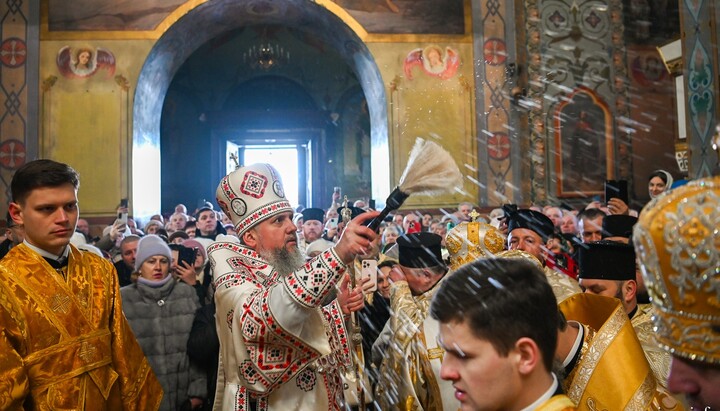
A bused-in crowd in the Dormition Cathedral in Volodymyr. Photo: OCU
Members of all three OCU parishes in Novovolynsk publicly thanked their mayor, B. Karpus, for providing transportation to Volodymyr for Serhii Dumenko’s “service” in the Dormition Cathedral taken from the UOC. In doing so, OCU members naïvely “gave up” the mayor – revealing that he used budget funds to manufacture the “picture” of nationwide support for Epifaniy and his structure.
Since there were indeed quite a lot of people at the “liturgy” on January 31 in the Dormition Cathedral, one can safely assume that the authorities organized shuttles not only from Novovolynsk, but from other towns in the region as well. And here an unavoidable question arises – why? Why block off streets for Dumenko’s arrival? Because the very next day, at the Sunday “liturgy” in that same Dormition Cathedral seized from the UOC, there were no more than a dozen people.
History has a legend about the “Potemkin villages”, when Prince Potemkin, escorting Catherine II through the newly conquered Crimea, built houses and stage scenery along the road to create the illusion that the land was settled and flourishing. For the duration of the empress’s journey, peasants were also brought into these makeshift “villages”, promised a reward (which they never received). Catherine was pleased, convinced that Russia’s new Crimean lands were thriving.
So the question is – who, in Dumenko’s “services”, plays the role of Catherine? Because in Volodymyr, in Cherkasy, in Bila Tserkva, and in other seized UOC cathedrals that Serhii Petrovych visits, his motorcades are followed by buses of bused-in extras. Dumenko leaves – and the “Potemkin peasants” disperse. The clearest example is the Kyiv–Pechersk Lavra. When Dumenko “serves” in the Dormition Cathedral or the Refectory Church, there are people (and there are buses near the Lavra’s walls). When Dumenko is absent – there are 5–10 people standing in the church at OCU “liturgies”.
We know that inside the OCU itself, those dissatisfied with Serhii Dumenko’s rule call him behind his back by a certain fairy-tale female name. But perhaps he truly believes that all those who appear at his “services” are the real parishioners of these churches? If so, the name of the Russian empress would suit him even better.
Read also
Why is it legal to kill a person before birth but not after?
Children are the most privileged members of society. Yet that same society officially permits children to be killed – and on a massive scale.
Honoring the Bolsheviks’ successors at Kyiv Lavra
It was under the Reserve that the relics of the saints were desecrated, Lavra churches were turned into an atheism museum, and toilets were installed in sanctuaries.
"Degenerates" and "stupid animals": anti-UOC activists turn on children
Future historians will wonder how a vast country’s information agenda could have been shaped for so long by people so petty, vicious, and utterly contemptible.
Zelensky sees murder of Polish priest but not of Sviatohirsk monk
Why does Zelensky react so emotionally and swiftly to the murder of a Catholic cleric while remaining completely silent about the murder of an Orthodox monk?
UOC vs. OCU numbers: pollsters count, social media recount
Official polling suggests Dumenko’s structure has an overwhelming lead in the number of parishioners, while social media polls paint a very different picture. Which should we believe?
Who is working for the Kremlin in Poland? OCU, Uniates and Catholics versions
Who in the conflict between Poland and Ukraine is "an agent of the Russian Federation"? Zelensky, who gave the UPA name to an AFU special operations center? Nawrocki, who stripped him of an order for it? Polish MEPs?