At the end of time: Will we encounter God’s wrath – or His silence?
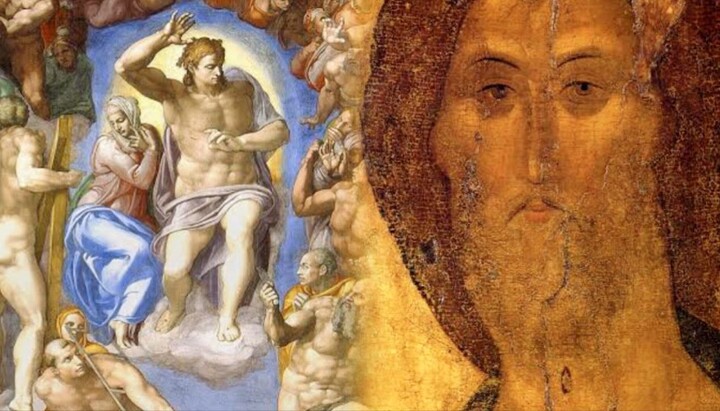
Two dissimilar images of God. Photo: UOJ
The vaults of the Sistine Chapel press down on our shoulders. History tries to pin us to the floor. The altar wall is not painting – it is a scream set in plaster.
Michelangelo (Buonarroti) returned here a quarter-century after painting the ceiling. But the world had already changed beyond recognition. In 1527 Rome endured a dreadful sack. The soldiers of Emperor Charles V turned the eternal city into a slaughterhouse, and churches into stables. Michelangelo painted The Last Judgment in 1536–1541. The horror of the world’s end that he had seen in the streets of Rome now stared at viewers from the altar wall.
At the center of the composition is Christ. We do not recognize Him. Where is the gentle Shepherd, where is the One who said, “Come to Me, all you who labor”?
Before us stands a beardless athlete. He resembles an ancient Apollo. His muscles are tensed so tightly it seems that one more moment and the marble will crack. His right hand has flashed upward. The entire space of the fresco shudders under that gesture. He is not judging – he is striking the universe itself.
When the Mother of God turns away
We are used to seeing the Mother of God in scenes of Judgment as an Intercessor: she stretches out her hands to her Son, pleading for sinners.
Here she draws in beneath His raised arm and turns her face away. As though admitting defeat: the time of mercy has run out.
This is the gesture of love’s capitulation before justice. It frightens more than all the hell swirling below.
The pope’s master of ceremonies, Biagio da Cesena, called the fresco obscene. Too many naked bodies. It belonged more in public brothels than in a chapel. Michelangelo took his revenge as an artist: he depicted his critic as the infernal judge Minos, with donkey ears. When Biagio complained to the pope, the pope replied that his jurisdiction did not extend to hell.
A skin painted in one day
At Christ’s feet sits Saint Bartholomew. In his hands is a flayed skin – the symbol of his martyrdom. Look at the face that shows through that empty membrane.
It is Michelangelo’s own face, distorted by suffering.
The chapel’s restorers said the artist painted this fragment in a single day. Without a cartoon, without a preliminary drawing. With semi-transparent paint, in broad strokes – utterly uncharacteristic of his manner.
They said it feels as though he wanted to “be done” with that image as quickly as possible. As though he could not bear to look at his own face turned into an empty hide.
The artist placed himself in a strange space between life and death. Not among the saved righteous. Not among the condemned sinners. But between hope and despair.
In his sonnets he wrote about a thirst for divine love – for the One who “on the Cross opened His arms to receive us.” Yet on the chapel wall he painted Christ with a hand raised to strike.
This contradiction is not a mistake. It is the honesty of a person who at once believes in mercy and fears wrath. Who longs for an embrace and expects punishment.
The Western concept of Dies Irae – the Day of Wrath – reaches its summit here. Judgment is understood as the juridical triumph of law over sin. As God’s retribution, wounded by human betrayal.
A Light that does not judge
Now let us move a thousand kilometers east – and one hundred and twenty years back.
In 1918, the restorer Grigory Chirikov found three darkened panels in a woodshed, near the Dormition Cathedral in Zvenigorod. When he began cleaning one of them, eyes began to emerge from beneath the soot.
Those who saw the image for the first time fell silent. Because those eyes looked not like a judge at the accused – but like a father at a long-lost son.
The icon has survived poorly. The paint layer remains only on the face and part of the shoulders. Yet that is precisely what creates the astonishing effect: as though Christ steps toward us not from the historical past, but from eternity itself – from that golden un-being that existed before the creation of the world.
Venerable Andrew (Rublev) painted the Zvenigorod Savior at the beginning of the fifteenth century. In Rus’ at that time the hesychast movement was in bloom. Monks were learning to see the Taboric light – the very light that shone on Mount Tabor at the Transfiguration.
That light permeates every millimeter of the icon. The Savior’s gaze is not an interrogation. It is a meeting. And there is not the faintest shadow in it of the anger that seethes on Michelangelo’s fresco. The ancient Fathers called this state “dispassion” – not indifference, but a love so deep there is no room in it for rage.
Pavel Florensky said of Rublev’s Trinity: “It exists – therefore God exists.” These words can be repeated while looking at the Zvenigorod Savior.
This is not a logical proof of God’s existence. It is the manifestation of His presence through beauty and silence.
Golubets – the precious azure of Christ’s garments – is not merely paint made from an expensive mineral. It is the color of a heaven that has ceased to be unreachable – that has bent down toward the earth so that a person might touch it with his hand.
The tragedy of love vs the triumph of law
Nikolai Berdyaev put the difference in a single phrase: “In the Western Last Judgment – the triumph of law and justice. In the Eastern Face – the tragedy of love.”
For Michelangelo, Judgment is a tribunal. Every sin is weighed with mathematical precision. Guilt is recorded and punished. God appears as the supreme Prosecutor demanding retribution.
For Venerable Andrew (Rublev), the Parousia is a meeting with Light. The torment of sinners lies not in being thrown into fire, but in their own inability to bear that Light – because their darkness is laid bare in His presence.
We are not afraid of punishment. We are afraid of seeing ourselves as we truly are. That is the true meaning of Judgment as self-revelation.
Film director Andrei Tarkovsky wrote in the script for a film about Rublev: “Look at Him – He does not judge, He has compassion… In Him is all the pain of the world and all its hope.” These words capture the essence of Eastern iconography with precision. Christ the Judge is wounded not by our betrayal, but by His love for us. He suffers from our suffering more than we suffer ourselves.
What we choose now
We live in a time when the world again seems unstable and bleeding – like Rome after the sack of 1527. Justice can seem the only salvation from chaos. It is easy for us to understand Michelangelo, who painted his fresco while expecting the end of history.
But it is precisely now that we need the Zvenigorod Savior – not as consolation, but as a reminder that behind all the wrath of history stands a quiet light that never goes out.
We stand before these two images – before the whirlwind of the Sistine Chapel and the silence of the Zvenigorod icon – and we understand that the choice between them is not made at the moment of death, but now. Every day: in how we look at the world, at enemies, at ourselves in the mirror of conscience.
Pope Paul III, seeing Michelangelo’s fresco, fell to his knees. Whether from horror or from awe – no one knows. But the gesture says what matters most: before eternity, we all end up on our knees.
What gaze do we hope to meet at the end of time – the punishing hand of the titan, or the gentle eyes of Zvenigorod azure?
The question is not settled by theological treatises, but by the eyes we ourselves have learned to see with. Because in the end the Judge looks at us with our own eyes – cleansed of vanity, fear, and hatred.
Read also
Trial of a dead pope
Once in Rome, the body of a deceased pope was seated on the throne and put on trial. The accusation relied on a church canon that had once saved his see.
Monastery built in defiance of king
When Orthodox believers in Minsk were left with just one church, townspeople decided to build another – and even a royal decree did not stop them.
Young Mother and Sleeping Christ
Michelangelo carved a Virgin Mary who looks younger than her Son – and signed his name in marble for the only time in his life. Neither of these peculiarities was accidental.
Orthodox books from a Uniate printing press
In the 18th century, Uniate monks at Pochaiv printed books used in prayer by Orthodox Christians and Old Believers alike.
The story of the honey brotherhood
The Mogilev Brotherhood began with members pooling money to brew honey drinks for feast days – and eventually grew to have its own printing press.
Golgotha in the midst of a pogrom
In the autumn of 1938, the Jewish artist Marc Chagall painted the crucified Christ. Synagogues burn and refugees flee around the cross, while the Crucified One Himself is wrapped in a prayer shawl.