A sack of patience and a sack of humility from Elder Isaiah
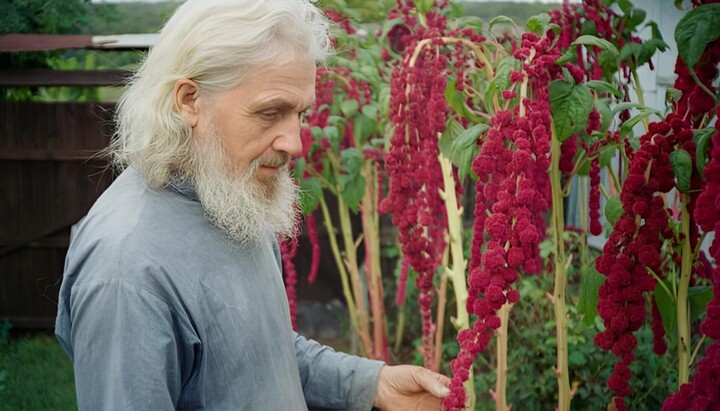
Schema-Archimandrite Isaiah (Korovai). Photo: the author
When we first met Father Isaiah (Korovai, +2011), we had no idea we had encountered a true struggler – an ascetic, a man of prayer – akin to the monks of ancient times, say, the Egyptian desert of the fourth and fifth centuries. And that is no exaggeration.
Humble, then still not an old man yet already gray-haired, a monk in the rank of hegumen, he was squatting with a jar of white paint in his hands and a brush by a heating radiator in front of the gallery of the Faraway Caves of the Kyiv Caves Lavra, which reopened in 1988.
We did not know that Hegumen Isaiah had fought on the fronts of the Second World War. He was born in the settlement of Nosovka in the Chernihiv province, into a family of deeply believing peasants. Interestingly, his parents also received monastic tonsure toward the end of their lives – and it was Father Isaiah himself (his secular name was Yakov) who tonsured them.
“I don’t even know now who I am to you,” his father marveled after the tonsure. “Seems I used to be your dad, and now I’m your spiritual son, and I have to take your blessing and call you ‘father.’ Wondrous are Thy works, O Lord!..”
Exorcising demons and the gift of healing
Yakov’s longing for monastic life went back to childhood. He even trained himself to eat only the foods he grew with his own hands. He did not eat meat. He loved studying the properties of medicinal herbs so much that, in a respectable old age, he could outshine a professional homeopath – he healed people, monks and layfolk alike, often from the gravest illnesses. He also practiced what are called “readings” over the unfortunate – those possessed by demonic force.
Back near Kursk in 1990, where he served as the superior of the reviving, famous Root Hermitage of the Nativity of the Mother of God, one could hear, during such readings, how the possessed screamed, howled, barked in voices so terrifying that a chill ran through the body. At times one could see another scene: a woman, collapsed on the floor, writhing like a snake, crawled toward the batyushka with a growl: “I hate you, Isaiah! May you die!..”
Father Isaiah, utterly unruffled and calm, would sign the wretched with the Cross and with the Gospel. And when, at the end of the moleben, he anointed the sick with blessed oil, they would stand quietly like little lambs and often, with tears of gratitude, kiss the hegumen’s hand.
A hidden chapel in a tree hollow
We did not know, when we met him, that during Khrushchev’s persecutions Father Isaiah labored in the mountains of the Caucasus, in Abkhazia, where he and other ascetics hid in impassable forests and clefts, outfitted tree hollows as living quarters – and in the hollow of a massive tree they set up a tiny chapel. They carried enormous loads on their backs up from Sukhumi. And in winter the snow buried them so deeply that to reach the stream one could walk through a tunnel cut in the snow. Their spiritual guides were the elders of Glinsk – some of whom have been glorified among the saints.
More about the ascetic feat of the Caucasus desert-dwellers and the elder Isaiah’s own life can be read in a book by the novice Serhiy Frich, which unfolds a vast canvas of the many years of Schema-Archimandrite Isaiah’s labors (in the great schema his name did not change).
After coming down from the mountains after Khrushchev’s departure, Father Isaiah served for a time in Georgia, in Tbilisi, where he likewise gained renown as a man of prayer and a selfless healer – which stirred grumbling among certain clergy. Once, at a service in Tbilisi, Father Isaiah was handed the collected offerings – something more than a thousand Soviet rubles. For those times it was an enormous sum. Without hesitation he sent a box of the money to Catholicos-Patriarch David VI, astonishing the latter.
“This is that same Isaiah who doesn’t take money?” the patriarch asked, and invited the monk for a conversation.
Either the patriarch or another Georgian hierarch, as the elder himself used to recount, treated Father Isaiah to a shot of expensive cognac. “I’ve never drunk strong spirits in my life,” the monk objected carefully, pushing the drink away. “But with a blessing?” the hierarch replied. Father Isaiah had to drink the ill-fated shot – and immediately lost consciousness, to the horror of his host. “Truly, this is a servant pleasing to God!” the hierarch cried.
Conflicts and expulsions
All his life Elder Isaiah moved from one monastery to another. Returning to Ukraine, he settled first in Pochaiv, then lived in other functioning monasteries – but nowhere did he remain long, because of the displeasure of certain members of the senior brotherhood, who simply envied the ascetic’s popularity among laypeople.
His treatment of sufferers and his exorcism rite over the demon-possessed sometimes caused bewilderment both among monastery superiors and among church authorities.
In the Kyiv Caves Lavra he did not last long either – he was expelled by a young superior at the prompting of the future schismatic Metropolitan Filaret (Denysenko). Likewise, in the Kursk Root Hermitage, where he was abbot, a conflict arose with the hierarch because Father Isaiah opposed the building of a cow farm on monastery grounds. The point was that the monastery, like many others, lay in ruins – it was necessary to restore churches and monastic buildings. “The monks have nowhere to live, and we’re building cells for cows!..” the abbot would say, taking on the stance of a holy fool.
Sketes in Nosovka
In his native Nosovka, where Father Isaiah had his own small brick house, he organized something like a skete, buying a neighboring hut for obedients – spiritual children from among the laity. And there were quite a few similar little sketes, in houses he had purchased, across Ukraine and Russia, thanks to the elder’s help and support. Father Isaiah used to say that a time would come when it would be impossible to go to churches – and his sketes would serve a good purpose.
From time to time he visited hermits, cared for them, guided and instructed them. It is not known for certain from whom, and what kind of blessing, he had for such activity. Perhaps from the Glinsk elders, or perhaps from some eminent hierarchs who not only knew and respected Father Isaiah, but even confessed to him.
I recall one of our trips to see the elder in Nosovka in the 1990s. It was Great Lent. We entered the house and saw this scene: two sisters were dining at the table, while the хозяин (the host) sat at the table eating a salted cucumber with bread. Having settled in for the night, overwhelmed with impressions from our conversation, we could not fall asleep – and so we could see how, in the batyushka’s cell, the light burned all night and the prayer could be heard: “Lord Jesus Christ, Son of God, have mercy on me, a sinner!..”
It turned out that Father Isaiah was an active doer of the Jesus Prayer and trained his spiritual children in it.
And he taught this way: “If a blasphemous thought comes to you, or any other unwholesome thought, you must cut it off with the words: ‘I do not consent! Let your blasphemy be on your own head! Lord Jesus Christ, Son of God, have mercy on me, a sinner!..’”
Harsh prophecies
In general – let us say it plainly – the elder often shocked us, the neophytes, with his statements. The then still lawful Metropolitan Filaret, the future schismatic, he called a scoundrel. And his “lawful sister” Rodionova, who, as it turned out, was the mother of his children, he called “a spawn of hell” and uttered an appalling, violent-sounding remark about her that threw us into dreadful confusion. But that was how he was – inconvenient for many and revered by many – Father Isaiah (Korovai).
I remember: when we were leaving Nosovka and taking the elder’s blessing, we asked, “Batyushka, what should we bring you next time?” He smiled and answered: “A sack of patience and a sack of humility.”
Schema-Archimandrite Isaiah was buried in his native Nosovka on March 6, 2011. He completed his feat-filled life’s path in his eighty-fifth year, and people never stop coming to the grave of this servant pleasing to God.
Read also
A lesson from a speechless donkey
The famous seer struck his donkey three times for refusing to go forward. All the while, she was saving his life – and seeing what he could not.
The time when the soul ripens
Modern society has turned youth into a cult and old age into a period of merely “living out one’s days.” The Christian perspective reveals the profound spiritual meaning of our later years.
Faith is not a checker piece in a spectator sport
Arguments about faith on social media increasingly resemble no-holds-barred fights. We turn to a saint who, sixteen centuries ago, knew how to speak to those interested only in turning theology into a combat arena.
The metropolitan who fought with a pen
St. Cyprian of Kyiv was robbed, expelled, and barred from his see. He answered with letters, books, and canons – and before his death, forgave everyone.
Loneliness under one roof
Spouses can share a home for years, raise children, and faithfully attend church – yet remain strangers to each other.
The cross – the deepest healing of the human soul
Emotional exhaustion and anxiety have become a way of life. Ancient Christian tradition offers an unexpected way out – embracing one's own cross.