Facing the сlosed doors: Why Adam became the first refugee in history
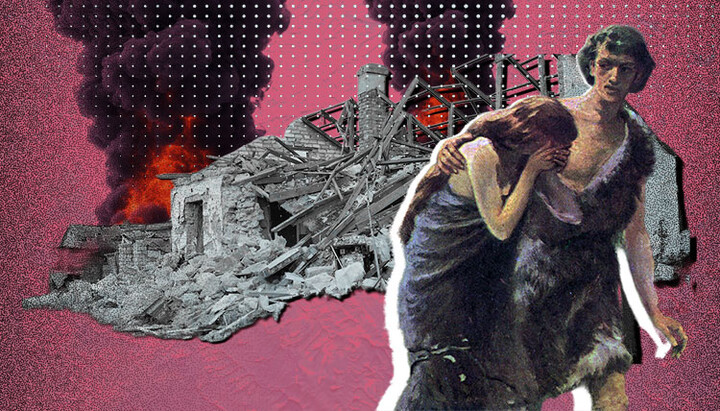
Exile: Past and Present. Photo: UOJ
We are standing on the very threshold. Great Lent is near, but today we are still here – at that strange point of stillness the Church calls the Remembrance of Adam’s Expulsion. There is something uneasy in the very name, a bitterness you can almost feel in the body. We are used to thinking of this story as something endlessly distant, archived in the opening chapters of Genesis – but today it sounds like a breaking news alert.
Reading the lines of the liturgical texts, you can stumble over one word: “right.” In the sticheron we sing: “Adam sat right before Paradise.” Right – that means opposite. It means he did not walk beyond the horizon, did not hide in the woods to forget the loss. He sat at the very gates. Paradise remained in his line of sight – as a light-filled beauty that no longer belonged to him.
The most terrible torture one can imagine is the torture of nearness. We know this more than we would like. We know what it is to stand at the roadside, staring at the walls of a home now blocked by checkpoints or reduced to rubble. We are heirs of that “refugee status” that Adam received first.
A man in a leather spacesuit
Here we need a brief detour into theology – not the kind found in dusty volumes, but the kind that concerns our very skin. In the Bible there is a mysterious phrase: God made for Adam and Eve “garments of skin.” We often picture primitive people in animal hides, like characters from a fifth-grade history textbook. But St. Gregory of Nyssa saw something far deeper.
He wrote: “This is what the human being took on in addition, with the irrational skin: the marital union, conception, birth, defilement, nursing at the breast, then food and its expulsion from the body, gradual growth, adult life, old age, illness, and death.” These “garments” are our present biology – our mortality, the heaviness of flesh, sickness, the need for food and sleep.
This is a kind of spacesuit – or a heavy armored vest – that God put on us so we might survive in the hostile environment of the fallen world.
We became heavy. We lost that luminous robe of grace of which St. Symeon the New Theologian wrote. Now we look at the world through the embrasures of this spacesuit: we are limited, we hurt, we age, we fear. And this “biological camouflage” is both our protection and our prison. It keeps us from flying – but it also keeps us from finally disintegrating into emptiness, cut off from the Source of Life.
Why does the All-Knowing ask questions?
Let us read Genesis closely: Adam hides among the trees, and God walks in the garden and asks: “Adam, where are you?”
We understand, of course, that God is not a policeman who has misplaced a suspect. He knows under which bush His creature is crouching. Why, then, the question? St. Basil the Great explained it simply: God is not seeking information – He is seeking the human being. The question was for Adam himself.
“Where are you?” is a summons to recognize the distance. It is God’s attempt to break through the wall of self-isolation Adam erected around his heart.
For sin began not with the fruit, but with the fact that Adam grew afraid and hid – he severed the bond. And God, as the true Physician, is the first to initiate contact.
This is the greatest consolation for us today. We may feel endlessly lost, “internally displaced persons” in this world – but God always asks: “Where are you?” He always seeks us first, even when we have crawled into the darkest corner of our conscience.
Quarantine for evil
Many are troubled by the idea of expulsion as punishment. Surely God is not so touchy? But St. Gregory the Theologian, in his Oration on Holy Pascha, overturns our notions of divine justice.
He writes: “Yet even here he gains something – namely death, as a cutting off of sin, so that evil might not become immortal. Thus the very punishment becomes an act of philanthropy; for so, I am persuaded, God punishes.”
Expulsion and death are not revenge – they are healing. They are a merciful quarantine.
God permits us to be mortal so that evil in us will not become immortal. Imagine an eternal tyrant, or an eternal hatred – that would be true hell. Death limits the spread of the tumor of sin. God leads us out of Paradise so that we will not be “preserved” in our distorted condition, but may, through repentance and labor, return to Him renewed.
Nostalgia for the Person
St. Silouan of Mount Athos wrote an astonishing poem, “Adam’s Lament.” In it there is not a word about losing comfort, sweet fruits, or endless summer. Silouan’s Adam weeps over the loss of the Person.
Listen to the sound of his lament: “My soul longs for the Lord, and with tears I seek Him. How can I not seek Him? Thou didst first seek me and didst grant me to delight in Thy Holy Spirit, and my soul loved Thee.” And further: “He grieved not so much over Paradise and its beauty as over this: that he had lost the love of God, which insatiably draws the soul toward God every minute.”
This is true longing. We often confuse it with nostalgia for places, for old things, for “the times before the war.” But at the deepest level it is longing for the Father. In the Greek text of the Gospel, when loss is spoken of, it is often precisely orphanhood that is underlined.
We are orphans, sitting opposite a locked door, trying to remember the voice of the One who waits for us within.
Scenes from Andrei Tarkovsky’s film Nostalghia come to mind. There the hero builds a model of his village house right inside a vast, half-ruined Italian cathedral. Home is inaccessible, left behind across a border – and yet the man tries to recreate it, if only in thought. We try to build a likeness of Paradise here on earth, from the fragments of our lives, but the heart still aches: “Not it… not it…”
Great Lent as a road back to the beginning
Soon we will begin a path that is strange in its very logic: we go forward in order to return back. Thomas Stearns Eliot, in his Four Quartets, wrote something brilliant: “And the end of all our exploring will be to arrive where we started and know the place for the first time.”
The Lent is not about dieting. It is an escape from the exclusion zone, an attempt – at least for a time – to loosen this heavy armored vest of the “garments of skin” and feel the breath of eternity.
We begin the Lent at the closed gates, sitting together with Adam on the edge of history. We weep over our nakedness, our helplessness, our ruined homes – earthly and heavenly alike. But we know what Adam, in that moment, could not yet fully know: this path will end not at the locked doors of the Garden, but at the opened doors of the Tomb. We are walking toward Pascha.
We do not know how long we must still wander the roads of this world. We do not know when our personal and common tragedy of exile will end. But on this Sunday of Forgiveness we take the first step – we stop hiding among the trees, we come out into the light, and we answer that very question:
“Lord, I am here. I am going Home.”
Read also
Prayer commemorations instead of loving embraces
At every Orthodox wedding, the choir sings a hymn to the martyrs. For families separated by war, these words carry a special meaning.
Honest atheism vs. spiritual hypocrisy
The 70th anniversary of Albert Camus’s Nobel Prize recalls an uncompromising challenge to Christianity. An honest unbeliever brings theology back to the mystery of the Cross.
The valley of trouble and the gateway of hope
One soldier buried an expensive cloak and some gold beneath his tent. Because of this, all Israel lost a battle. Why did one man’s sin bring disaster upon an entire nation?
From love spells to bishop's throne
Antioch’s most powerful sorcerer sent demons against a devout young Christian woman three times – and failed every time. In the end, a demon himself revealed the truth that led to his conversion.
The Weeping Queen of Blachernae
On the night of the Feast of the Protection, only two people witnessed the miracle in the Church of Blachernae. Everyone else prayed and saw nothing. Yet they, too, received grace.
Deadly spiral of human hatred
The tragedy of Lebanon's civil war lays bare how dehumanization and fear can turn human beings into monsters.