A woman who overcame sin
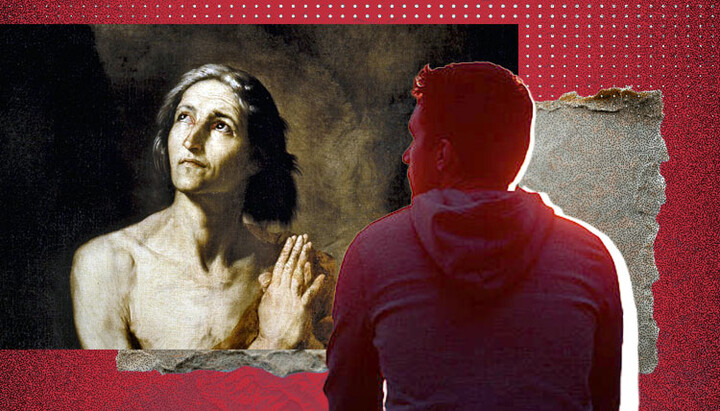
The repentance of the harlot. Photo: UOJ
She had no intention of going to Jerusalem. To be honest — she had no intention of going anywhere at all, except to the next man. In Alexandria, which Saint Mary of Egypt left at the age of twelve, she spent seventeen years in behavior that is difficult to describe in words without falling into moralizing. It wasn't about money — she herself later confessed to Elder Zosimas that she often refused payment. Passion possessed her so completely and for so long that the very thought of stopping seemed unreal to her.
When she saw a ship at the pier carrying pilgrims traveling for the Feast of the Exaltation of the Holy Cross, there was no religious awe in this woman’s heart. “Intending to entice as many people as possible into sinful passion,” this is how she herself explained her decision to Father Zosimas to board the ship. In essence, one could say that God brought Maria to Jerusalem with bait.
A wall that does not punish
The Feast of the Exaltation of the Cross of the Lord. Mary mingles with the crowd of pilgrims and walks toward the doors of the Church of the Holy Sepulchre. People enter, she walks with them — and suddenly runs into something that isn't there. Twice, three times she tries to enter, and each time she is thrown back to the wall of the narthex. Meanwhile, others pass through freely.
Theologians sometimes speak of this moment as "punishment." But if you think about it — this is no punishment at all. A light bulb doesn't punish water for conducting electricity — it simply cannot burn in water. Incompatibility — this is a more accurate description of her condition.
Maria faced the fact that her inner reality and the sanctity’s grace were so far apart that there was simply no common point of contact between them.
How many of us come to church with the same feeling – that there is a wall, though invisible, that something is not letting us in? It's not God who closed the door. It's that we haven't yet reached the height at which this door is located.
An icon of the Most Holy Theotokos hung on the wall of the narthex. Mary looked at it – and for the first time saw herself from the outside. Not from others' words, not from someone's reproaches, but as in a mirror. This is the beginning of metanoia, which we translate as "repentance," but literally this word means "change of mind." Not a change of behavior, but a change in the very way of seeing.
Seventeen vs seventeen
Mary went beyond the Jordan taking with her three loaves of bread – they turned to stone on the journey, but nourished her for many years. She spent forty-seven years in the desert, of which the first seventeen passed in unceasing war with her own memory.
This coincidence – seventeen years of sin and seventeen years of struggle – cannot be considered accidental.
It took just as long for the sinful woman to repent as it had for her sins to build up.
"When I began to partake of food, immediately came the thought of meat and wine," she told Zosimas. "Sometimes the desire would arise to sing sinful songs I was used to." The desert did not rid her of her passions instantly. It provided a place where she could fight them without external influence.
We often think of repentance as a moment – said "forgive me," received absolution, and went on. But the story of Saint Mary shows something different: it is a process of reconstruction, long and painful, during which what had taken root over the years is is eradicated.
Zosimas and what he lacked
The monk Zosimas had lived in the monastery for fifty-three years. He was strict in fasting, precise in prayer, knowledgeable in Scripture. And once – the hagiography recounts this without embellishment – he had a thought that there was no one who could surpass him. God answered him in His own way: He sent Zosimas to the desert beyond the Jordan.
There he met a human being that he first took for a phantom: blackened by the sun, naked, with hair white as snow — unlike anything living. This was Mary. She knew his name, though she had never seen him. During prayer she rose above the ground by a cubit. Scripture, which no one had taught her, she quoted freely. "I am nourished and covered by the voice of God," she told him simply.
Zosimas, who had labored over himself his entire life according to monastic rule, stood before a woman who had come to God not through rule, but through the abyss.
And it was precisely the abyss that gave her what the rule could not: complete absence of illusions about herself. Mary never considered herself good. This freed up space in her for something greater.
We, the "right" believers, observing fast days and regularly attending services, sometimes fall without much effort into Zosimas's quiet self-satisfaction. It seems to us that God is pleased with our orderliness. But next to Mary, orderliness means little – there is a different measure there, a different fire.
When the desert comes to us
We now live in a world that unexpectedly and against our will has given us its own desert. War, fear, forced isolation, etc. — these all deprive us of the familiar anesthetics we used to drown out our inner voices. And it turns out that those voices haven’t gone anywhere; they were simply waiting for silence to set in.
Saint Mary told Zosimas that in the desert there was nowhere to run from herself.
This is the main gift that the desert gives to a person – the impossibility of further flight. When there is nowhere to run, all that remains is to stop and look at what you have inside.
The first reading of the Canon of Andrew of Crete has concluded. For four days it listed examples of falls for us – Adam, Cain, David – and each time asked: and you - which of them are you? Now, in the finale, it draws before us the image of Mary.
We call upon her in prayer precisely because she knows firsthand what the hellish abyss is and how one can emerge from it through radical transformation of oneself.
Read also
The Weeping Queen of Blachernae
On the night of the Feast of the Protection, only two people witnessed the miracle in the Church of Blachernae. Everyone else prayed and saw nothing. Yet they, too, received grace.
Deadly spiral of human hatred
The tragedy of Lebanon's civil war lays bare how dehumanization and fear can turn human beings into monsters.
Woe to expectant mothers – or to those of little faith?
God commanded one prophet not to have children, yet told his people in exile to bear sons and daughters. What does this apparent contradiction tell us today?
The help God never asked for
Uzzah wanted only to keep the Ark of the Covenant from falling into the dust. Why did this well-intentioned act cost him his life, and who was really responsible for his death?
Freedom begins when there's nothing left to take
Fear of persecutors takes root in our attachment to possessions. We turn to St. Basil the Great to understand why the prefect's threats held no power over him.
The bride in the window frame
The author of the earliest account of St. Thecla’s life was defrocked. Yet it was his book that preserved the only ancient description of the Apostle Paul’s appearance.