Candle stubs and a clear conscience: The story of altar server Sasha
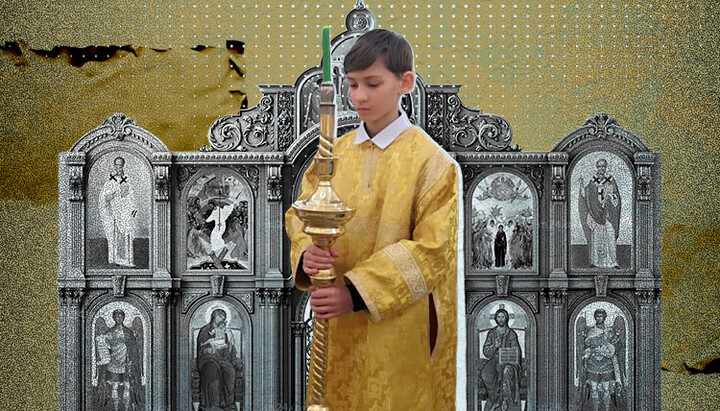
A lesson for an altar boy. Photo: UOJ
On our parish, altar server Sasha was considered an experienced ponomar compared to the “pencil-kids” – that was his slightly condescending nickname for the younger servers who tended to get in the way more than they helped.
“First,” Alexander instructed them, “a professional ponomar must arrive at church earlier than everyone else” – like the Morning Angel. “Ponomar” in translation means “assistant.” Then – make three bows to the Holy Table. After that, light the lamps before the deacon arrives, switch on the electric kettle so the water is hot, and turn on the electric hotplate where the coals are placed to light the censer.
“Second, when the priest comes, you need to ask his blessing to vest in the sticharion, and prepare water for Father to wash his hands – and hand him the towel.”
Sasha skipped many other service details included in an altar server’s duties, taking into account the age of his trainees.
School of church servants and the art of sexton
Once upon a time, in the last century, such sextons were called dyachki, Father told Sasha. Among other things, on feast days they would read Old Testament paroemias on the kliros, ring the bells, assist the bishop like subdeacons, and perform many other liturgical tasks.
Of course, Sasha-Alexander was respected among the other servers of the cathedral. He gave instructions – who should go out with candles, and who with the holy oil for anointing the faithful. And most importantly, he knew which vestments to prepare for the serving priest, and which mitre to retrieve for the rector.
A special responsibility lay on young Alexander in reading the Epistle. For this he had to find the liturgical directions in the church calendar, prepare in advance, and read the text in Church Slavonic with the accompanying dialogues – a responsible and important task. Naturally, both clergy and parishioners predicted a path for him to seminary, to the academy, and to ordained service – something he himself occasionally dreamed of, watching the priests and deacons in their magnificent vestments.
A blackout as a test
A major trial for Sasha the ponomar came with the war and the shelling of the city. Electricity and heating began to be cut off. The apartment was cold, while in church the light came from candles and an installed generator.
And then the temptation happened.
As usual, Sasha was the last to leave the altar. Before that he took the vacuum cleaner from the cupboard, cleaned the altar carpet, tidied the sexton’s room, scrubbed the censer, locked the altar from the inside, and got ready to go home. His eyes fell on a little table where wax candles lay – candles removed from the stands after the service to be replaced with fresh new ones.
Later, the used candles would be collected in boxes and sent somewhere to a candle factory for melting down, and new ones would return in their place. Especially valued were the candles that did not drip molten wax down the sides and that burned long, without splashing hot wax onto the Holy Table or the clergy’s vestments. It was precisely such a small bundle of used candles that altar server Sasha slipped into his backpack – to light them at home, to his mother’s delight, when the next blackout came.
Light in the kitchen, darkness in the soul
His mother truly did rejoice at the novelty: the kitchen became brighter and cozier. For nothing warms the soul like a candle flame, one of the priests in church used to say. Still, his mother asked:
“Were you allowed to take these home?”
Alexander replied that there was no need to ask anyone, because the candles were no longer really candles – only stubs, even if large ones.
“Still, I think you should have asked for a blessing,” his mother concluded gently.
Doubts crept into Sasha’s heart. He brushed them aside, reasoning that he served as a ponomar completely selflessly, and had every right to take 5–7 used candles for himself. And so the candle question was closed – though in his soul it remained open.
“All right,” he thought to himself before sleep, after evening prayers. “Who needs these stubs? They’ll go for melting anyway. And how many new candles would come out of them? Let’s say three large ones. A candle like that costs 25 hryvnias at the candle kiosk. That means I stole 75 hryvnias from the Church! And that means,” Sasha continued, “I broke God’s Eighth Commandment, ‘Thou shalt not steal.’ Therefore I am a thief and a criminal – a sacrilegious looter!”
Poor Sasha, at that self-accusation, turned red and broke into sweat. “And you will burn in the unquenchable fire, where there is weeping and gnashing of teeth…” Terrified by such a dreadful prospect, he nearly cried, and barefoot he padded into the kitchen, gathered up the candles, and wrapped them again in a plastic bag.
The deacon’s voice and victory over himself
On Saturday, as usual, he came to serve in the altar and brought the ill-fated candles with him. As he pulled the bag from his backpack, he heard the deacon’s thunderous question:
“And what have you dragged in here, Alexander?” the deacon’s bass boomed over the terrified altar server. And Sasha felt as though in the deacon’s hand was not the end of a golden orarion, but a gleaming sword that would strike off his sinful head. A lump rose in his throat, and the pale ponomar, with tears in his eyes, forced out:
“Father, I took the stubs of those big candles home, and then I realized I shouldn’t have done it – because I acted like a thief and a robber, since I took them without a blessing. That means I stole and am subject to God’s judgment. And they will strip me of my altar service and anathematize me…” the poor boy stammered, and burst into tears like a five-year-old child.
The deacon stared at him, stunned and bewildered.
“Well, you really went for it, Sasha!” he rumbled. “Of course, in your case it wouldn’t have hurt to ask for a blessing – because without a blessing you shouldn’t even take a step in church. But go to the rector after the service, and I’ll tell him myself to give you a dozen large candles in gratitude for your labors. And, by the way, I’ve just been reminded of an episode from Metropolitan Anthony of Sourozh: when he was a young man at a scout camp, he stood over a pencil stub, wrestling with himself – take it or not. And he overcame the temptation and did not take it. And you, by returning these candle stubs, have overcome a temptation too – small, perhaps, but real. May Christ save you!”
Read also
Archpastor's word for weary city dwellers
When exhaustion weighs us down, we turn to ancient sermons to ask profound questions about human destiny and the nature of existence.
Brother of tax collector and brother of Lord
The Gospel is silent about the son of Alphaeus, and commentators have argued for centuries over who he was. And the Church commemorates two apostles named James in close proximity.
Prayer commemorations instead of loving embraces
At every Orthodox wedding, the choir sings a hymn to the martyrs. For families separated by war, these words carry a special meaning.
Honest atheism vs. spiritual hypocrisy
The 70th anniversary of Albert Camus’s Nobel Prize recalls an uncompromising challenge to Christianity. An honest unbeliever brings theology back to the mystery of the Cross.
The valley of trouble and the gateway of hope
One soldier buried an expensive cloak and some gold beneath his tent. Because of this, all Israel lost a battle. Why did one man’s sin bring disaster upon an entire nation?
From love spells to bishop's throne
Antioch’s most powerful sorcerer sent demons against a devout young Christian woman three times – and failed every time. In the end, a demon himself revealed the truth that led to his conversion.