The practice of lay communion: how it has changed over 2,000 years
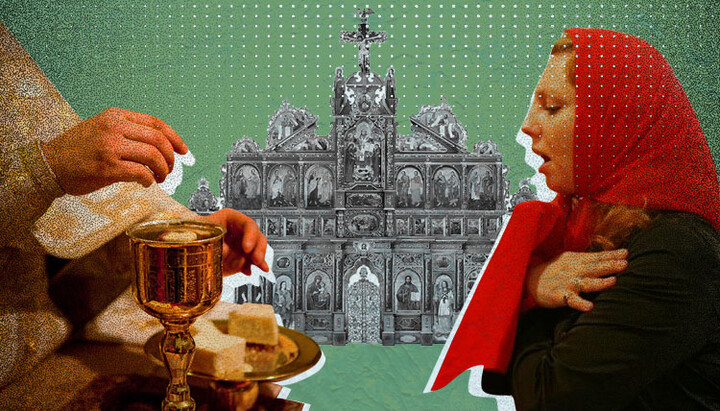
Communion: tradition and modernity. Photo: UOJ
In the afterword to the article “The Veneration of Saints: From the Reformation to Our Days,” it was noted that the development of the veneration of saints and the fading of the practice of frequent Communion of the Holy Mysteries of Christ roughly coincide chronologically. Whether there is a connection between these two phenomena, we leave for readers to decide; here we will try to briefly outline the history of how the practice of lay Communion developed.
Communion in the Early Church
Beginning with the Mystical Supper, at which Jesus Christ established the sacrament of the Eucharist, it became the central act of the Church’s life. We find a description of the liturgical life of the first Christians as early as the second chapter of Acts: “And they, continuing daily with one accord in the temple, and breaking bread from house to house, did eat their meat with gladness and singleness of heart” (Acts 2:46).
Believers went each day to the Jerusalem Temple for prayer, and then gathered in someone’s home to celebrate the Eucharist.
From this it follows that the norm was daily Communion of the Holy Mysteries of Christ.
There is evidence that in some places this practice continued until the fifth century. One interpretation of the Lord’s Prayer says that the words “Give us this day our daily bread” refer to the Body of Christ – the “supersubstantial” Bread – which we ask for each day. Today, a faint echo of daily Communion remains in the custom of taking prosphora and holy water in the morning.
The Eucharist itself was celebrated in common gatherings, and afterward believers took the Holy Gifts home and communed between the eucharistic assemblies. St Basil the Great (4th century) writes of this practice among monks: “All who live in the desert, where there is no priest, keep the Eucharist with them and commune themselves.” St Cyprian of Carthage (3rd century) writes of Christians who, during persecutions, kept the Holy Gifts at home and communed on their own: “Believers, being in prison or in exile, communed of the Holy Mysteries which they kept with them.”
And of course, it was taken for granted that all believers would commune at every Liturgy.
Meeting Christ in the Mystery of the Eucharist was the sole purpose of this service. For this the community gathered; for this prayers were offered; for this believers often risked being seized and handed over to torture. There were no formal rules of preparation. What mattered was faith and an inward disposition.
Yet even from apostolic times there are references to worthy and unworthy Communion. Thus the Apostle Paul writes to the Corinthians: “But let a man examine himself, and so let him eat of that bread and drink of that cup. For he who eats and drinks unworthily eats and drinks judgment to himself, not discerning the Lord’s Body” (1 Cor. 11:28–29). To commune unworthily means to approach without faith that these are truly the Body and Blood of Christ, without reverence and longing for Christ, while remaining in grave, unrepented sins.
The radical turning point of the 4th century
In the fourth century the Church undergoes a radical turning point in its history. Christianity becomes the state religion and begins to perform governmental, public, and other functions not proper to it. Vast masses formally join the Church – people who had no real desire to exchange a pagan worldview for a Christian one. The level of catechesis and personal ascetic struggle drops sharply. The Church becomes entangled in politics and geopolitics.
All this profoundly affects popular piety. The cult of saints and the veneration of iconographic images emerge in the form recognizable even today. The attitude toward the Eucharist also changes. A crucial shift takes place in religious consciousness: the Eucharist ceases to be a “meal of brotherhood” and becomes a “sacred action of the clergy.” The clergy grows distant from the laity and by the Middle Ages becomes a closed caste, a distinct social class. The clergy continues to commune at every Liturgy, while the laity communed less and less. As early as 506, the local Council of Agde recommended Communion at least three times a year – at Christmas, Pascha, and Pentecost.
The very way people looked at Communion changes at its roots. From a source of life and spiritual strength, Communion becomes something holy and fearsome – something one may approach only after lengthy ascetic exercises, repentance, fasting, and prescribed prayers.
Communion is no longer medicine for sin, but a reward for temporary “holiness” achieved during the period of preparation. The relationship with God also changes: from a merciful Father He is increasingly perceived as a righteous Judge.
The Middle Ages
By this time a customary preparation for Communion had taken shape, including fasting, a rule of prayers, and confession. This penitential discipline was strict and prolonged. In the West it became more formalized; in the East, less so. At the same time, the notion spreads that a person is sinful and unworthy of Communion – constantly. The prescribed preparation makes him, for a brief moment, if not “worthy,” then at least able to approach. In the West this is intensified by a tendency to reduce the relationship between God and man to a juridical dichotomy of sin and punishment.
A telling example for Western Christianity is the decree of the Fourth Lateran Council (1215) that believers must receive Communion at least once a year during the Paschal season. This minimum was introduced not because people were communing more often, but because they had stopped communing at all.
This is evidence of a decline in eucharistic tradition. Communion was to be approached with the greatest consciousness – but with the greatest rarity.
The paradox is striking: the more the Church spoke about the importance of the Eucharist, the less often people approached it. The more dogmas about Christ were formulated, the less people united with Him in the Mystery of Communion. In the East there were no formal canonical rules about frequency, but in practice the pattern was much the same as in the West.
Modern and contemporary times
This practice continued into the modern era. In some countries the sacrament even became a civic obligation. For example, in the Russian Empire every official was required to produce a certificate proving that he had communed once a year. St Ignatius (Brianchaninov) recalled that, when he was an officer, he went to receive Communion in different churches so that priests would not report him for communing too often.
And it was not only St Ignatius Brianchaninov who sensed that something was wrong with the practice of Communion. On Mount Athos the Kollyvades movement arose (18th century). Its representatives – the best known among them being St Nikodimos the Hagiorite – opposed the entrenched practice of rare Communion. They argued that it did not correspond either to Holy Scripture or to the Tradition of the ancient Church.
In his book On Frequent Communion (1777), Nikodimos wrote: “It is not boldness to approach the Divine Mysteries often; boldness is to approach them unworthily. But to approach often with repentance and humility is saving and necessary.”
At the end of the eighteenth and the beginning of the nineteenth century, several Synods in Constantinople recognized the permissibility of lay Communion at every Liturgy, provided the believer was in a proper spiritual state.
In the West, by contrast, fear of unworthiness for a time became even stronger. This was encouraged by the Jansenist movement (17th century), which emphasized absolute predestination and the necessity of severe asceticism. Only at the beginning of the twentieth century did Pope Pius X proclaim a return to frequent Communion and to an understanding of the Eucharist as medicine for the weak, not a reward for the perfect. The rules of preparation were significantly simplified. In 1957 Pope Pius XII reduced the eucharistic fast to three hours without food and one hour without water and non-alcoholic beverages. In 1964 Pope Paul VI reduced the eucharistic fast to one hour for all. Contemporary Catholic theology proceeds from the premise that a believer in a state of grace can and should receive Communion as often as possible, up to daily Communion.
The Eucharist as a mirror of Christianity
Contemporary Orthodox theological thought develops St Nikodimos’s idea that Communion is not a privilege of the perfect, but a vital necessity. Today the practice of Communion is quite uneven – not only from country to country, but from parish to parish. In some places, communing several times a year remains the norm; in others, the norm is Communion at every Liturgy. Strict preparatory rules (a three-day fast, a prayer rule, obligatory confession) are softened in some places and remain mandatory in others.
Church canons are considerably milder than the customary tradition of preparation. The canons prescribe an absolute fast only after midnight before the Liturgy, abstinence from marital relations on the night before Communion, and forbid Communion to those in grave unrepented sin or those barred from Communion by a priest or bishop. Everything else – the prayer rule, obligatory confession, and so on – is not prescribed by the canons. But this does not mean the established tradition should be treated with contempt.
The history of lay Communion is not merely a history of disciplinary rules, fasts, and external prescriptions. Above all, it is a history of how the Church has understood the relationship between man and God. In the early Church the Eucharist was the breath of the community and of each Christian – received as the food and drink of eternal life. As the Church became a state and social institution, the Eucharist gradually turned into an object of reverent distance.
Today the Church is gradually returning to the understanding of the Eucharist that prevailed in the first centuries: a person communes not because he is worthy of Communion, but because he needs it.
In the end, the question of Communion practice is the question of who we believe ourselves to be before God: prodigal sons, whom the Father waits for and calls to His feast – or hired servants who must first earn the right to approach the table.
Read also
Trial of a dead pope
Once in Rome, the body of a deceased pope was seated on the throne and put on trial. The accusation relied on a church canon that had once saved his see.
Monastery built in defiance of king
When Orthodox believers in Minsk were left with just one church, townspeople decided to build another – and even a royal decree did not stop them.
Young Mother and Sleeping Christ
Michelangelo carved a Virgin Mary who looks younger than her Son – and signed his name in marble for the only time in his life. Neither of these peculiarities was accidental.
Orthodox books from a Uniate printing press
In the 18th century, Uniate monks at Pochaiv printed books used in prayer by Orthodox Christians and Old Believers alike.
The story of the honey brotherhood
The Mogilev Brotherhood began with members pooling money to brew honey drinks for feast days – and eventually grew to have its own printing press.
Golgotha in the midst of a pogrom
In the autumn of 1938, the Jewish artist Marc Chagall painted the crucified Christ. Synagogues burn and refugees flee around the cross, while the Crucified One Himself is wrapped in a prayer shawl.