
Anathema in the name of a dead man
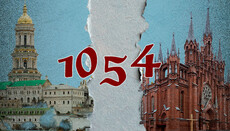
In 1054, the Christian world split because of a document with no legal force. This is the story of how ambition and a chance scandal proved more powerful than unity.
The pope whose legates entered Hagia Sophia had already been lying in his grave for three months. A cardinal in a red mantle cast a decree onto the altar – a decree that possessed no force, either canonically or humanly speaking. And thus the world was divided.
If there is any terrifying genius in this story, it lies in one detail – a legal one. Pope Pope Leo IX, who had sent the legates to Constantinople, died on April 19, 1054.
According to the Church law of that time, the mandate of a papal envoy expired upon the death of the pontiff who had commissioned him. Which means that the man we habitually call “Cardinal-Legate Humbert,” when he burst into Hagia Sophia on July 16, was simply a foreigner in a red hat.
At that moment, Cardinal Humbert was a private individual from Lorraine. A tourist with colossal self-importance. The decree he hurled onto the altar had no force. The anathema he proclaimed was not an anathema. The schism that divided the Christian world for a thousand years was formalized by a document that no longer had an author.
It is worth recalling how this whole story began. Not with the Filioque, nor with the nature of the Holy Spirit. But with bread. The Latins served using unleavened bread – flat bread without yeast. The Greeks used leavened bread – risen dough.
Bread as a cause for war
Theologically, these two traditions reflected different emphases: the Passover bread of ancient Israel, or the living, breathing dough of the Resurrection. Arguments over which bread was “more correct” had existed in the Church for centuries and had unfolded calmly over generations.
But beginning in the mid-11th century, politics entered the dispute. In Southern Italy, the Normans were conquering Byzantine territories and forcibly converting Greek parishes to the Latin rite. Greek priests who refused to serve with unleavened bread lost their churches. News of this reached Constantinople – and the ambitious Patriarch Michael Cerularius decided to respond in kind. He closed the Latin churches in the imperial capital.
A theatrical gesture in Hagia Sophia
Sakellarios Nicephorus, sent by the patriarch to enforce the decree, burst into Latin churches and ordered the Holy Gifts to be shaken out of the tabernacles. He did this directly onto the floor. He then demanded that they be trampled underfoot – because, in the logic of the aggressor, those Gifts were supposedly “without grace.”
This was utter madness: Christians of two rites, disputing how the Body of Christ should properly be offered – were trampling upon Christ Himself.
There were no dogmatic grounds for this whatsoever. There was merely a rite that its defenders had transformed into a banner. And there was bread, transformed into a weapon in the struggle against an opponent.
A list of false accusations
In April 1054, Pope Leo IX dies. In Rome, the conclave moved slowly: the next pope would not be elected until 1055. The delegation of legates, dispatched while Leo was still alive, had by then already arrived in Constantinople.
According to the canons, they should have turned around and left. By ordinary human logic – even more so. But according to the logic of wounded pride – no. Cardinal Humbert, the Lorrainer, a hard and educated man, had no intention of departing without triumph.
The patriarch, meanwhile, made it clear that he would not negotiate with the legates as equals: at the council, he seated them in the last places. Humbert was offended and broke off the talks.
A bull in the street dust
On Saturday, July 16, 1054, the Divine Liturgy was being celebrated in Hagia Sophia. The church was filled with people. Cardinal Humbert and his entourage passed through the entire crowd of worshippers, ascended to the altar, and placed upon it a papal bull excommunicating the patriarch. Silently. Without explaining anything to the people. Then he turned and walked toward the exit. At the doors, he dramatically shook the dust from his feet, just as the apostles once shook dust from their sandals when leaving a city that had rejected them.
The text of the bull contained a list of accusations capable of bewildering anyone. The Greeks were accused of simony (even though Byzantium had long ceased to struggle with this as a systemic problem). They were also accused of Arianism – a heresy that by the 11th century had long been dead. They were accused of selling church offices, rebaptizing Latins, and refusing to baptize infants before the eighth day.
And above all – of removing from the Creed the procession of the Holy Spirit “and from the Son.” Today, every third-year seminarian knows that the Filioque – “and from the Son” – was inserted into the Creed by the Latin tradition. The Greeks removed nothing from the Creed. It was a Western addition, a fact now acknowledged even by Catholic scholarship. Cardinal Humbert, in essence, accused the Greeks of something they had never done, while attributing to them the very fault that belonged to the West.
The voice that became an echo
This is the classic pattern of every schism: dogma becomes a club wielded blindly.
Immediately after the legates departed, a small, almost unnoticed scene unfolded in the church. One of the subdeacons of Hagia Sophia seized the bull left upon the altar, ran out into the street after the delegation, and begged Humbert to take it back.
Humbert refused. Then the subdeacon – whose name history did not preserve – threw the bull directly into the street dust of Constantinople. The document that would, a thousand years later, be called the act that divided the Christian world lay for some time simply on the pavement.
Mercy is more important than precision
During those months, a single letter traveled between Italy and Constantinople. It had been written by Patriarch Peter III of Antioch – a man almost never mentioned in this story. He was an observer from the sidelines and tried to stop the madness.
Peter of Antioch wrote to Michael Cerularius: the Latins err in their rites, err in their fasting, err in their bread – but they are still our brothers. Show them condescension, he pleaded; do not lose what is essential for the sake of achieving absolute precision in every detail.
Peter III implored Cerularius in the same tone with which Abraham spoke to God about Sodom: just a little more mercy, just a little more patience, and perhaps the situation would heal itself. He was not heard.
Forgotten mutual resentments
The voice of a man calling for peace in the midst of conflict always sounds like the voice of a traitor.
In 1965, Patriarch Athenagoras I of Constantinople and Pope Paul VI jointly lifted the mutual anathemas of 1054.
They declared that the reciprocal excommunications were “consigned to oblivion.” On paper, the schism was abolished nine centuries and six years after Cardinal Humbert flung his bull onto the altar of Hagia Sophia. But, as we all know, real unity was not restored.