The man who painted with his mind: Theophanes the Greek and his white lightning
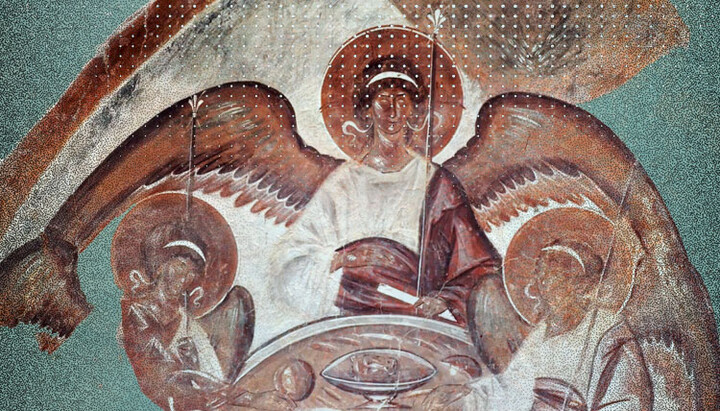
Fresco "Trinity" by Theophanes the Greek. Photo: UOJ
One man saw Theophanes at work and left a written account of it. His name was Epifaniy the Wise – a bookman, a traveler, a man who knew how to look closely. In his “Letter to Kirill of Tver” (1415) he returns to that memory again and again, as though he cannot quite believe it himself. Theophanes, Epifaniy writes, while painting “never looked at models, as our icon painters do.” He spoke with visitors, reasoned about theology, answered questions – and all the while kept painting without pause. His hand moved as if by itself, as if someone else were guiding it.
Epifaniy searched for words for a long time and found the only ones that fit: to him, Theophanes looked like a man “painting with his mind, not with his hands.” The icon painter worked in buon fresco – on wet plaster that dries within a few hours. That meant every section of wall had to be finished in a single sitting. A mistake could not be corrected. Every stroke was final – like a word spoken aloud.
The “drive” on a fresco
The only fully preserved cycle of his wall painting is in the Church of the Transfiguration of the Savior on Ilyina Street in Novgorod, dated 1378. You step inside – and immediately understand you have entered a space that lives by different laws.
From the dome, the Pantokrator gazes down – a face of God nearly three meters across, dark and severe, with an asymmetry in the eyes that will not let you rest. The right eye looks straight at us. The left – past us, toward some point behind our backs.
But what holds your gaze the longest is not the eyes, and not the scale. It is a small white slash on the cheekbone. Sharp, almost coarse, refusing to melt into anything around it. Restorers call it a “drive” or a “highlight.” Technically, it is the final layer of white laid over the base tone. The method is well known – every icon painter uses highlights. Many do it with a gentle transition: a gradual brightening, a flare that settles onto the form almost invisibly.
With Theophanes, there is no such softening. He takes pure white – and strikes our eyes with a flash against dark ochre.
When you see it for the first time, you want to step closer and check: perhaps the plaster has chipped away? No. It is deliberate – and it repeats on every face: on the pillar-dwellers, on the Angels in the “Trinity.” The same gesture, the same refusal of smoothness. Viktor Lazarev, who devoted an entire monograph to Theophanes the Greek, described his manner as “the art of inhalation and exhalation.” That “drive” really does resemble an exhale – brief, abrupt, and joined to nothing.
An echo of hesychasm
There are different ways to explain why Theophanes painted like this. One can speak of temperament – hot, impatient, unwilling to sand anything down. One can speak of the expressive tradition of late Byzantium in which he was formed. But there is another explanation – theological – and it is more precise than the rest.
Theophanes arrived in Rus roughly twenty years after one of the most important theological events of the fourteenth century. In 1351 the Council of Constantinople settled a dispute that had lasted for decades and had drawn in the finest minds of the age. The essence of it was this: the Athonite monk Gregory Palamas maintained that the light of Tabor – the light the apostles saw on Mount Tabor at the Transfiguration – was not created, not something God produced “for that occasion.” It was God Himself – His energy, real and accessible to man. “God is light, not in essence, but in His energy,” Palamas wrote. His opponent, Barlaam of Calabria, insisted the opposite: God is unknowable and inaccessible, and the light on Tabor was a beautiful effect – nothing more.
The Council sided with Palamas. And Theophanes, raised within that theological atmosphere, brought the hesychast victory to Rus in the most literal way – in a jar of white pigment. Every one of his “drives” is a visual claim: the uncreated light is real; it pierces matter and leaves its mark upon it. Precisely like this – sharp, unsoftened.
Leonid Ouspensky, in “Theology of the Icon,” put it differently, yet aimed in the same direction: Theophanes’ “drives” are not the depiction of light – they are its manifestation.
The difference is fundamental. Depiction is always a little lie, because it pretends to replace what it depicts. Manifestation is a fact of presence. The white on the Pantokrator’s cheek does not tell us about light – it is light, to the extent that such a thing can be made visible on a wall.
Faces with an inner beauty
Let us come down from the dome into the diaconicon – a small chamber east of the altar. Here Theophanes painted the pillar-dwellers: Daniel and Symeon the Younger. These are no longer faces in the ordinary sense of the word. They are skulls drawn tight with dry skin, with hollowed eye sockets from which, against all anatomical logic, light bursts forth.
Mikhail Alpatov wrote of these images briefly and exactly: “Theophanes paints not saints, but their ecstasy.” Let us add – and the price of that ecstasy. Stylitism is decades on an open pillar: no roof, no horizontal life, no ability to lie down. Theophanes does not hide it and does not beautify it.
His stylites are men whose flesh seems to have gone into the fire – and only what does not burn remains.
The white flashes on sunken cheeks are not visible beauty. They are what breaks through to the surface when no beauty is left.
Theophanes and Rublev on the same scaffolding
In 1405 Theophanes the Greek and the young Andrei Rublev painted the Annunciation Cathedral – together, on the same scaffolding. We do not know what they said to one another. But their icons still speak to each other – and that conversation has never ended.
Rublev painted with smooth transitions of color – soft, flowing tones, an azure that does not strike the eye but gathers the viewer into its embrace. His faces shine evenly and quietly from within, as though what burns in them is not fire, but a candle behind glass. It is a world where God is present as repose – deep, endless, warming.
Theophanes painted otherwise. With him, God is present in tension. He does not threaten – but he does not soothe.
Dmitry Likhachev linked that severity to Theophanes’ historical experience: he grew up in Constantinople, a city that already knew it was dying – from the “black death” of Turkish pressure. He sensed history rushing toward an ending. His art is the art of a man who saw catastrophe up close. Rublev painted an ideal world as he longed to see it. Theophanes painted the world as he saw it now. And both were right – showing us the invisible world of the Heavenly Church from different sides.
Read also
Man before the forces of nature
A solitary figure on the shore seems insignificant before the immense power of the sea, yet it is he who stands before the Creator.
The mysteries of Golgotha in the light of archaeology
The veil of centuries obscures what really happened in the fourth century. Archaeology and ancient texts shed light on the true history of one of Christianity’s greatest sacred sites.
Zaporozhian Cossacks defend the persecuted faith
The story of how Cossacks drew their sabers to defend abused priests – while sometimes causing violent disturbances inside churches themselves.
A forgery at the foundation of Mohyla Academy
For centuries, historians have repeated an appealing story about a wealthy benefactor’s generous gift. Archival documents, however, paint a very different picture of what happened.
Theology of worn-out shoes
A painting of a pair of old shoes in a Dutch museum preserves the memory of an ordinary working person and a life of hard labor.
Everyday life and labors of the Lavra brotherhood
We are accustomed to seeing the Pechersk Monastery as it appears on picture-perfect postcards. Archival records from the 19th century take us back to the down-to-earth realities of monastic life.