Persecution of UOC and liquidation of UGCC in 1946: Are there parallels?
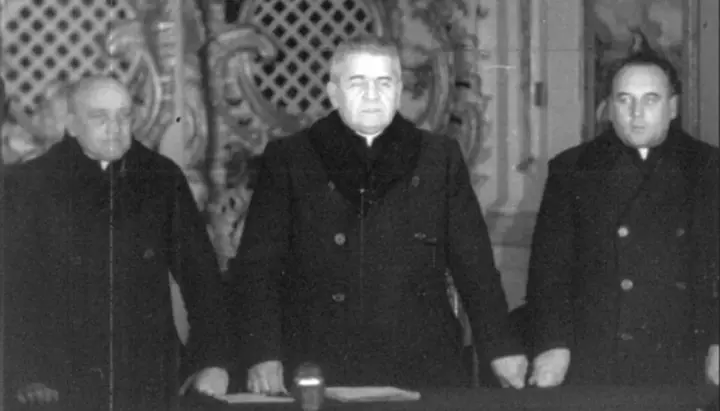
The Lviv Council of 1946. Photo: open sources
From March 8 to 10, 1946, the Lviv Church Council was held, at which the liquidation of the UGCC was proclaimed and its clergy and faithful were declared joined to the Russian Orthodox Church. Today, the authorities and the Uniates are holding conferences devoted to that event. Their central thesis is that the UGCC was liquidated because it refused to become a servant of Stalin’s criminal regime.
This, in particular, was stated by Voinalovych, deputy head of DESS: “In the 1940s, the Church effectively faced a stark choice without compromise: either to become an instrument of the Soviet regime or to remain unconquered while fully aware of the consequences.”
Historians maintain that after the defeat of the Nazis and the liberation of Western Ukraine, the leadership of the UGCC initiated negotiations with the Soviet authorities over the future of its structure. One meeting took place in Moscow, another in Lviv. The only demand the authorities made of the Uniates was that they act as intermediaries in negotiations with the OUN-UPA. They were expected to appeal to those formations to lay down their arms.
But the UGCC refused to do so. Ivan Hrynokh, chaplain of Nachtigall, would later write: “The delegation was asked to take part in the struggle against the Ukrainian insurgents. Our explanations were of no avail – that the Church cannot directly and actively involve itself in an entirely politicized internal conflict.”
Of course, no one can guarantee that, had the UGCC agreed, the Soviet authorities would have left it in peace. But it was given a choice. A choice that the Orthodox did not have in 1596, when the Union was imposed on these lands through deception and force.
The parallels that the authorities are drawing today with the events of eighty years ago deserve separate attention. The official narrative is built around the “continuity” of present-day Russia, which persecutes Greek Catholics in the occupied territories of Ukraine. Yet for some reason their words evoke quite different associations.
For example, Voinalovych says the following: “Back then, the authorities also spoke of ‘agents of the Vatican,’ of a ‘threat to the state.’ Today – the same accusations. In effect, directed at one another. Almost like a carbon copy.”
Doesn’t that sound familiar? Simply replace “the Vatican” with “Moscow,” and the whole phrase begins to look exactly like the accusations now being leveled by the authorities against the UOC. DESS has also stated that after the banning of the UGCC, it “developed a unique experience”: “in the underground, in the catacombs, through the transmission of tradition, formation, ordinations, and continuity of ministry despite pressure.”
Today, in Western Ukraine, communities are likewise developing a “unique experience” of underground existence, hiding from the state and from “activists,” while in other parts of Ukraine hundreds of parishes, after the seizure of their churches, are serving in basements, private homes, barns, and the like.
So before our present authorities point fingers at the actions of occupiers, they might do well to visit an ophthalmologist and have the logs and splinters removed from their own eyes. In reality, their current policy toward the UOC differs very little from that of their Soviet predecessors eighty years ago.
Read also
Why is it legal to kill a person before birth but not after?
Children are the most privileged members of society. Yet that same society officially permits children to be killed – and on a massive scale.
Honoring the Bolsheviks’ successors at Kyiv Lavra
It was under the Reserve that the relics of the saints were desecrated, Lavra churches were turned into an atheism museum, and toilets were installed in sanctuaries.
"Degenerates" and "stupid animals": anti-UOC activists turn on children
Future historians will wonder how a vast country’s information agenda could have been shaped for so long by people so petty, vicious, and utterly contemptible.
Zelensky sees murder of Polish priest but not of Sviatohirsk monk
Why does Zelensky react so emotionally and swiftly to the murder of a Catholic cleric while remaining completely silent about the murder of an Orthodox monk?
UOC vs. OCU numbers: pollsters count, social media recount
Official polling suggests Dumenko’s structure has an overwhelming lead in the number of parishioners, while social media polls paint a very different picture. Which should we believe?
Who is working for the Kremlin in Poland? OCU, Uniates and Catholics versions
Who in the conflict between Poland and Ukraine is "an agent of the Russian Federation"? Zelensky, who gave the UPA name to an AFU special operations center? Nawrocki, who stripped him of an order for it? Polish MEPs?