The keys of Kaniv: How St. Martyr Macarius did not retreat before the horde
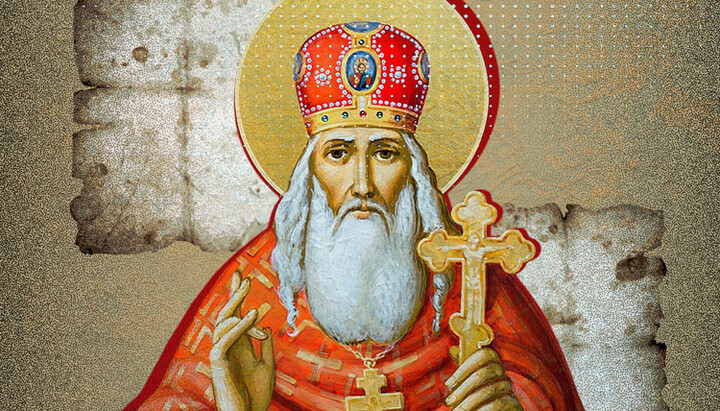
The feat of the Venerable Martyr Macarius of Kaniv. Photo: UOJ
Reading the chronicles of Samiilo Velychko and Hryhorii Hrabianka about September 1678, one realizes that Right-Bank Ukraine in those days smelled not of ripe apples, but of bitter soot and fresh human blood. The Hetmanate had been torn apart, Chyhyryn had turned into a smoldering ruin, and the Turkish-Tatar hordes of Kara Mustafa were moving north like floodwater filling every space that offered no resistance. A heavy haze from burned villages hung over the Dnipro, and only the Dormition Cathedral in Kaniv remained motionless – like a fixed point around which all that chaos slowly revolved.
It is here that we encounter the Venerable Martyr Macarius (Tokarevsky). A note in his own hand in the margins of John Chrysostom’s Homilies on the Fourteen Epistles of the Holy Apostle Paul lists his offices plainly and without any flourish: “Macarius Tokarevsky, Archimandrite of Ovruch, Hegumen of Pinsk, Kupiatychi, and Kaniv.” Behind each of those monasteries lay a front line in the struggle against the Union of Brest, and each time Macarius went where Orthodoxy was under the greatest pressure. By 1678, he already had behind him the devastation of Ovruch, a temporary refuge in the Kyiv Caves Lavra, and finally Kaniv, where that September invasion found him with a heavy ring of iron keys to the cathedral doors – keys that meant far more in those days than any golden regalia.
A fortress of prayer and ancient stone
The Dormition Cathedral in Kaniv, founded in 1144 under Prince Vsevolod Olgovich, was packed to the walls by early September 1678. Women, children, and the elderly from the surrounding ravaged settlements had streamed there like birds driven ahead of an approaching fire, unsure whether beyond the next hill there was even a single living tree left. The people placed their hope in the pre-Mongol walls and in their shepherd, who had every chance to cross to the left bank and save himself. But he did not cross.
One detail in the documents of that period is especially striking: shortly before the attack, Archimandrite Macarius had distributed all the monastery’s property to local people during a famine. So when the Turks reached the cathedral in September 1678, there was literally nothing left in the monastery treasury. That is important to remember when the question of the monastery’s “treasures” arises.
On September 4, the invaders stormed Kaniv. Venerable Macarius went out to meet them with a cross in his hands – directly onto the church porch, where he was seized at once. Witnesses recorded that he was suspended by his arms and legs between two posts, as though he were not a man but a warning sign. Behind him, inside the cathedral, beyond the locked oak doors, stood hundreds of defenseless people for whom this man was the last thread binding them to something stronger than wooden walls. According to those same witnesses, his calm affected the people more powerfully than the presence of an entire regiment of Cossacks.
A dialogue on the threshold of eternity: keys to heaven
The invaders demanded treasures – gold, church vessels, a demonstrative confession of defeat before the Orthodox faith. Macarius’s answer was preserved in an akathist composed from hagiographical sources: “My treasure is not on earth, but in Heaven. And the wealth of the Church is in the grace and mercy of the Lord.” This was not rhetoric. Having given everything away to the starving, he did not utter a single false word – there truly were no earthly treasures left in the monastery. That answer cost him his life, and he seems to have understood that perfectly well before he ever spoke.
For three days he was tortured – burned, beaten with iron rods, and kept hanging on the posts. According to the hagiographical sources, during all this time he did not let out a single groan and continued to pray. “One cannot receive the incorruptible crown except by lawfully accomplishing one’s подвиг” – he had told his flock even before the siege began. On September 7, 1678, when it became clear that this man could not be broken, the Venerable Martyr was beheaded.
A fiery liturgy on the Feast of the Nativity of the Mother of God
The faithful managed to carry the archimandrite’s body into the monastery church and shut themselves inside, condemning themselves – they understood this – to nearly certain death. When the Turks returned, they piled wood around the church and set it ablaze. The Kaniv cathedral became a mass grave for those who refused to save themselves without their shepherd – and to the invaders, that heap of ashes must have seemed like the final sentence on the Orthodox presence on the Right Bank.
When the surviving townspeople later began to sort through the bodies, one was found among the pile of charred remains untouched by the fire. The body of the Venerable Martyr Macarius lay in a hair shirt, with one cross on his chest and another in his hand, and according to the chroniclers, appeared “as if alive.” He was buried beneath the altar table of the monastery church on September 8, 1678.
In 1688, when the ruined church was being restored, the grave was opened – and the saint’s body was found incorrupt. On May 13, 1688, the relics of the Venerable Martyr were solemnly transferred to the Regimental Resurrection Church in Pereiaslav. For contemporaries, this transfer was more than a ceremony: it became the answer to the question his torturers had asked their prisoner in vain for three days – whose victory it truly was.
A cathedral that remembers much
There is one detail in the history of the Dormition Cathedral in Kaniv that is hard to dismiss as mere coincidence. In May 1861 – nearly two centuries after the death of Archimandrite Macarius – the coffin of Taras Shevchenko stood in that same building for two days before his burial on Chernecha Hill. The cart bearing his coffin from the cathedral to the hill was drawn by unmarried girls, while others strewn the road with green branches and fresh flowers.
The twelfth-century Dormition Cathedral remembers them both: the monk who met the Janissaries on the church porch with a cross in his hand, and the writer who went to penal servitude with a Bible in his pocket. Different roads, different ages – yet both, in their own way, chose this place as their last earthly resting place.
To this day, the name of the Venerable Martyr Macarius is spoken in Cherkasy region with that special intonation that distinguishes living memory from a dry archival line in a historical chronicle. And the keys of faith that he refused to surrender to cruel persecutors have never been taken away from the Orthodox, despite all trials.
Read also
Stories of the Early Church. Level of governance: patriarch
How did several episcopal sees rise above the rest, why did the Church’s administrative map come to mirror that of the empire, and is the patriarchate a sacred form of Church governance?
A Chronicle without an author
We are accustomed to calling The Tale of Bygone Years the work of St. Nestor. Yet another monk left his signature on it, while the chronicle itself passed from one generation of scribes to the next.
How a wedding stopped a war
The young princess of Slutsk was married off to keep two powerful noble families from drowning the city in blood. Soon afterward, a Uniate metropolitan complained that Orthodoxy had been reborn in Slutsk.
Man before the forces of nature
A solitary figure on the shore seems insignificant before the immense power of the sea, yet it is he who stands before the Creator.
The mysteries of Golgotha in the light of archaeology
The veil of centuries obscures what really happened in the fourth century. Archaeology and ancient texts shed light on the true history of one of Christianity’s greatest sacred sites.
Zaporozhian Cossacks defend the persecuted faith
The story of how Cossacks drew their sabers to defend abused priests – while sometimes causing violent disturbances inside churches themselves.