Myltsi monastery brethren: The monastery was handed over to us in ruins
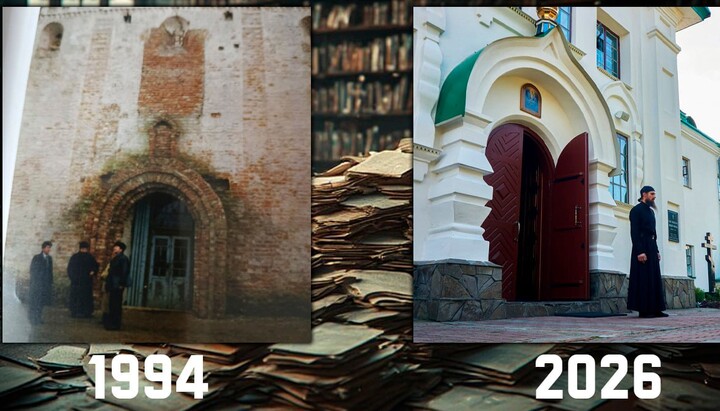
St. Nicholas Monastery in Myltsi in 1994 and 2026. Photo: Pershyi Kozatskyi
The brethren of the St. Nicholas Myltsi Monastery of the Ukrainian Orthodox Church in Volhynia have recounted the story of the monastery’s revival and described the devastated condition in which it was transferred to them after the Soviet period. The account appears in a documentary about the monastery released by the Pershyi Kozatskyi channel.
Archimandrite Alexander, the monastery’s dean, said that under Soviet rule the St. Nicholas Cathedral had been turned into a dining hall for a residential care facility. According to him, a large cooking vat was installed directly in the altar, on the very place of the Holy Table, where meals were prepared for the institution’s residents. The church itself had been divided into two floors with low ceilings, while the roof was leaking so badly that water and snow poured inside.
“The church was buried under nearly half a meter of garbage and construction debris. We had to carry all of it out with our own hands. The godless authorities had no interest in preserving the shrine, even though the church is about five hundred years old,” Archimandrite Alexander said.
He added that during the years when the monastery buildings were used for secular purposes, many parts of the complex were severely damaged. Additional openings had been cut into the walls, the interior space of the churches had been altered, and some of the structures had fallen into a dangerous state of disrepair. The brethren had to undertake large-scale restoration work to return the churches to their historic appearance.
After the monastery was returned to the Church, the monks gradually began restoring the monastic buildings. The church underwent reconstruction, the roof was repaired, a dome was installed, and the premises were cleared of debris. According to Archimandrite Alexander, the brethren are doing everything possible to preserve the shrines’ historic character and restore their original appearance.
Parishioners say that for believers from dozens of surrounding villages in northern Volhynia, the monastery remains a place of prayer and spiritual strength, where entire generations of families have worshipped. At the same time, the faithful say the monastery is now facing the threat of state expropriation and the eviction of its brethren, despite the fact that the shrine was revived and restored precisely through the labor of the monks of the Ukrainian Orthodox Church.
As the UOJ previously reported, on February 26, 2026, a commission arrived at the St. Nicholas Myltsi Monastery of the UOC in Volhynia for an “inspection.” Officials examined all of the monastery’s buildings and carried out “measurements of the architectural structures.” Despite calls not to view the visit pessimistically, many Orthodox believers fear the data collected may be used to prepare new technical documentation and pave the way for future decisions to transfer the monastery to the OCU.
Read also
Shevchuk thanks Catholic cardinal for visit to Russia
The UGCC head called Catholic Cardinal Matteo Zuppi’s visit to Ukrainian prisoners held in Russia an extremely important step.
‘Won’t find a girl better than you’: UGCC clergy dance on church porch
In Ternopil, UGCC clergy danced to a wedding song on the steps of a church and tossed candy into the crowd.
‘This is not how freedom is done’: Met. Theodosiy on secret Phanar report
The Cherkasy hierarch said the Constantinople cleric’s report on the 2018 “council” shows that the fate of “autocephaly” was determined not by the canons but by the authorities and security services.
UOC lawyer urges police to prevent provocations at upcoming court hearing
The next court hearing in the case seeking the dissolution of the UOC Kyiv Metropolia is scheduled for October 7.
UOC hierarch consecrates new bell tower at church in Behendiatska Pastil
In Transcarpathia, a vicar bishop of the Mukachevo Eparchy celebrated the Liturgy and then performed the rite of consecration of the new bell tower.
Metropolitan Onuphry calls for prayers to Mother of God for peace in Ukraine
On the feast day of the “She Who Is Quick to Hear” icon, the UOC Primate spoke of the Mother of God’s maternal care and urged the faithful to live by the laws of holiness and love.