Mobilization of priests is real genocide, says Metropolitan Theodosiy
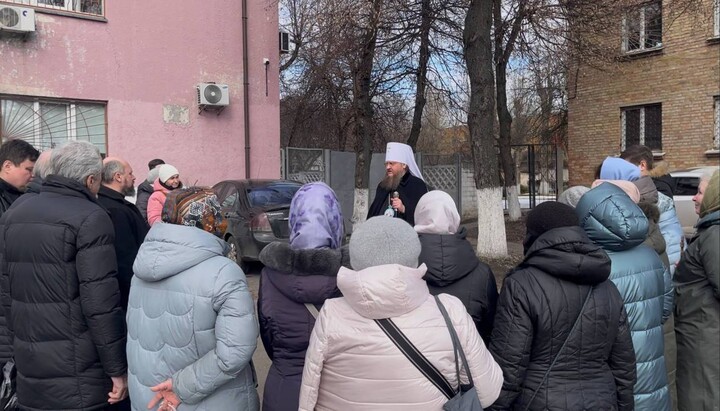
Metropolitan Theodosiy. Photo: Cherkasy Eparchy
On March 6, 2026, outside Kyiv’s Sviatoshyn District Court, Metropolitan Theodosiy of Cherkasy and Kaniv addressed the faithful and sharply criticized the authorities’ policy of mobilizing UOC clergy.
The hierarch recalled that, under a whole series of canonical rules of the Orthodox Church, a priest has no right not only to kill anyone, but even to take up arms or serve in the military. Despite this, clergy continue to be forcibly mobilized. As recent examples, he cited the cases of Fr. Yaroslav and Archimandrite Rafail from the theological academy.
Metropolitan Theodosiy then spoke in detail about how a clergyman should conduct himself under conditions of forced mobilization. In his view, the main thing is not to betray oneself – not to take off one’s cassock, not to conceal one’s priestly rank, and not to exchange one’s robe for a military uniform.
He warned against the temptation to “compromise one’s conscience” and rely on the promises of those who offer priests leniency in exchange for hiding their clerical status. According to him, such promises are deception, like a spider’s web.
“Every second a priest remains in the army after forced mobilization, so long as he is in his cassock, he remains under God’s protection,” the hierarch stressed.
At the same time, he pointed to representatives of other confessions – Baptists and Adventists – who are prepared to go to prison rather than betray the principles of their faith. “Are we, the Orthodox clergy, really to have no principles that are even more serious and well-grounded?” Metropolitan Theodosiy said.
In conclusion, he expressed hope that the crimes committed against the UOC – against its clergy, faithful, and episcopate – would receive a proper legal assessment. He referred to UN documents adopted after the Second World War, which define genocide on religious grounds.
According to the hierarch, responsibility should fall not only on the direct perpetrators, but also on those who passed laws banning the UOC, incited interreligious hatred, and members of the media who contributed to it.
“I am certain that the time will come when they will be held accountable for this. And if they do not manage to answer for it on this earth, then I have no doubt that before God, in eternity, that answer will still be given,” Metropolitan Theodosiy concluded.
Earlier, the UOJ reported that in Chernivtsi, military enlistment officers attempted to abduct a UOC bishop.
Read also
UGCC cleric calls Russian Orthodox literature cangerous for clergy
While examining the causes of divisions within the UGCC, Yustyn Boiko concluded that Russian Orthodox literature had influenced Greek Catholic clergy.
UOC will play major role in achieving peace, says Vadym Novynskyi
UOC Protodeacon Vadym Novynskyi believes the Church will help bring about reconciliation within Ukrainian society after the war ends.
Catholic media outraged by forcible conscription of Uniate cleric
The Vatican’s Apostolic Nunciature has demanded the return of a forcibly mobilized Greek Catholic cleric.
Rivne court fines man for criticizing parish's "transfer" to OCU
A resident of the Rivne region was convicted over Facebook posts criticizing the “transfer” of a religious community in the village of Butove to the OCU.
Novynskyi: I quoted the Gospel to Zelensky on first day of war
The former Ukrainian MP said he advised Davyd Arakhamia to begin negotiations with Russia in the first days of the full-scale war and later spoke with Volodymyr Zelensky.
Sumy Eparchy venerates miraculous Korsun-Shpylivka Theotokos Icon
Celebrations honoring the Mother of God’s icon known as the “Restorer of Sight” were held at Sumy Cathedral and concluded with a car procession around the city.