Why mosaics glow when the lights go out
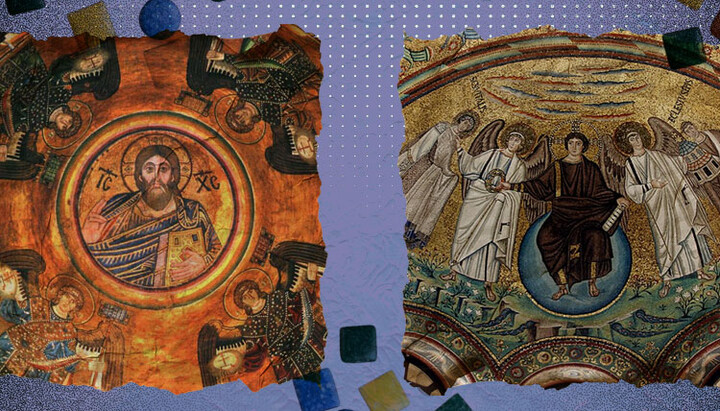
Mosaics of Ravenna and the Saint Sophia of Kyiv. Photo: UOJ
If you approach the frescoes of the Saint Sophia of Kyiv closely, almost pressing your forehead against the wall, we see chaos. Thousands of tiny glass cubes – each the size of a pinky fingernail – are pressed into gray mortar roughly and without the slightest attempt to create a smooth surface. They stick out at different angles, like city cobblestones after an earthquake. This is not carelessness but the precise calculation of masters.
A Byzantine mosaicist never laid a tessera cube flat. He pressed it in with a slight tilt – most often downward, toward the viewer, so that each piece of glass would catch light from the oil lamp standing below and cast it not to the ceiling, but into the eyes of the observer. Thousands of such tilted mirrors break one weak candle flame into a thousand rays.
The golden background that floods the space behind the backs of saints is a leaf of gold leaf, microscopically thin, baked between two layers of glass: a thick base and a transparent cover, like a butterfly between the pages of a book. Light enters the glass, strikes the gold and returns back, acquiring a deep, inner glow that is impossible to achieve by simply painting the wall with gold paint.
Priest Pavel Florensky noted: gold in iconography is "pure unmixed light, and it cannot be placed in a row with paints that are perceived as reflecting light." After all, it does not reflect but glows from within.
One hundred seventy-seven shades of one gaze
In the mosaics of Saint Sophia's Cathedral there are one hundred seventy-seven shades of smalt: thirty-four shades of green and twenty-one of blue. Twenty-five of gold alone. When we stand below, under the five-meter Orans, we do not distinguish individual cubes. Colors mix directly in our pupils, creating an iridescent shimmer that cannot be stopped and examined. This was pointillism eight centuries before the impressionists, only invented not for beauty but for prayer.
And one more detail that sends a chill down the spine. The apse, a concave semicircular wall behind the altar, works like a parabolic mirror. It gathers the weak scattered light of candles standing below and focuses it on the figure of the Mother of God in the center.
The Orans begins to visually separate from the wall, to step forward into the space of the temple, as if She were taking a step toward us, as She once appeared in the Blachernae Church to Saints Andrew and Epiphanius.
What Kyivans saw when the lights went out
In the winter of 2022–2024, Kyiv sat without electricity for days. Museum spotlights in the Saint Sophia of Kyiv went out, and museum staff still observe during power outages what they had not seen for decades. Under modern flooding light, the Orans looks beautiful but motionless, like a photograph in a frame. But when only candles and flashlights remained at hand, the uneven smalt suddenly came alive. Shadows from the protruding edges of cubes began to move, and it seemed that faces were breathing, and the folds of clothing on them were swaying from an invisible wind.
It turned out that the mosaic was technologically created precisely for this. Modern lighting kills it, flooding it with even dead light and destroying the ripple and shimmer for which 11th-century masters spent years of work.
Blackouts and the cruel underside of war returned to the cathedral's paintings their authentic design.
In Ravenna, in the Mausoleum of Galla Placidia, something similar happens, but in reverse. There the background of the mosaics is dense, almost black cobalt. Blue glass absorbs light instead of reflecting it, and the walls seem to dissolve. The ceiling turns into a bottomless night sky studded with golden sparks, and we stand not in a small room a few steps wide, but in the middle of a universe that has no walls.
This is the secret of the golden background: it represents spatial vacuum, the emptiness in which God dwells. This background has no horizon, no shadows, and no perspective. There is only radiance and those who stand inside this brilliance as observers.
Why a screen cannot replace a candle
We are used to perfect screens. They are flat, bright, impeccably smooth. They emit even synthetic light that depends neither on us, nor on wind, nor on daytime. A pixel is a dead cube that is always obedient and always the same.
We can scroll through a gallery of the Saint Sophia of Kyiv on our phone while lying on the couch – and feel nothing of what we could experience by being in the cathedral in person.
A tessera – a glass cube a thousand years old – is arranged exactly the opposite way. It is rough, coarse and dependent on the light of living flame. It requires that we come to a cold, dark temple, light a candle, and take a place. And ourselves – with our presence, our breath that makes the flame flicker – become co-authors of the light that burns on the wall.
Without a person, this light does not exist. It awaits our candle, as a moonbeam on a lake awaits ripples – without wind it remains one dead white spot, but as soon as the water trembles, the light breaks into a thousand living sparks that run along the shore.
The Apostle John the Theologian saw the Heavenly Jerusalem: "And the city has no need of sun or moon to shine on it, for the glory of God gives it light, and its lamp is the Lamb" (Rev. 21:23). He beheld a city that needs no external sun because it glows from within. Byzantine mosaicists, it seems, tried to build precisely that – cube by cube, shade by shade, tilt by tilt – and they succeeded!
Read also
Why holy monasteries turned into state prisons
The history of Christian Europe has preserved the memory of times when monasteries became places of state exile. The fates of monarchs and righteous men were decided there.
A shepherd boy with a letter from Christ to French king
In the summer of 1212, thousands of pilgrims carrying staffs waited for the sea to part before them. Later chroniclers added ships, slave traders, and a pope's lament to their story.
Facade of bones and facade of light
Antoni Gaudí spent forty-three years building a church in Barcelona, knowing that this construction was for the ages.
Trial of a dead pope
Once in Rome, the body of a deceased pope was seated on the throne and put on trial. The accusation relied on a church canon that had once saved his see.
Monastery built in defiance of king
When Orthodox believers in Minsk were left with just one church, townspeople decided to build another – and even a royal decree did not stop them.
Young Mother and Sleeping Christ
Michelangelo carved a Virgin Mary who looks younger than her Son – and signed his name in marble for the only time in his life. Neither of these peculiarities was accidental.