The heavenly dome: how the Byzantines suspended a temple on a golden chain
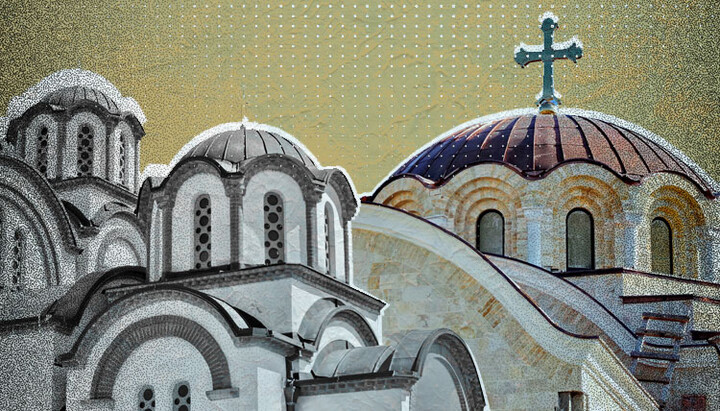
Churches in Byzantine style. Photo: UOJ
The dome of the Turkish capital's main temple begins from nowhere, rises to nowhere, and closes at a height of fifty-six meters with a ring of windows, beyond which is light. It seems as if the sky has descended thirty meters lower and settled upon the building.
Forty windows that dissolved the wall
Justinian's court historian Procopius of Caesarea attempted to describe this in his treatise "On Buildings" and arrived at a formulation that would be quoted for fifteen hundred years: the dome, he wrote, "seems not to rest upon solid construction, but descending on a golden chain from heaven, covers this place." Procopius was not a mystic. He was a bureaucrat, accustomed to precise formulations. And yet he found no other words than "golden chain."
The secret lies in the ring of forty windows at the base of the dome. Architects Anthemius of Tralles and Isidore of Miletus arranged them so closely that the wall sections between them narrowed to a minimum. When the southern sun strikes these windows, it creates overexposure: a bright halo that optically ‘erases’ the stone lintels.
The human eye ceases to see the support. The hemisphere weighing thousands of tons breaks away from the building and hangs in golden radiance, seemingly supported by nothing.
This is an engineering problem solved at the level of visual physiology. We stand beneath the dome and cannot understand what holds it up because we can't see the supports. They were hidden. And instead of massive load-bearing walls, we see only light.
How to place a circle on a square
To understand what this illusion cost, one must recall a problem that no one before the Byzantines had solved. The dome is round, the building is rectangular. The Romans in the Pantheon simply placed a round dome on a round solid wall. The solution works, but it's a dead end: the wall beneath the dome has to be incredibly thick, windows cannot be made in it, and inside it is dark and oppressive.
Anthemius and Isidore came up with a different idea. They invented pendentives - four concave spherical triangles at the corners of the square base, which take upon themselves the monstrous weight of the dome and smoothly transfer it to four hidden pillars. The wall between the piers no longer had to bear the load. It could be pierced through with windows, arcades, galleries. The weight did not disappear. It simply became invisible, like the bones of a skeleton beneath the skin: we know they are there, but we see only the lightness of movement
Bricks lighter than water
The dome itself was also constructed differently than one might expect. The architects rejected stone and concrete. They used bricks made from special porous clay from Rhodes, which made them very light. The mortar between them - thicker than the bricks themselves - contained volcanic ash and crushed ceramics and worked as a shock absorber. It is resilient, soft, and capable of absorbing the shocks of earthquakes.
In 558, twenty years after construction, the dome collapsed from an earthquake. It was rebuilt higher and steeper. It cracked again. It was propped up, patched, reinforced – and it still stands to this day, fifteen centuries later, in a seismically active zone, having survived dozens of serious tremors. Engineers explain this precisely by the softness of the mortar: the building bends but does not break, like bamboo in the wind.
The singing dome
In the 2010s, Stanford University professor Bissera Pentcheva conducted the Icons of Sound project. Her team popped balloons inside Hagia Sophia. This was the only available way to measure acoustics, because singing in the former mosque (then a museum) was forbidden. It was discovered that the dome creates reverberation lasting more than eleven seconds. Every sound uttered beneath it lives, gradually dissolving into space.
When the Cappella Romana ensemble performed Byzantine chants in the Hagia Sophia's acoustics, something happened that even the researchers didn't expect: consonant sounds faded away, and vowels merged into a continuous, rolling sound stream. It turned out that the dome didn't simply cover the building. It was a musical instrument, tuned to erase the boundary between human and angelic singing.
Heaven descends below
The Psalmist wrote: "You cover yourself with light as with a garment; you stretch out the heavens like a tent" (Ps. 103:2). The Byzantine dome is an attempt to build this tent from stone and light. Gothic architecture, which arose later in the West, is an upward impulse: pointed arches, spires, resembling a person reaching toward God.
The Byzantine dome has the opposite vector. It doesn't grow from the earth, it descends from heaven. In Orthodox theology, it's not man who storms the heavens - but God who condescends to man.
At the apex of the vault, at the zenith, they always placed a mosaic of Christ Pantocrator. Structurally, this is the keystone - the point that holds all the tension of the vault. Remove it - and the dome will collapse. Theologically, it is the same thing: Christ the Almighty is like a keystone, preventing the universe from falling apart.
We're used to living under flat ceilings, under concrete slabs that protect us from rain and are good for nothing else. The Byzantines thought completely differently. They declared that above us is not emptiness, but He Who holds heaven upon Himself. And they built a temple in which it's impossible not to believe this.
Read also
Why were holy monasteries turned into state prisons?
The history of Christian Europe preserves the memory of times when monasteries served as places of exile imposed by the state. Within their walls, the fates of monarchs and righteous men were decided.
A shepherd boy with a letter from Christ to French king
In the summer of 1212, thousands of pilgrims carrying staffs waited for the sea to part before them. Later chroniclers added ships, slave traders, and a pope's lament to their story.
Facade of bones and facade of light
Antoni Gaudí spent forty-three years building a church in Barcelona, knowing that this construction was for the ages.
Trial of a dead pope
Once in Rome, the body of a deceased pope was seated on the throne and put on trial. The accusation relied on a church canon that had once saved his see.
Monastery built in defiance of king
When Orthodox believers in Minsk were left with just one church, townspeople decided to build another – and even a royal decree did not stop them.
Young Mother and Sleeping Christ
Michelangelo carved a Virgin Mary who looks younger than her Son – and signed his name in marble for the only time in his life. Neither of these peculiarities was accidental.